The purpose of this forum is to allow members of SABR’s Baseball Landmarks Committee to write about baseball sites. Posts could include detective work to find long-lost places, celebratory gatherings, ideas for marking currently unmarked locations, stories about what makes the landmark special in the first place, and more.
The main purpose of our committee is to create and support the SABR Baseball Map. But the project lends itself to storytelling. Why is the plaque here? Why did I decide to visit? We’d love to read what you have to write.
As I mentioned in my previous blog about Gil Hodges, I grew up in Terre Haute, Indiana. My friends from Terre Haute were fans of the Cubs, White Sox, Cardinals, or Reds. My team was the Cincinnati Reds and Pete Rose was my guy.
I was born in 1968. Most of my memories of the Reds are from games at Riverfront Stadium, and I saw lots of them. The 1990 wire-to-wire, World Series Champion season was probably the best. Opening days are always special, but there is nothing like post-season baseball on a cool fall day in Cincinnati.
Like most people in Reds Country, I treasure the memories I have of listening to Marty Brenneman and Joe Nuxhall on the Big One, 700 WLW. Marty and Joe were broadcast partners with the Reds for 31 years! The people of Cincinnati love them both so much. Marty was polished and is a Hall of Fame Ford C. Frick Award winner. Not many, if at all, were better than Marty Brenneman. Joe was the hometown guy, the “Ol’ Left-Hander” from nearby Hamilton, Ohio (Hamilton is about 20 minutes north of downtown Cincinnati). Joe had a folksy-style that was uniquely his. Marty called it like he saw it. Joe always pulled for his team. They were great friends on and off the field and a perfect pair in the booth.
I have started working on a project about Joe Nuxhall that I hope to present one day at the National Baseball Hall of Fame’s Cooperstown Symposium on Baseball and American Culture. As part of my research, I recently spent a little time with Chris Eckes of the Reds Hall of Fame Museum and Kim Nuxhall (one of Joe’s sons). Both seemed like great guys and were very nice to me.
This blog is to share a few pictures and stories of my time in Cincinnati learning about Joe Nuxhall.
It is important to remember Joe Nuxhall because Joe is a cultural symbol of community in Cincinnati. The people of Cincinnati have found ways to sprinkle little reminders of him around to help them feel safe. Joe’s legacy reminds us to be humble and care for each other.
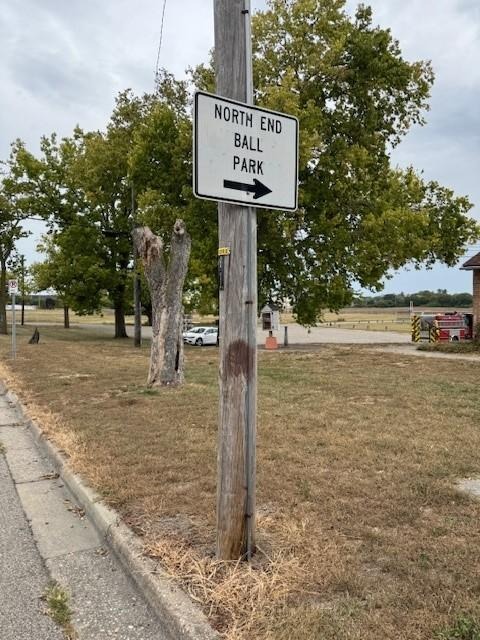
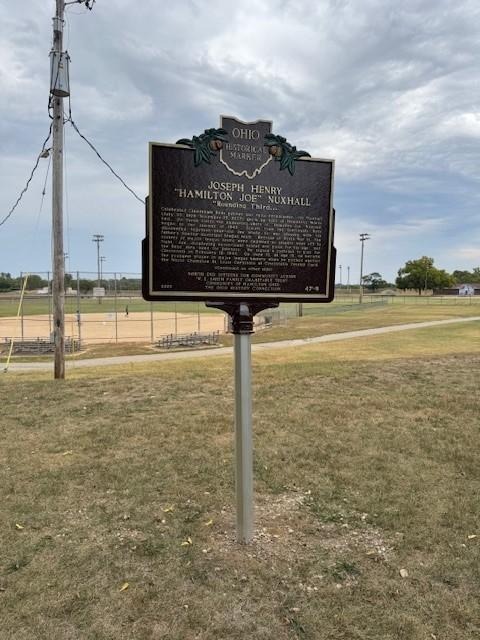
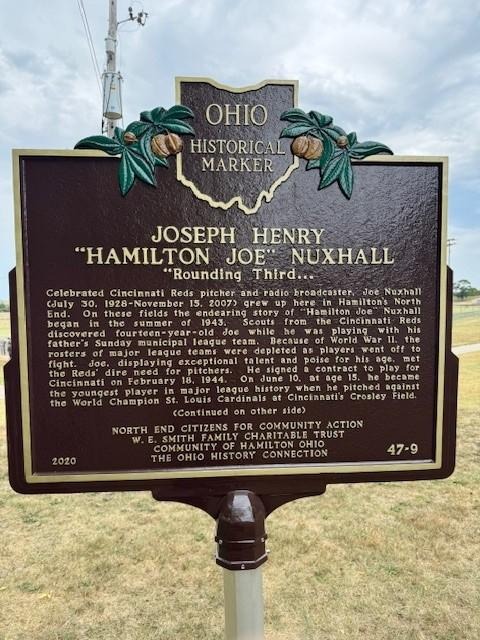
Joe grew up in the North End neighborhood of Hamilton and was first scouted by the Reds in 1943 as a 14-year-old. Rosters were depleted during this time of World War II but the Reds still believed in Joe’s talent as a ball player and signed him to a contract. I took the following four pictures at North End Ball Park on September 13, 2025.
After starting the 1945 season in spring training, Joe decided he wanted to return to Hamilton and finish high school. At Hamilton High School, Joe was a star athlete. His favorite sport was basketball. Joe was all-state in basketball and football while at Hamilton High School.
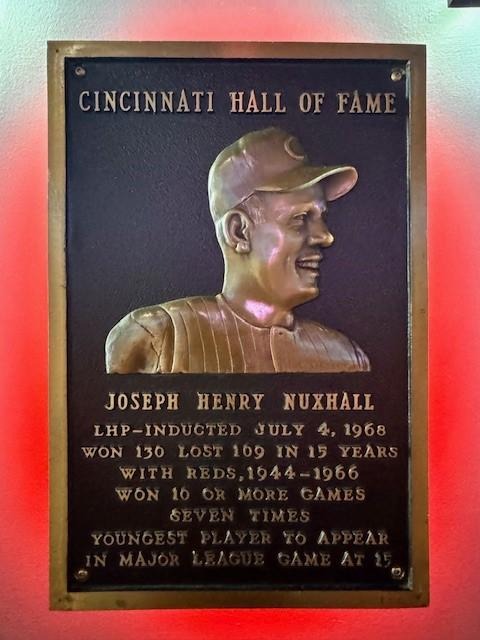
After high school, Joe returned to the Reds. It would take him about 7 years to make it back to the big-league roster. There were highs and lows in Joe’s playing career. The early and mid-1950s were good years for Joe. He won 17 games for the Reds in 1955 and was a two-time all-star (1955 and 1956). The latter part of the decade was not so good. Joe was booed at home games. Fed up, he requested a trade and was dealt to the Kansas City A’s. It was during his couple of years away from Cincinnati that Joe learned a few things. The first thing he learned was how emotions negatively impacted his performance on the mound. The second thing he learned was a good curveball. Joe returned to the Reds and finished his playing career in 1966. When he retired, he was first all-time in strike-outs and appearances for the Reds. Joe was elected to the Reds Hall of Fame on July 4, 1968.
Joe officially retired during spring training in 1967 and immediately joined Claude Sullivan and Jim McIntyre in the radio booth for the Reds. After later working with Al Michaels for three years, Joe was joined by Marty Brenneman in the radio booth at the beginning of the 1974 season. The magic that Marty and Joe had was special. Marty respected the player Joe was and understood what Joe meant to the people of Cincinnati. There are lots of calls and tv commercials and pictures to help tell the story about Joe and Marty’s time while working with the Reds. I can still watch and listen to that stuff all day.
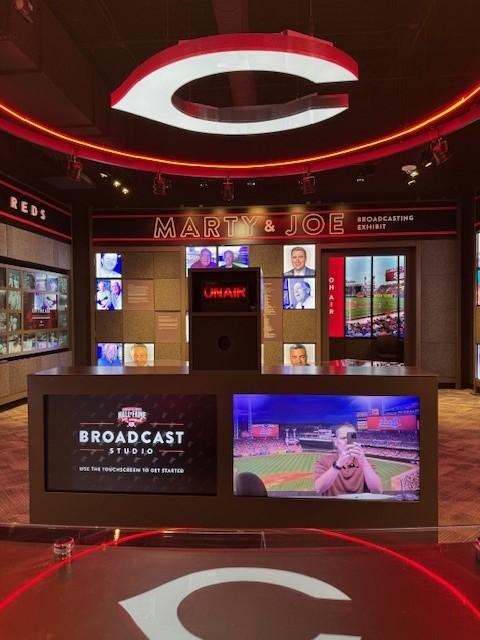
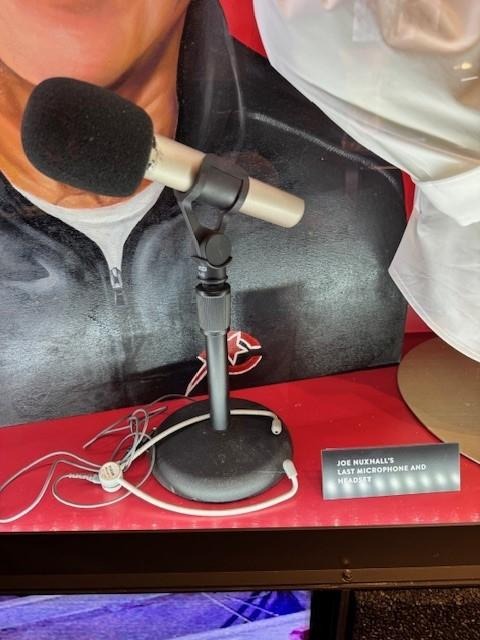
The next three pictures are from the Marty and Joe Broadcast Exhibit in the Reds Hall of Fame. Joe and Marty’s last microphones are on display in the Exhibit. The fourth picture is one I like of Marty and Joe having a good time at Riverfront Stadium. Those guys really had fun.
If you have are in Cincinnati, the Reds HOF Museum is a must-see!!
Joe would have been remembered for his time on the field, but it is what he did after his playing career was over that means the most to the people of Cincinnati.
Joe was always around. He hated to turn down an invitation to support anything. Little League games. Speaking at banquets. Joe was very approachable and very humble. The people of Cincinnati relate to his genuineness and appreciate the love he showed for his hometown.
Perhaps the most impactful thing that Joe did was form the Joe Nuxhall Foundation. The Joe Nuxhall Foundation funds the Joe Nuxhall Memorial Scholarships, Joe Nuxhall Character Education Fund, and the Joe Nuxhall Miracle League Fields.
Joe Nuxhall Memorial Scholarships are presented to high school seniors in Butler County each year. Next year, in 2026, the Joe Nuxhall Memorial Scholarships will cross over the $1 million mark for total awards.
Character development was very important to Joe. The Joe Nuxhall Character Education Fund was established to underwrite character development and projects for children.
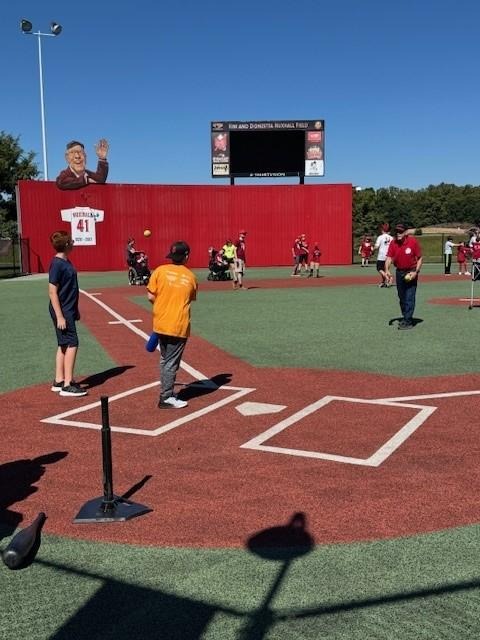
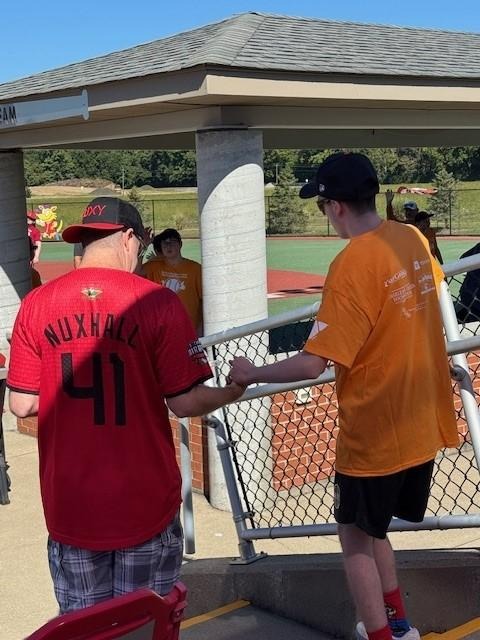
The Joe Nuxhall Miracle League Fields are in Fairfield, Ohio. Kim Nuxhall runs the Miracle Fields. It was a dream of Joe’s to see children and adults with disabilities playing the game he loved so much. There are two diamonds with electronic scoreboards and lights. Kids and adults join teams and play in leagues. The day I was there, I watched the Giants play the Angels. The kids had a great time. I saw a kid do the moonwalk as he walked to home plate to bat, and I watched a young girl using a walker get two hits as the announcer told everyone it was her birthday.
When I visited the Joe Nuxhall Miracle League Fields (on August 30, 2025), Kim Nuxhall told me about a new major project he’s very excited about (www.nuxhallmiracleleague.org/hope). Kim told me they are currently planning and fundraising to construct a new “Joe Nuxhall Hope Center” on the Miracle League Fields property. If I remember right, the cost will be about $12 million. The new Hope Center will be a 31,000 sq. ft., inclusive, indoor recreation center. With the addition of the new Hope Center, the Joe Nuxhall Miracle League Fields will be the world’s most inclusive, comprehensive campus for athletes and individuals with exceptionalities.
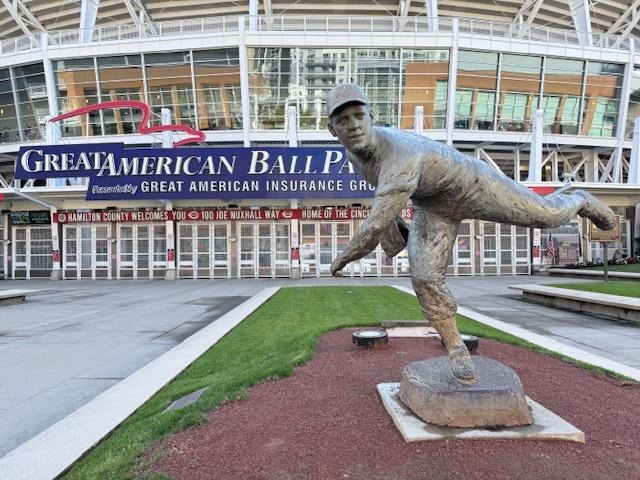
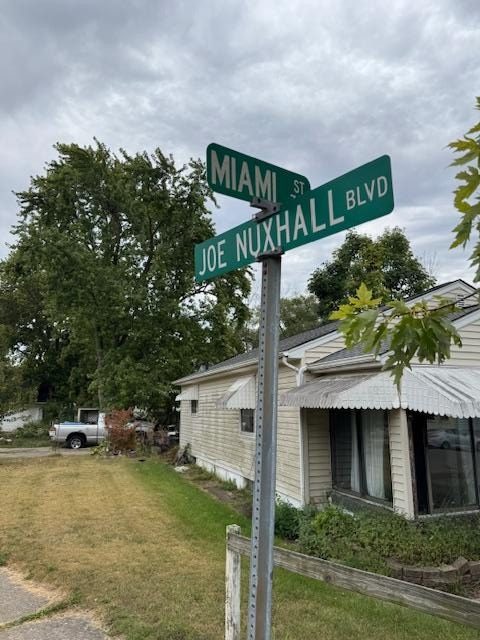
Joe is remembered inside and outside of Great American Ball Park. The street address for Great American Ball Park was changed to 100 Joe Nuxhall Way. Streets in Cincinnati, Farfield, and Hamilton are named after Joe. Player awards are named after Joe. A summer collegiate league team is named after Joe. College baseball teams in Cincinnati play in the Joe Nuxhall Classic.
Conclusion
“Rounding Third and Headed for Home”. Joe used that phrase as his sign-off each night following his post-game wrap up on the radio. He’d conclude each show by saying “This is the ol’ left-hander, rounding third and headed for home”. That phrase became associated with Joe Nuxhall. I think it has sort of a poetic meaning particularly because of the word “HOME.” The people of Cincinnati associated Joe Nuxhall with “HOME.” Home is a safe place where you can relax and be with family. “Hamilton Joe” represented “HOME” to the people of Cincinnati.
Joe Nuxhall was like a special tree or park or garden that a community treasures and celebrates around. Even 18 years after his death, the people of Cincinnati hold memories of Joe close to their hearts.
Marty Brenneman is quoted as saying that Joe is the most popular figure in the history of the Cincinnati Reds. That’s high praise considering that six of the nine bronze statues on Crosley Terrace outside Great American Ball Park are members of the National Baseball Hall of Fame…. and Joe Nuxhall isn’t one of them!
During our tour of the Reds HOF Museum, Chris Eckes commented that the people of Cincinnati grab hold of their hometown heroes with both hands and don’t ever let go.
The people of Cincinnati are holding tightly to the memory of Joe Nuxhall. Thank you Joe.
I hope you enjoyed seeing the pictures and reading my blog about Joe Nuxhall. Maybe I’ll finish the project and get to present it one day at Cooperstown?!?!
Additional Comments
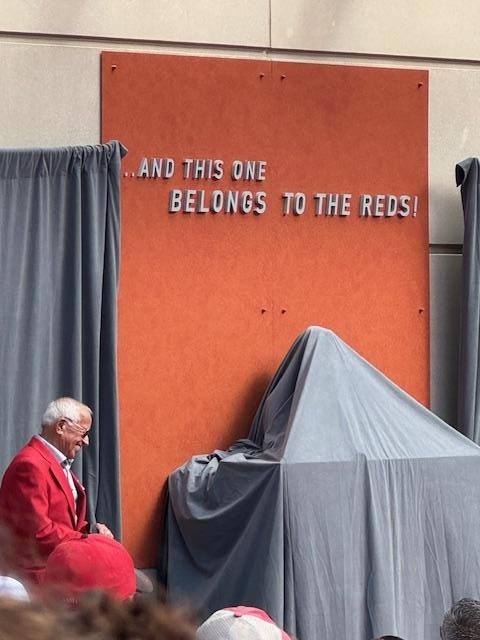
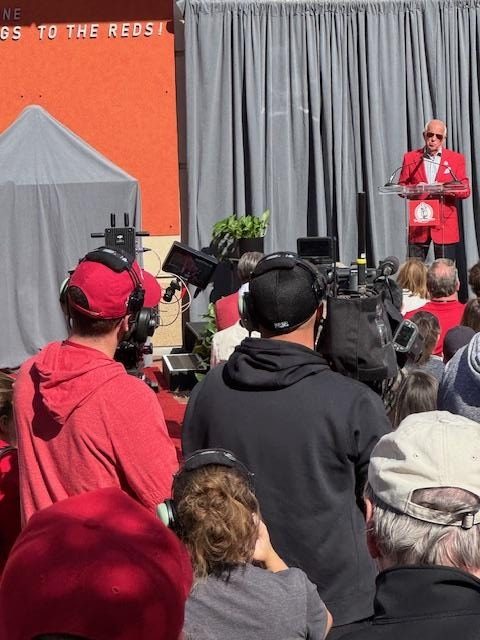
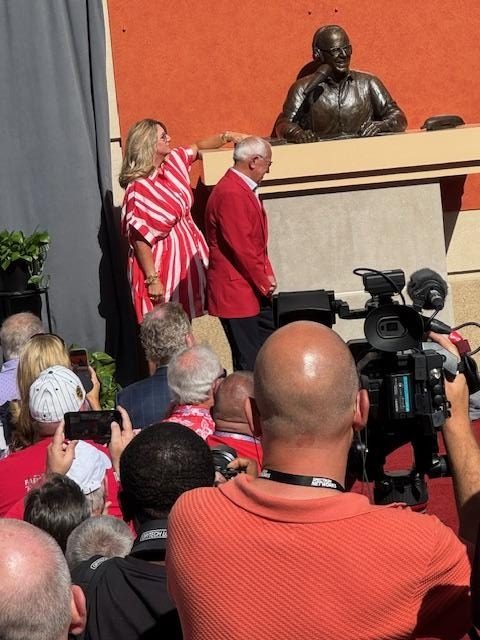
Marty Brenneman’s statue at Great American Ball Park was unveiled on September 6, 2025. A very large crowd came out to thank and celebrate Marty that day. I took these pictures from “way in the back”. Congrats Marty. You, too, are in a league by yourself.
As an Associate Producer of Cubs baseball games on television, I’m fortunate to be along for the ride on all the road trips. Sometimes, I take ferries to small islands all in the name of “game prep.”
This past August, I was in Toronto, and I woke up early to take a walk and check out the location of Babe Ruth’s lone minor league home run. As it happens, all of his career minor league homers were hit in Canada (all one of them), while all 714 of his Major League ones were hit in the United States.
The yellow pinpoint on Centre Island is where the markers are. See below.
On September 5, 1914, the Babe, playing for the Providence Grays (this was a few months after his Red Sox debut; he was sent down to help win the International League pennant) homered off Ellis Johnson of the Toronto Maple Leafs at Maple Leaf Park at Hanlan’s Point on Centre Island.
He was in the American League for good in 1915. And of course, Major League Baseball didn’t come to Canada until 1969.
This is what it looks like now. There’s an airport here.
And what a beautiful view looking back towards mainland Toronto.
Later that day, I showed our game producer these photos, and we got it into the game broadcast. Pretty cool.
Since late August I have been on a quest to log every pitching appearance in the extraordinary life and baseball career of Hank Aaron. Now before anyone loses their cool here, I’m well aware that Aaron played the outfield, winning three Gold Gloves to boot, but I’m also aware of something else: Aaron made more money in his career as a pitcher than in the outfield.
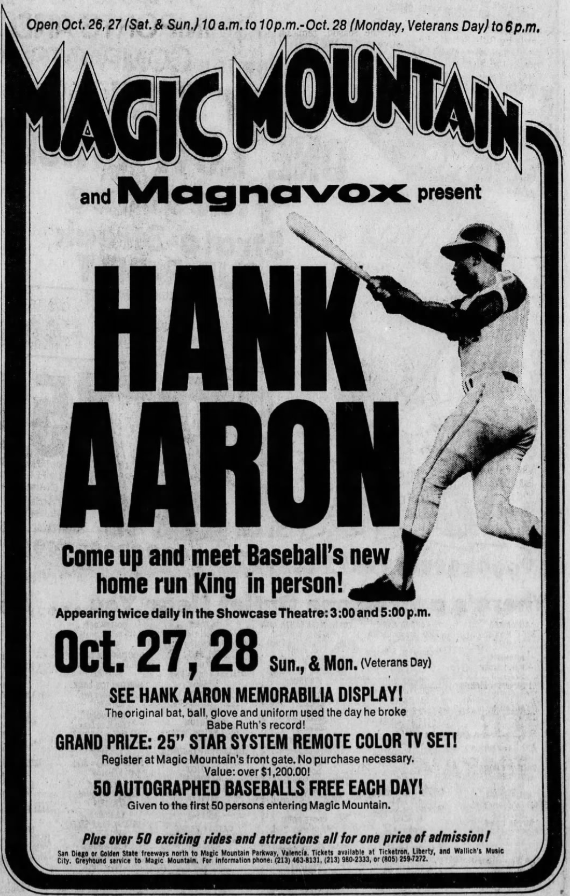
Confused? Then perhaps it’s time to clarify. Aaron wasn’t pitching baseballs. He was pitching television sets, specifically Magnavox television sets, a side hustle for which he was paid a cool million dollars over five years.
“I’m Hank Aaron and I want you to meet the winning team from Magnavox.”
Naturally a project of this magnitude requires that work be done in phases. At the moment, I am only releasing Aaron’s work as a Magnavox pitchman in the immediate aftermath of the 1974 baseball season.
With hopes that my friends at the SABR Baseball Map will eventually make this interactive, here is an early what is likely the most ambitious undertaking to date to map the Hammer’s work as an appliance salesman in October 1974.
In all, the Great Hank Aaron Magnavox Tour of 1974 had five phases, each represented by a cluster of location markers on the map.
October 8-10, 1974 – “Spring Training” at Magnavox plants in Tennessee and North Carolina
October 15-16, 1974 – Appearances at four Bay Area Magnavox dealers (Daly City, San Francisco, Concord, Oakland). Also attended Game 5 of the 1974 World Series while in Oakland.
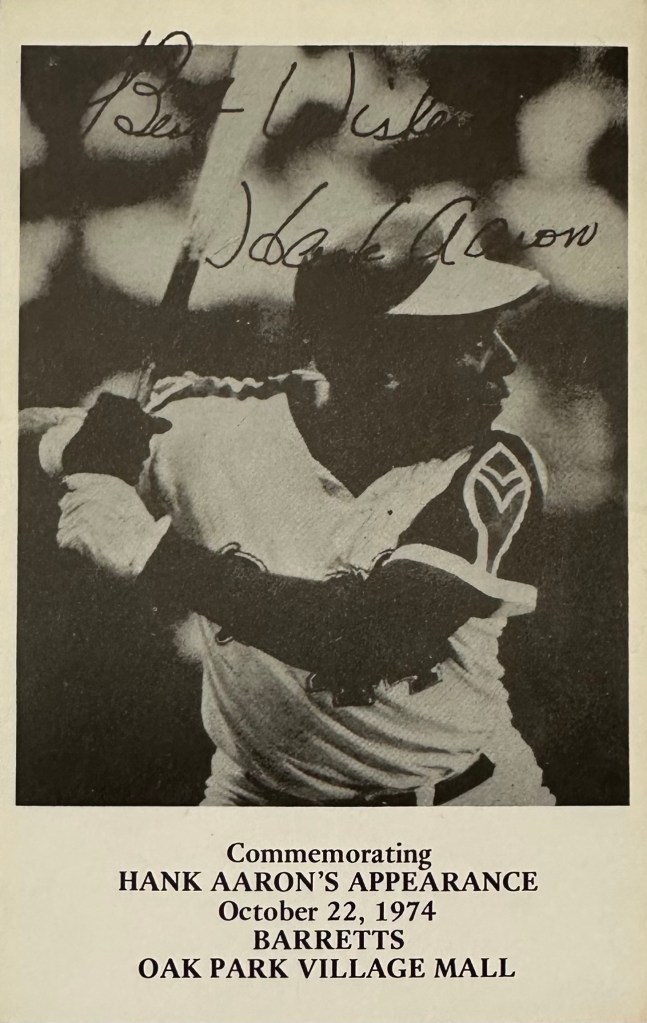
October 22, 1974 – Appearance at Magnavox dealer in Oak Park, IL
October 26-28, 1974 – Sponsored appearances at Magic Mountain theme park in Valencia, CA
October 30, 1974 – Appearances at four NY/NJ area Magnavox dealers (Staten Island, NY; Roxbury, NJ; Wayne, NJ; Paramus, NJ)
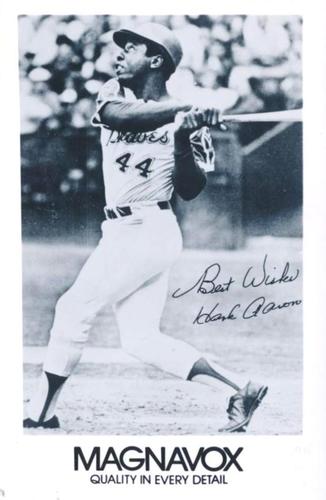
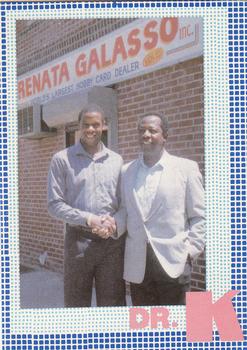
To the chagrin of the Hammer’s biggest fans, the dealership appearances were too frenzied and brief to support autograph requests. Some even bordered on violent. However, many attendees went home with specially produced baseball cards that included Aaron’s facsimile signature, and some even took home bigger prizes.
In the case of Aaron’s lone Midwest appearance, the card giveaway even identified the date and venue, though Hardball Voyagers hoping to visit the historic locale today will be sorely disappointed.
Having crisscrossed the country several times over as part of his tour, which began only days after hitting home run 733 in Atlanta’s season finale against the Reds, it would be natural to imagine the game’s newly crowned Home Run King would be ready for a break. Instead, however, the 40-year-old Aaron hopped a plane to Tokyo the very next day and on November 2 defeated Japanese slugger Sadaharu Oh in a home run hitting competition.
* * * * *
Author’s Note: Feel free to use the map and source data however you wish. But the Project is still very much a work in progress so your input would be appreciated. Specifically, if you come across any tour stop that is not here please let me know (jason DOT 1969 AT yahoo DOT com). If there are errors in any of the Magnavox locations, or if there are any errors in the appearance dates, please pass those on as well.
The Hank Aaron State Trail runs 14 miles from Lake Michigan in Milwaukee to the Milwaukee/Waukesha County line.
And when you think of Hammerin’ Hank and Wisconsin, you usually think of Milwaukee. But that’s not why we’re here.
Aaron’s road to the big leagues (following his sale from the Indianapolis Clowns, at least) began as an 18-year-old in Wisconsin. A three and a half hour drive northwest of Milwaukee, in Eau Claire.
On June 14, 1952, Henry Aaron played his first game for the Eau Claire Bears (Class C Northern League) at Carson Park.
Carson Park was built in 1937; a Works Progress Administration project.
Henry hit .336/.401/.493 with 9 home runs & 25 stolen bases in 87 games (at age 18, remember!) in his lone season in Eau Claire.
The Bears went 72-53 under player/manager Bill Adair.
I didn’t get a chance to go inside; it was a quick stop on the drive home to suburban Chicago from Minneapolis. But from the outside, it’s a pretty looking park.
My first time in the Baltimore area will always be a once in a lifetime experience. David Stinson, Vice President of the Baltimore Chapter, invited me to the area to show me historical sites.
As the person who spearheaded the effort to get the first SABR historical marker in the state of South Dakota paying homage to the old Baltimore Orioles minor league team the Aberdeen Pheasants, there was a lot to see.
The first area that I had to see was the hometown in which the Ripkens lived – Aberdeen, Maryland. The first location we visited was the home of the Ripkens at 410 Clover Street in Aberdeen. The next area that we visited was the gravesite of Cal Ripken Sr., which was located at Baker Cemetery 3641 Churchville Road in Aberdeen.
Coincidentally, the same day that I was in Aberdeen (Friday, August 22) the Orioles minor league team the Aberdeen Ironbirds were in town, so we went to a game. Peter Coolbaugh, Balitmore’s Chapter President, joined David and me for the game. The day was full of fun and excitement, but there was even more to follow the next day.
The next day we went to the former site of Memorial Stadium. Some notable Aberdeen Pheasants who either managed or played at Memorial Stadium after being called to “The Show” include Cal Ripken Sr., Earl Weaver, and Jim Palmer.
It is truly remarkable what the Cal Ripken Sr. Foundation did to the area so future kids can still play on that field. After that we had to go to, “Just a long fly ball from Oriole Park at Camden Yards” aka the Babe Ruth Museum. It was truly an awe-inspiring experience to see all of the old items that the museum has.
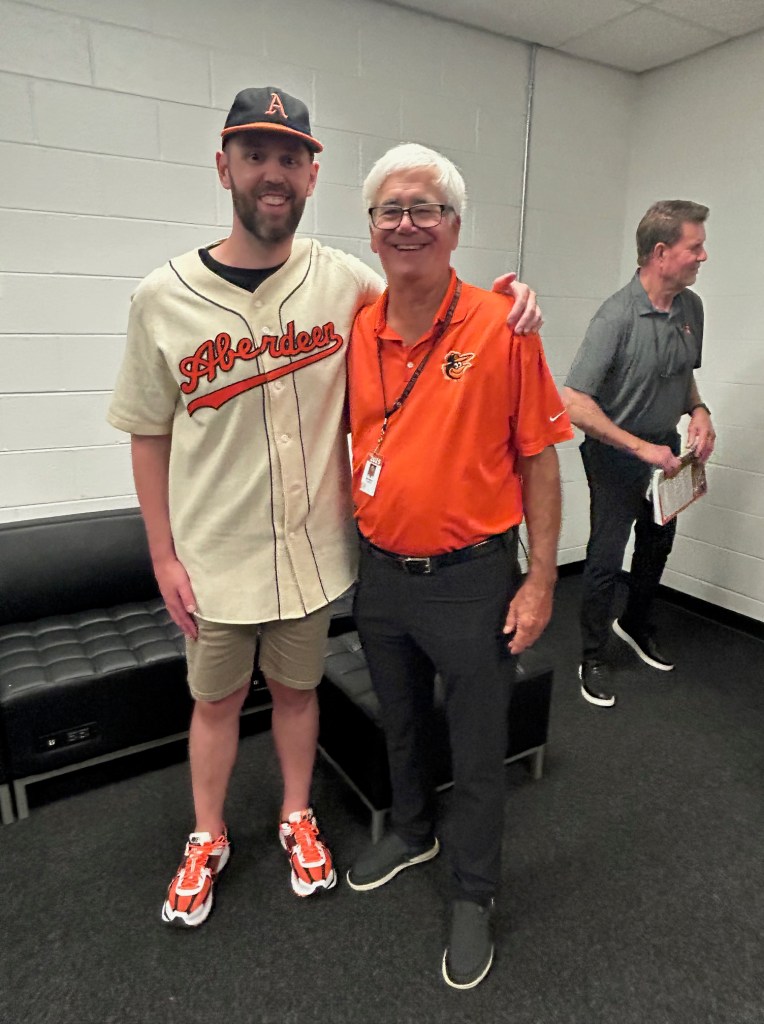
After that we went to the ballpark in which (on Saturday August 23) was Jim Palmer jersey giveaway day. David and Peter got in contact with fellow SABR member Bill Stetka. Bill Stetka is the Director of Orioles Alumni & Team Historian. Bill got in contact with Jim Palmer, and told him about the SABR historical marker. Jim gave us permission and we were able to meet with him before the game. It was truly a dream come true experience being able to meet the only Aberdeen Pheasant player ever in the Hall of Fame.
I am truly grateful to David, Peter, Bill, Jim, and the SABR organization. Dreams can come true, and this will always be a fond memory for me.
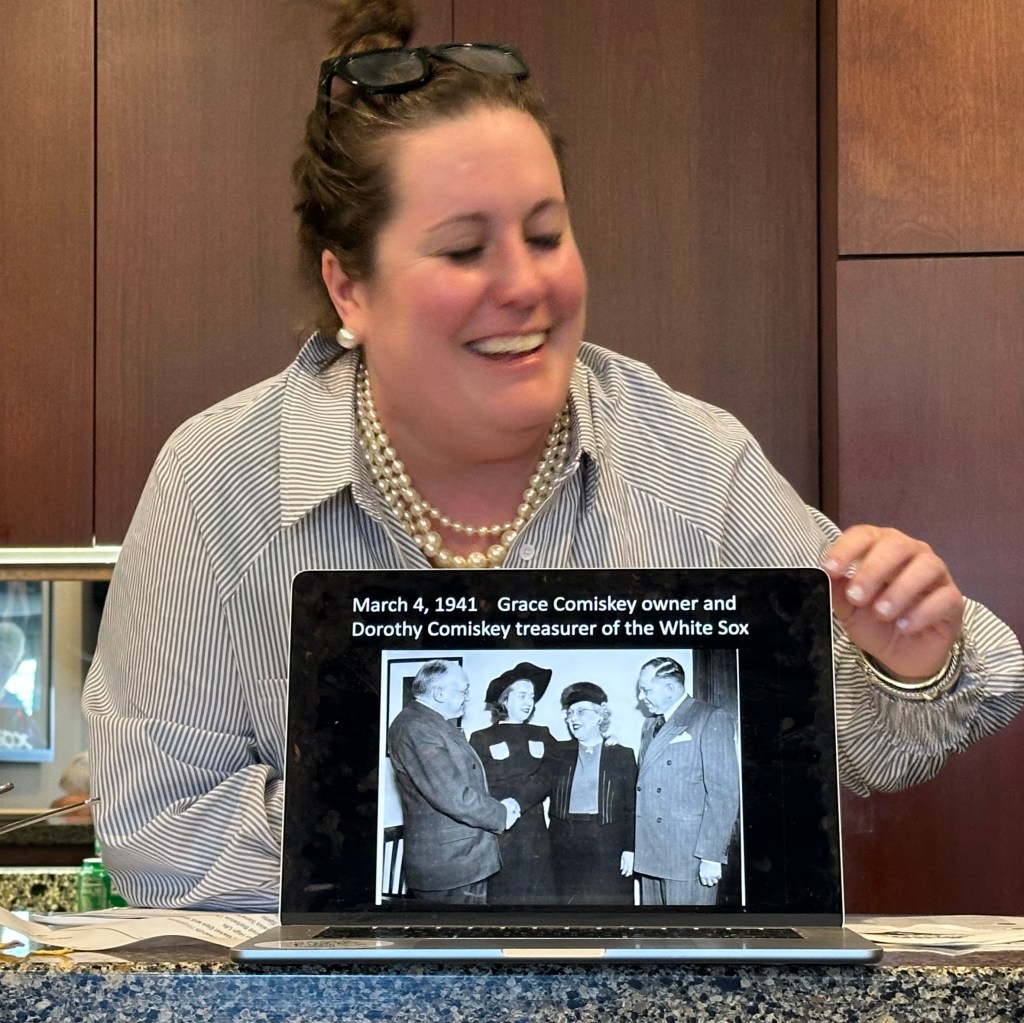
A tremendous SABR Chicago event starring Charles Comiskey researcher Mary O’Malley brought me to Rate Field, formerly known as Guaranteed Rate Field, formerly known as U.S. Cellular Field, formerly known as Comiskey Park (but not THE Comiskey Park), for my second White Sox game of the year.
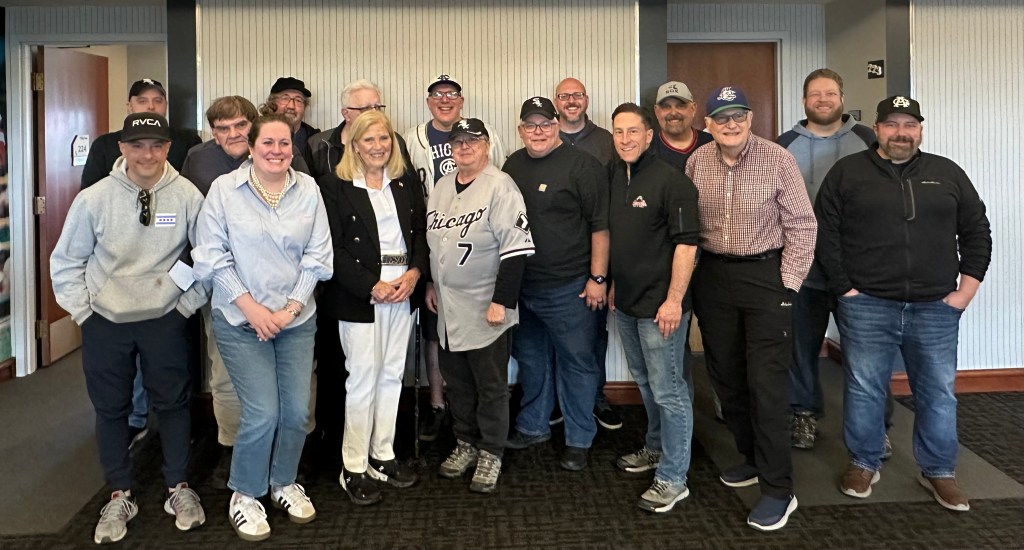
Mary O’Malley regales Suite 224 with an outstanding presentation on the Comiskey family
Though the Sox blew a 9th inning lead and 9th inning comeback, it was hard to remember a better day at the ballpark. Apart from the game action, which was as dramatic as it was inevitable, the “bonus content” was almost too much to fathom. For one thing, our suite enjoyed a visit from Charles Comiskey’s great-granddaughter Patti Bellock, who couldn’t have been a warmer guest or better storyteller.
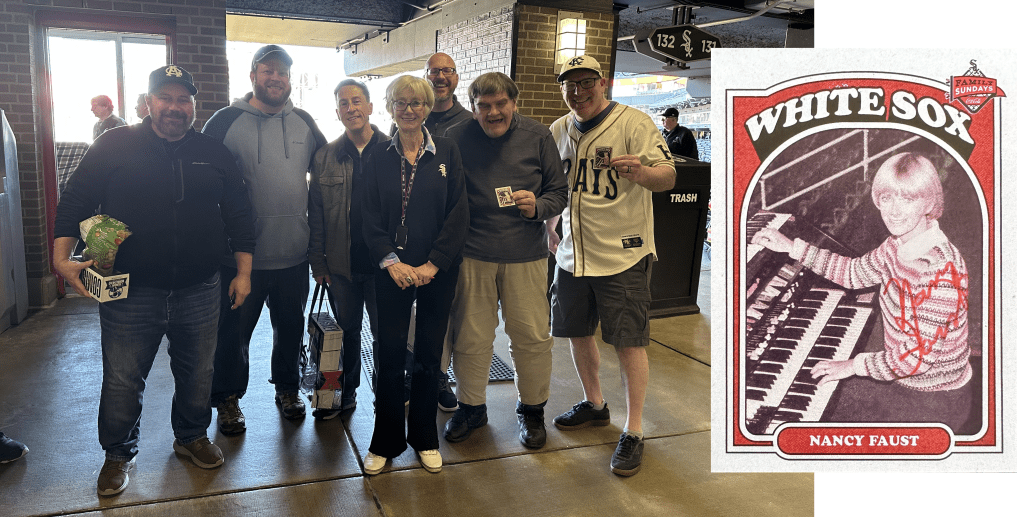
There was also a meet-and-greet with legendary organist Nancy Faust after the game, complete with signed trading cards!
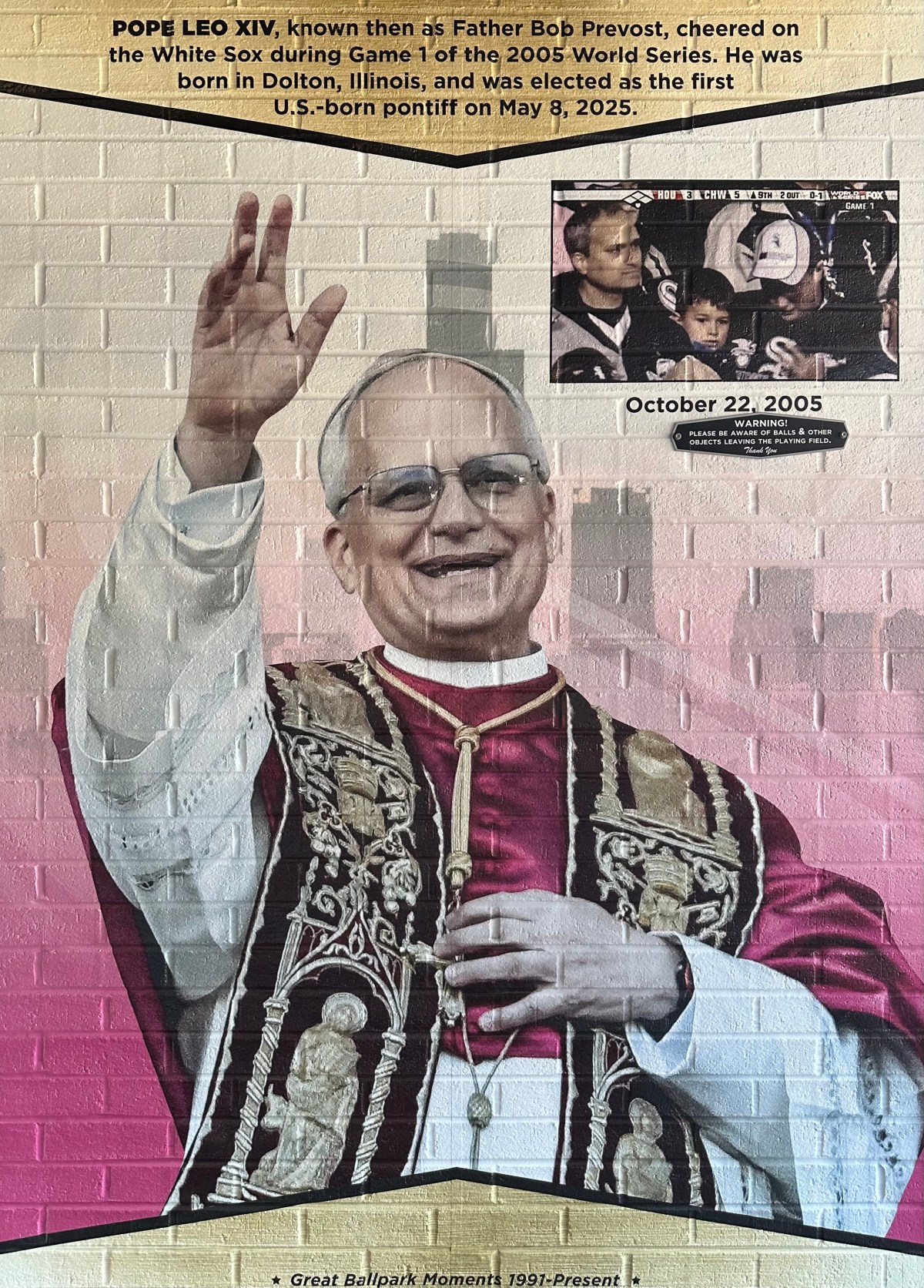
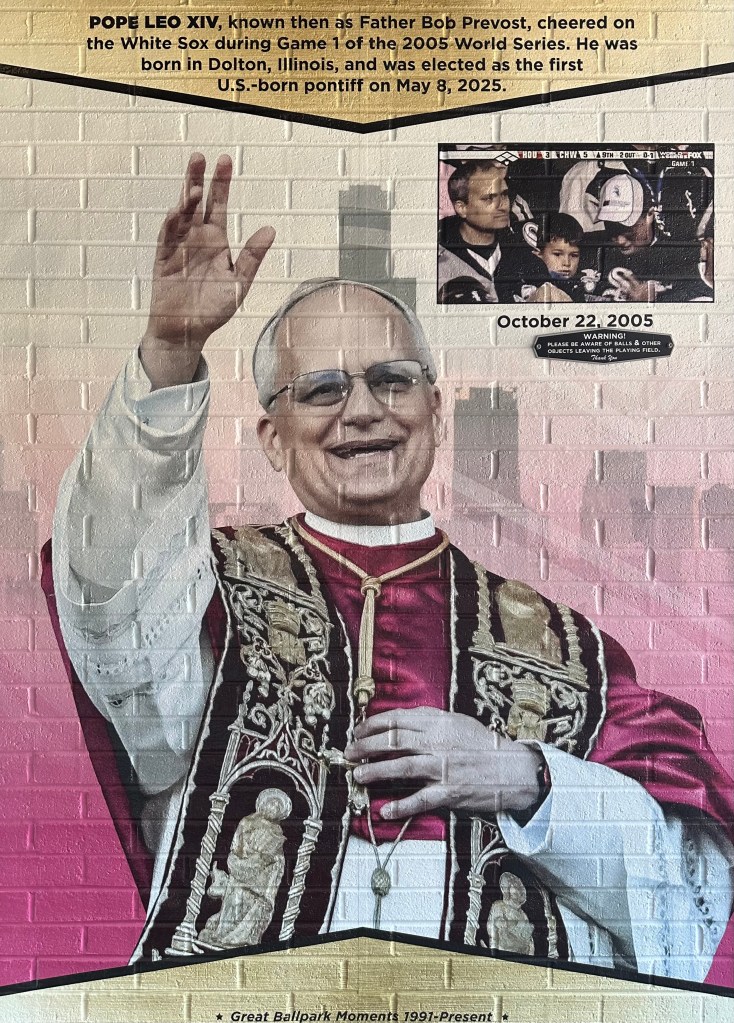
Finally, the game afforded a chance to visit the ballpark’s most newest, albeit unofficial, SABR Landmark, a mini-mural of the world’s most famous White Sox fan, Pope Leo XIV.
The installation is the latest in the Rate’s “Great Ballpark Moments, 1991-Present” series, somehow not yet rebranded as “First Rate Moments” to go with the stadium’s new name. As a testament to the new Pope’s popularity, a pre-game photo-op in front of Leo might have been the longest line of the day.
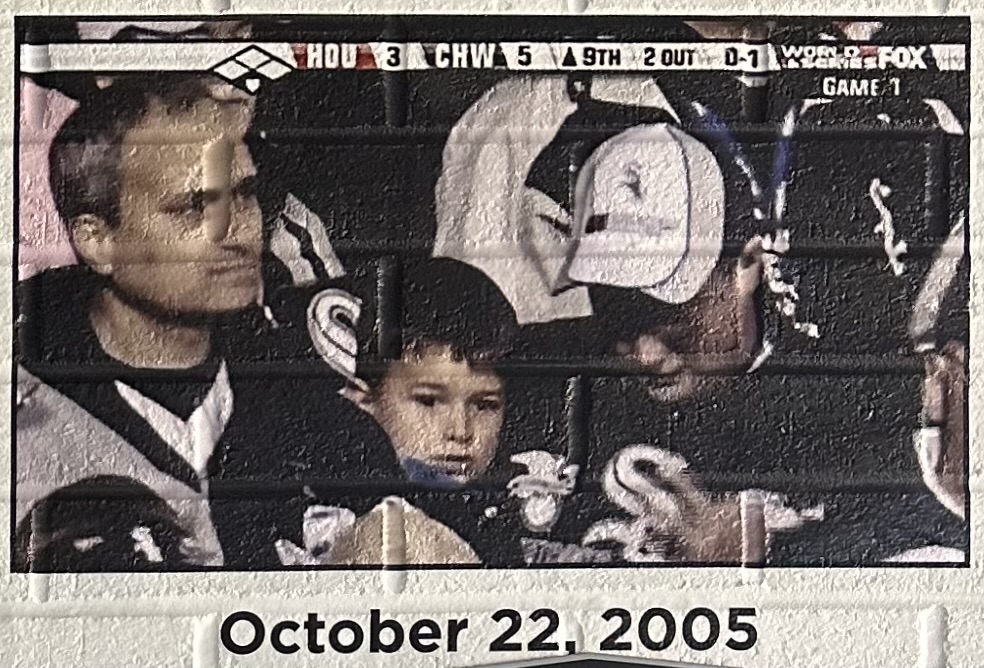
The mural’s placement, at the entrance to section 140, was selected to mark the former Father Bob’s seats at the 2005 World Series. A small inset graphic on the mural captures a moment from the first game of the series when Prevost was somewhat miraculously captured on camera.
Following an interview with the new Pope’s brother and the unearthing of this Fall Classic footage, there was no lingering mystery as to whether Leo was a Cubs fan or a Sox fan. However, that’s not to say the World Series image is wholly (or is that Holy?) without mystery. Beneath Pope Leo’s jacket, he appears to be wearing a jersey, but here’s the question: Which one?
Though today Leo may issue any number of Papal Bulls, a Greg Luzinski jersey is out of the question given that the four-time All-Star retired several years before the Sox donned the black pinstripes. Besides, if the Pope was looking to go throwback, would he not choose Don Pall? Similarly, Frank Thomas seems unlikely. After all, how could one reconcile the Pontiff’s pleas for peace and compassion with a hero known as the “Big Hurt?”
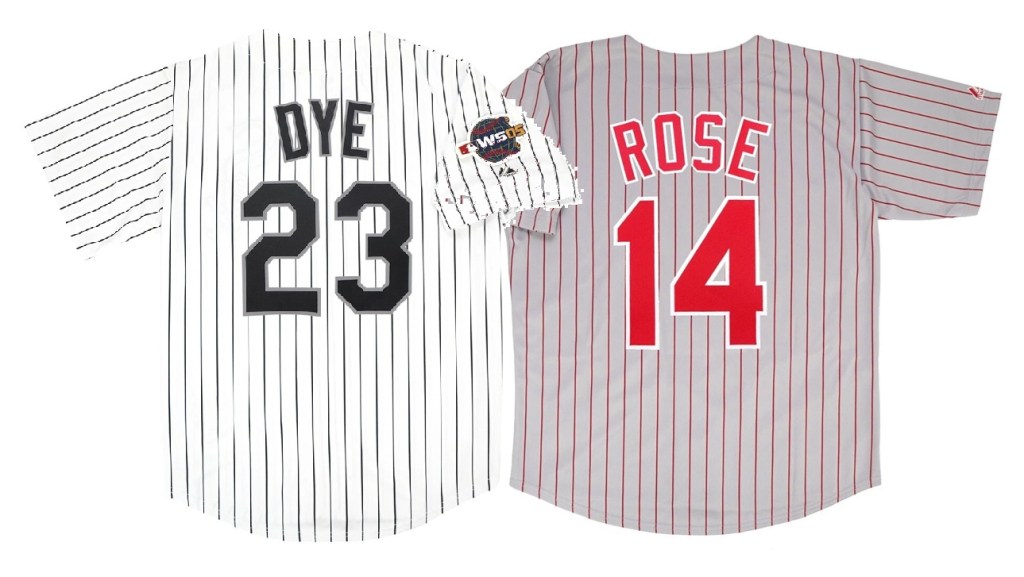
Given that Leo is not just Leo but Leo the Fourteenth it would be fitting indeed if he was rocking a Paul Konerko #14 jersey. Of course, how could Leo have known back then that he would someday be Pope? Lacking such prophecy, perhaps his fondness for the Apostle’s Creed might would instead have led him to a number 24 jersey.
Potentially, Prevost might have gone double duty with a 23 jersey, paying homage not only to Michael Jordan but to key Sox pickup Jermaine Dye. Provided he could forgive Baseball’s greatest sin, could the clergyman rep Easter weekend any better than Dye on Friday, Rose on Sunday?
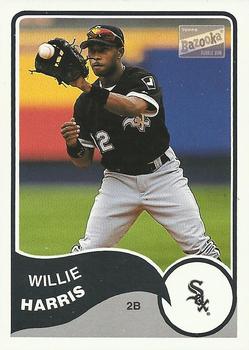
As with much in this world, we may never know the answer. About all we can do is petition the Lord in prayer. “Willie Harris?” you might ask, but you tell me: Is the Pope Catholic?!
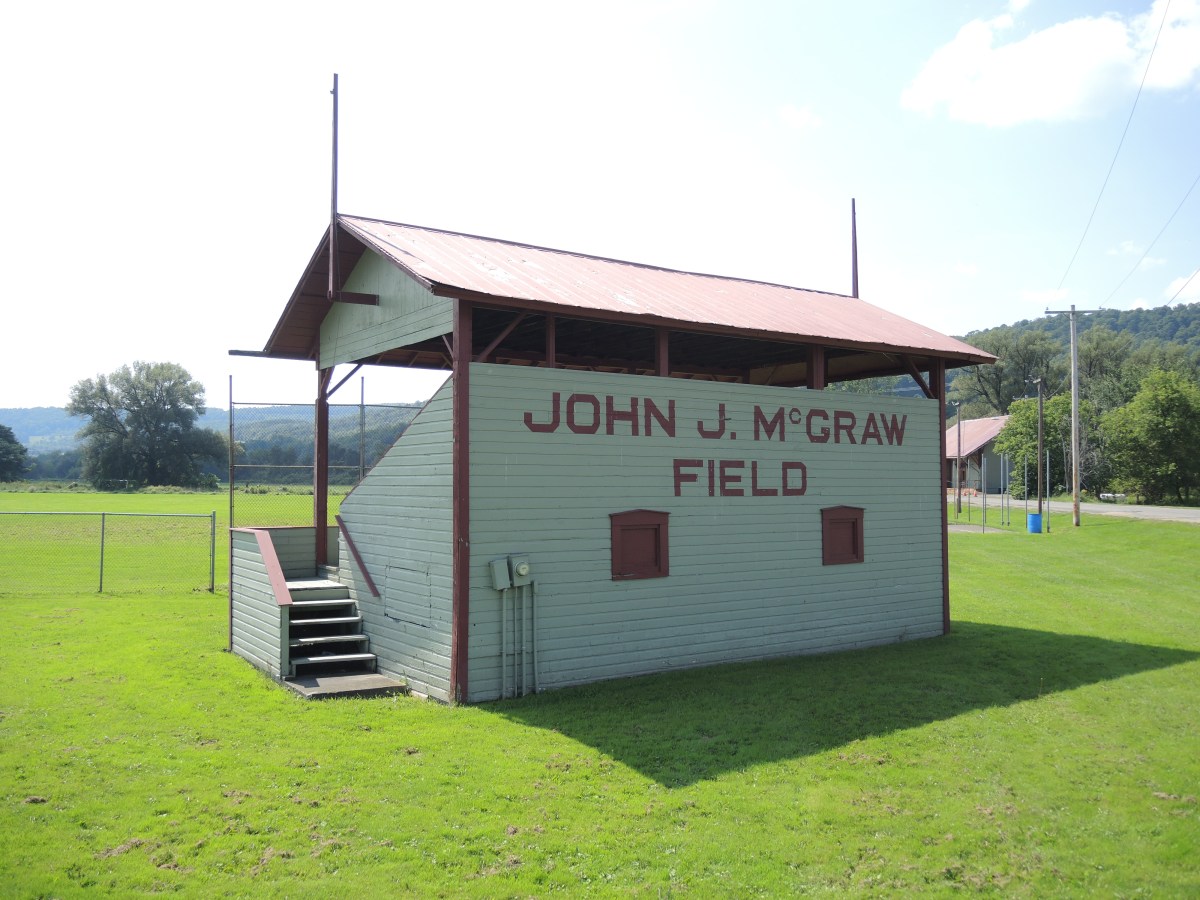
A new historical marker will be installed in Truxton, New York, at John J. McGraw Field on August 2, 2025. McGraw grew up in Truxton, and many of his family members are buried in a nearby cemetery. The marker commemorates a game played at John J. McGraw Field on August 8, 1938, between the New York Giants and a local town team.
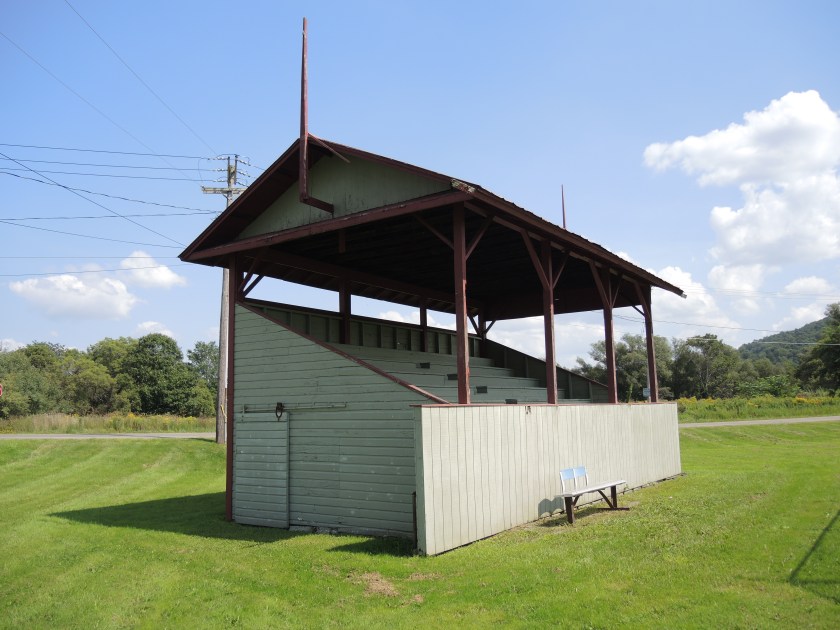
The original grandstand and field remain on site at 6290 Railroad Street. The August 2 event will include the unveiling of the historical marker, replication of activities from the 1938 game, and speeches by local representatives. A local exhibition baseball game will be played after the ceremonies. William Swisher, a resident of the area since 1966, and his wife Sarah have funded and designed the historical marker. https://www.facebook.com/people/John-J-McGraw-Historic-Field-Marker-Dedication/61574628082416/
In Search of McGraw Relatives
Amy Swisher Lozupone contacted the Baltimore Babe Ruth Chapter earlier this year requesting help in getting the word out about the marker ceremony and asking whether any members knew of any living relatives of John McGraw. If any SABR Landmarks Committee members have access to online ancestry records, we could use your help in locating a living relative of McGraw.
This information may prove useful: John and his second wife, the former Blanche Sindall, are buried in Baltimore’s New Cathedral Cemetery in a mausoleum with the remains of Stephen Joseph Van Lill Jr. and his descendants. Blanche’s sister Jannette S. Sindall Van Lill is interred there as well (which is possibly why McGraw and Blanche were buried there). During the 1900s, the S.J. Van Lill Co. manufactured and sold various food products in Baltimore.
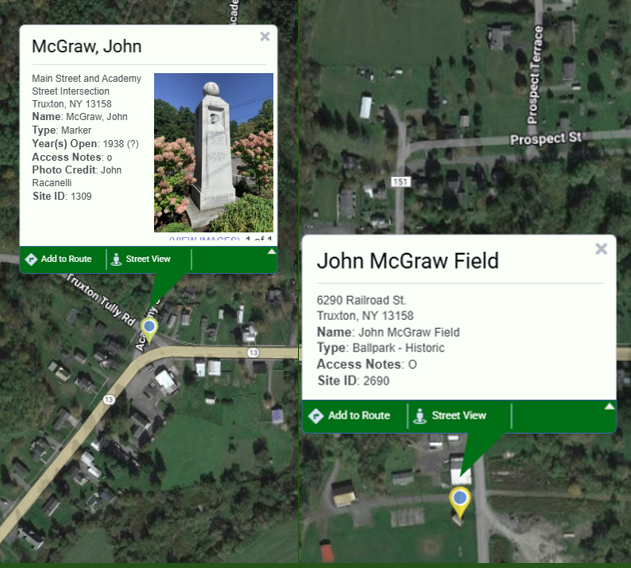
[EN] The John McGraw monument is located just northwest of McGraw Field near the Truxton Corner Station at 3674 NY-13 (the intersection of NY-13, Academy Street, and Truxton Tully Road).
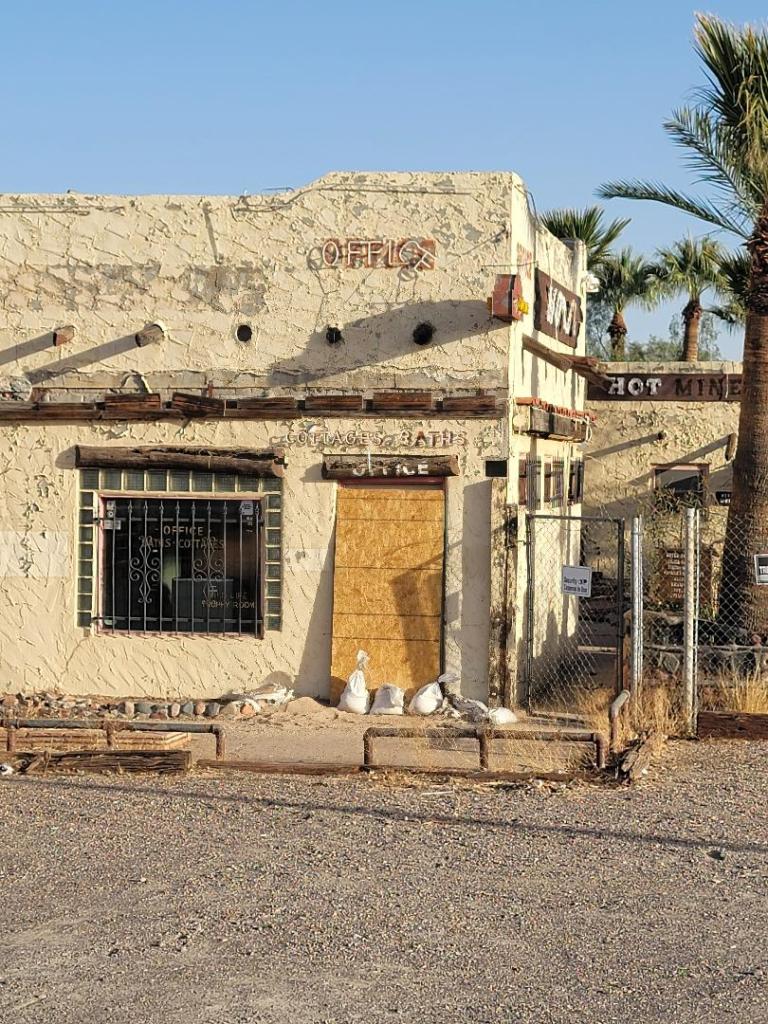
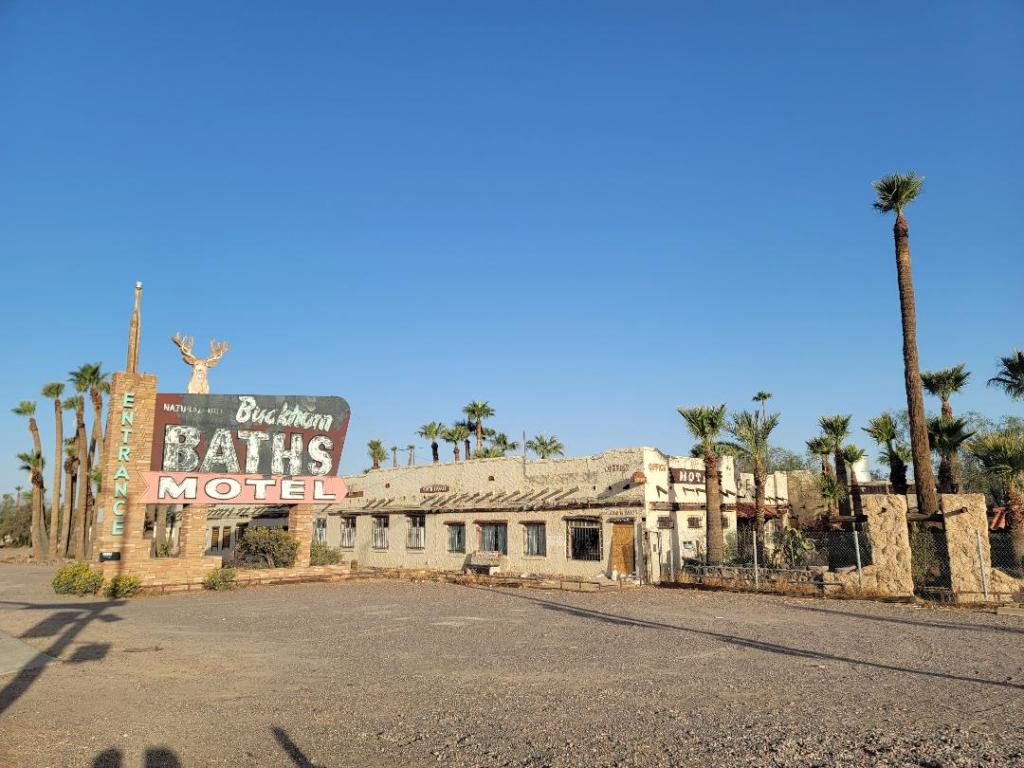
I had taken a five-day getaway to Arizona for spring training; the Cactus League in late February-early March is one of my favorite things in the world. On my fourth night in, I sat in my hotel room flipping through a book on the Cactus League, and I came across a chapter devoted to a place I had never been.
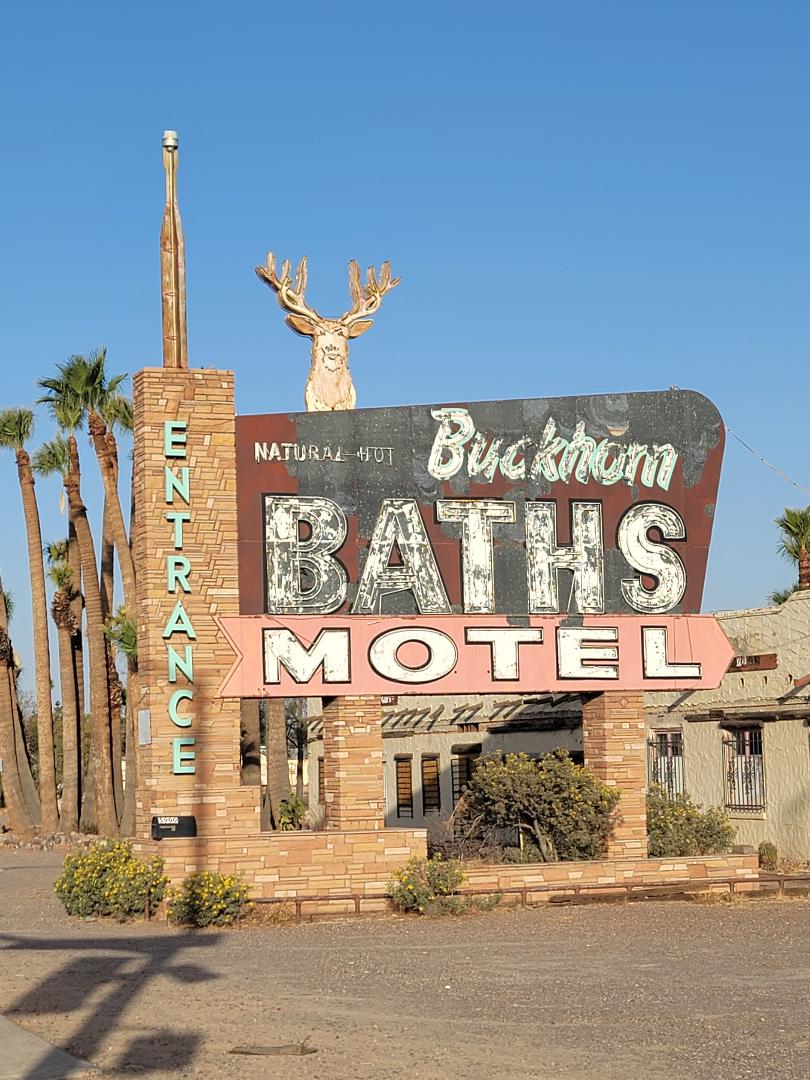
And that’s how I ended up entering the name of an abandoned mineral bath resort in Mesa into my GPS on a Friday morning.
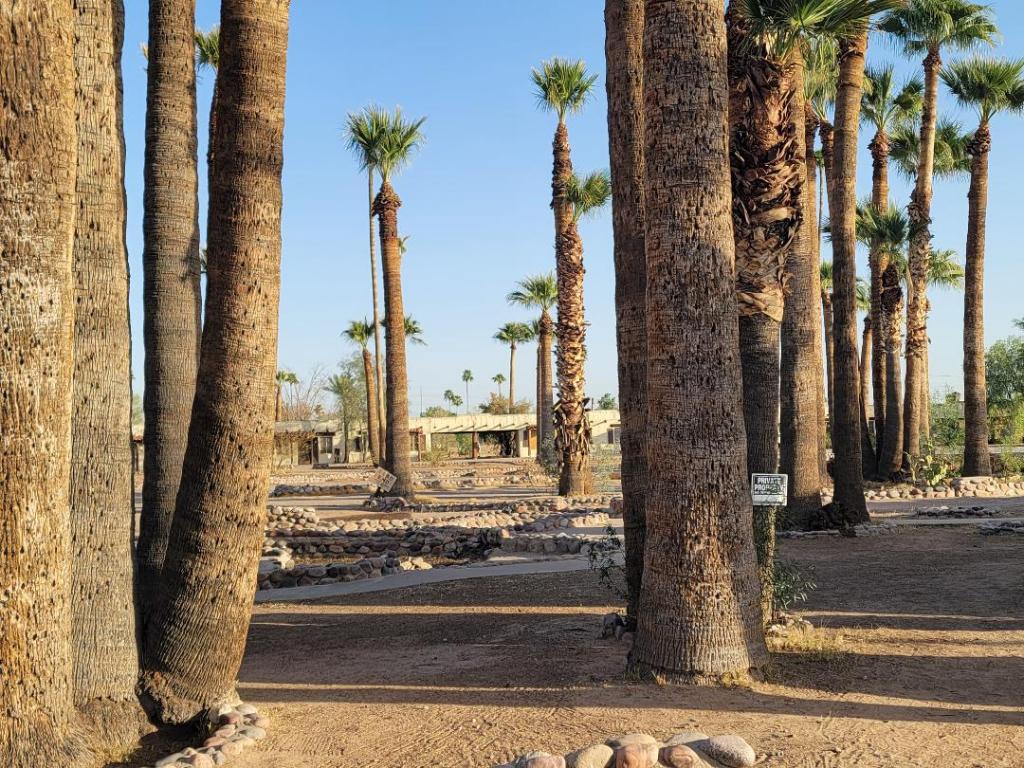
The Buckhorn Baths were a spring institution for ballplayers and celebrities located on what is now the corner of E. Main St. and Recker Road in Mesa.
Established by Ted and Alice Sliger in 1939, the Buckhorn Baths hosted numerous teams as they prepared for the season. The New York Giants, their most frequent visitors started the trend in 1947.
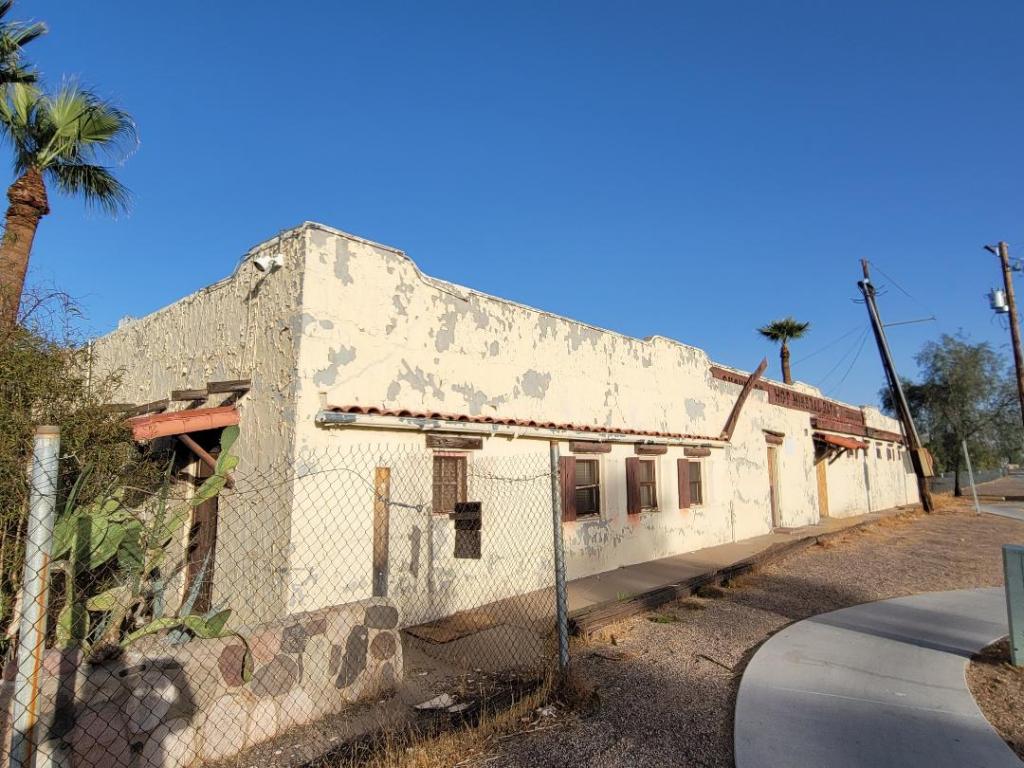
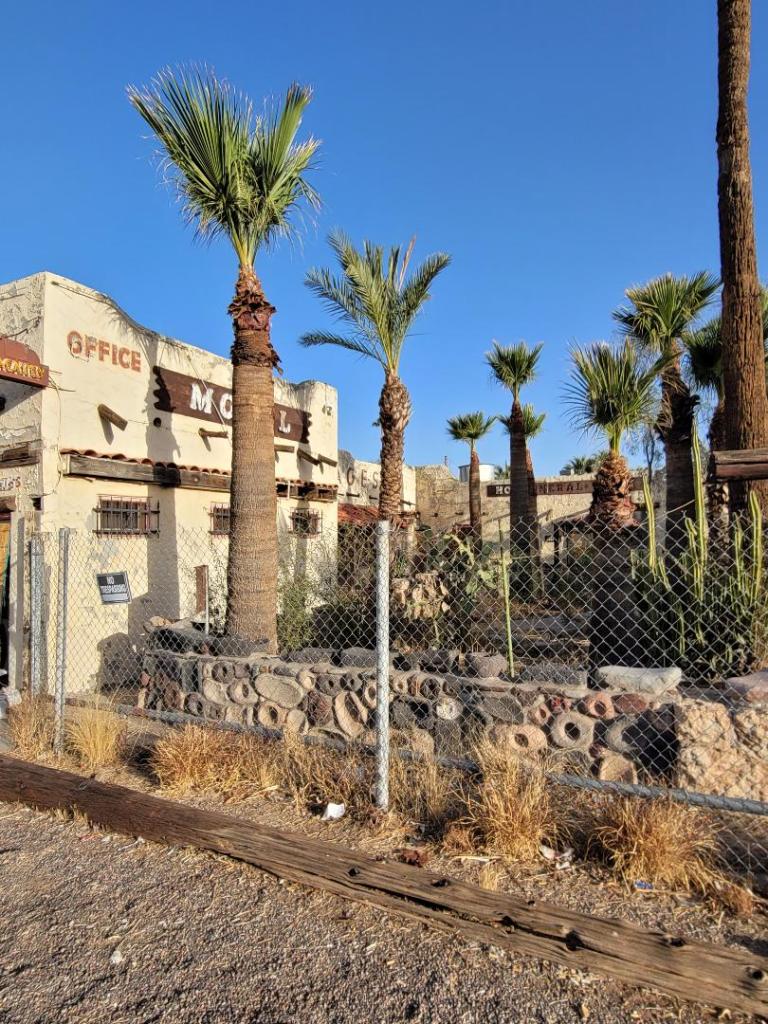
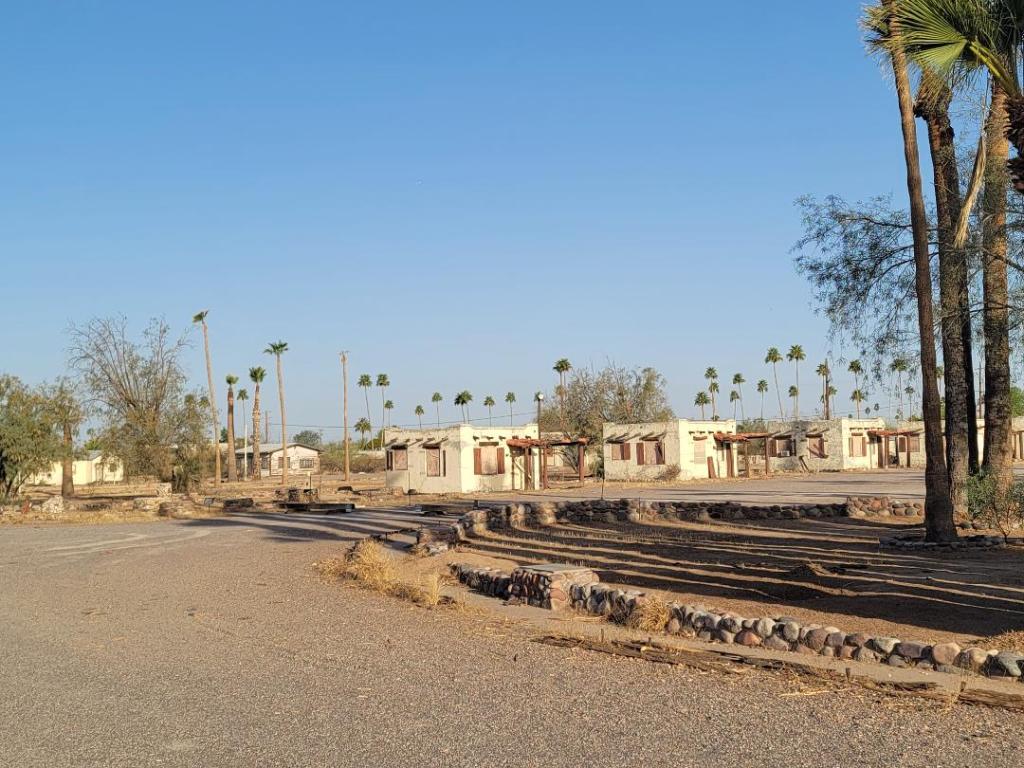
In 1999, the Buckhorn Baths closed for good, and have been sitting abandoned ever since.
I can’t believe it took me as long as it did to make it here. I’m fascinated with historic abandoned places, and I love baseball. It’s a perfect combination.
Wouldn’t it be great if the people in Mesa were able to transform this into a Cactus League Museum? It would probably never happen. But at the very least, I really hope they can avoid tearing this all down. You can imagine how wonderful this place was in its heyday just by looking at it.
For a good history of this place, I recommend checking out Cactus League Spring Training by Susie Steckner and the Mesa Historical Museum (Arcadia, 2012). There are some wonderful pictures in there.
While many who enjoy travel have bucket lists with the likes of the Galapagos or Santorini, I believe Kendrick Lamar put it best: They Not Like Us. I mean, blue-footed boobies are great and all, but remind me again what they have to do with baseball! And as for Santorini, take it from Yogi: “Nobody goes there anymore. It’s too crowded.”
Yes, for those of us with more refined appetites for travel, we prefer—really, demand—only the sorts of adventures that can (or should!) be found on the SABR Baseball Map. Not to be snobby or anything, but c’mon, are we really gonna waste our time sipping a Mai Tai or hang gliding across the Straits of Gibraltar when there’s baseball to be enjoyed?
Now, as to where the enthusiastic hardball voyager might land, here are ten destinations that are less recommendations than destiny. One might even say visiting them is “in the cards!”
10.
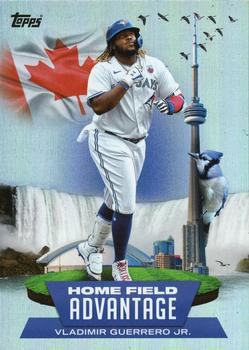
Destination: Roberto Clemente Statue, PNC Park, Pittsburgh, PA Card: 1998 Topps Jose Guillen
Note: The Guillen card shows the statue’s former location at Three Rivers Stadium.
9.
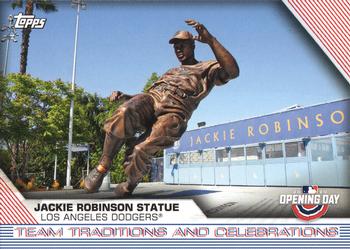
Destination: Jackie Robinson Statue, Dodger Stadium, Los Angeles, CA Card: 2020 Topps Opening Day – Team Traditions and Celebrations
Note: While you’re in the neighborhood, why not also check out the Jackie and Mack Robinson statues across from Pasadena City Hall and the Jackie Robinson football statue at the Rose Bowl!
8.
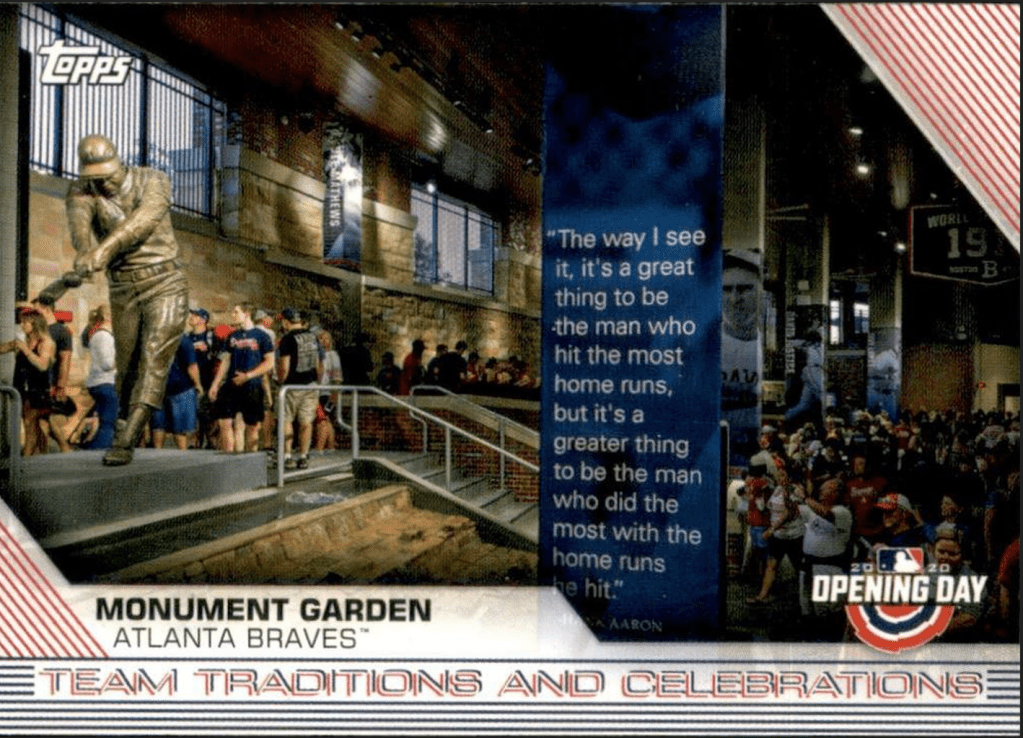
Destination: Hank Aaron Statue, Truist Park, Atlanta, GA Card: 2020 Topps Opening Day – Team Traditions and Celebrations
Note: The real-life model for the statue was C.J. Stewart, a former Cubs minor leaguer who even has his own baseball card!
7.
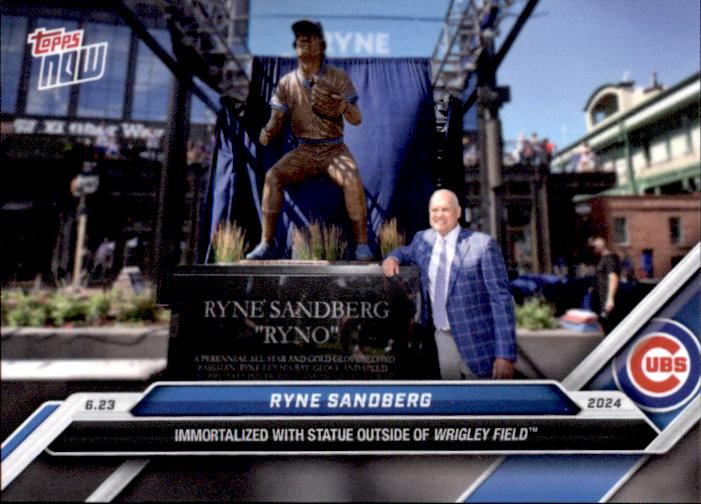
Destination: Ryne Sandberg Statue, Wrigley Field, Chicago, IL Card: 2024 Topps Now
Note: Also find statues of Cubs legends Ernie Banks, Fergie Jenkins, Ron Santo and Billy Williamsjust to the left of Ryno, not to mention Harry Caray on the nearby corner of Sheffield and Waveland. But alas, still noHack Wilson!
6.
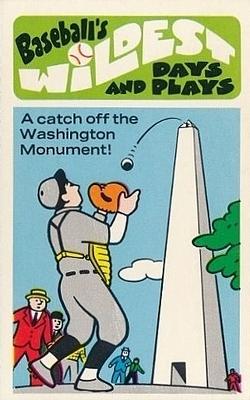
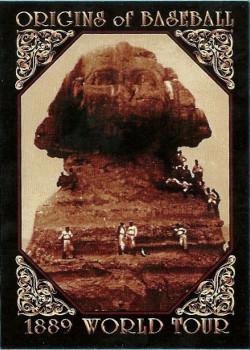
Destination: Washington Monument, Washington, D.C. Card: 1974 Fleer Laughlin “Baseball’s Wildest Days and Plays” Gabby Street
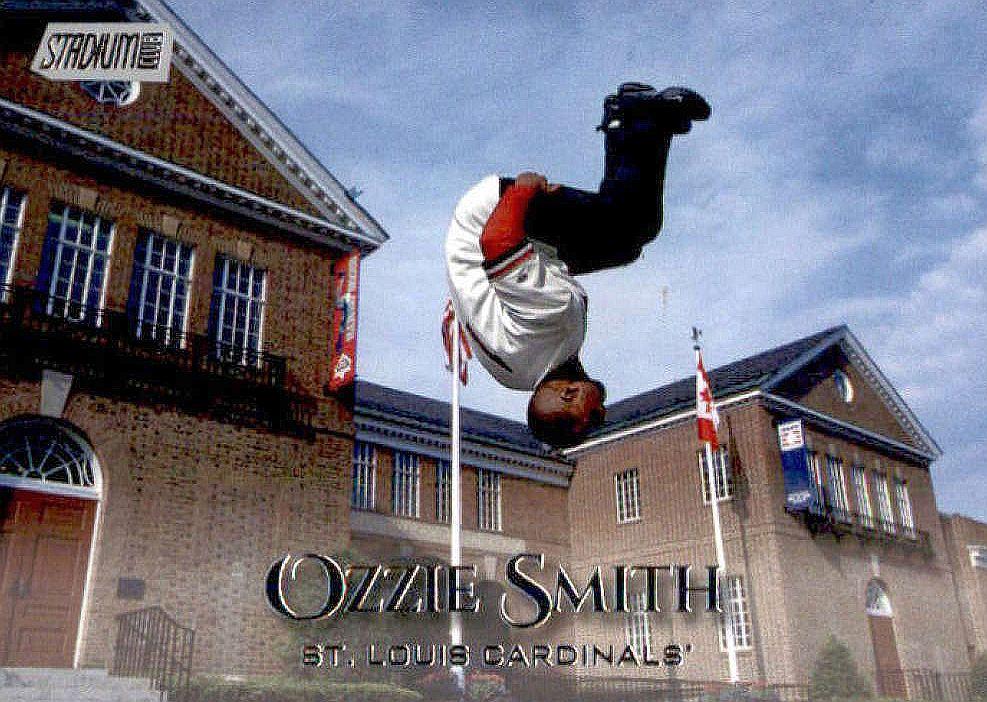
Note: We know the Washington Monument isn’t an actual SABR Landmark (yet!), but who doesn’t love a great Bob Laughlin card!(And here’s a more modern card for Washington Monument lovers.)
But speaking of monuments…
5.
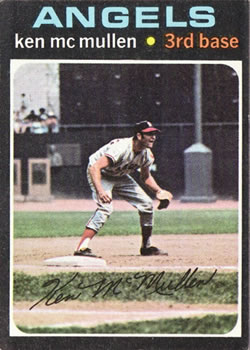
Destination: Monument Park, Yankee Stadium, New York, NY Card: 1971 Topps Ken McMullen
Notes:
No need to head onto the playing field anymore to visit Monument Park. In fact, we recommend you definitely don’t do that!
I am really excited to share the story of my day trip on January 3, 2025 to visit Gil Hodges’ hometown of Petersburg, Indiana.
Let me first explain for those that might not know. Gil Hodges was born in Princeton, Indiana but Petersburg was his hometown.
Petersburg is in southwest Indiana, about a 30-minute drive east of U.S. 41, in Pike County. I live in Terre Haute. Terre Haute is north of Petersburg on the central west edge of Indiana (at the intersection of U.S. 41 and Interstate 70). Princeton is about thirty minutes southwest of Peterson (at the intersection of U.S. 41 and S.R. 64).
I visited Petersburg and Princeton on this trip. It took me only about an hour and thirty minutes to drive from Terre Haute to Petersburg; a very easy drive, mostly on good state roads and national highways.
I visited sites in Petersburg and was fortunate to spend a little time with a man who knew Gil and the Hodges family. I’ll tell you more about that man later. While in Petersburg, I visited:
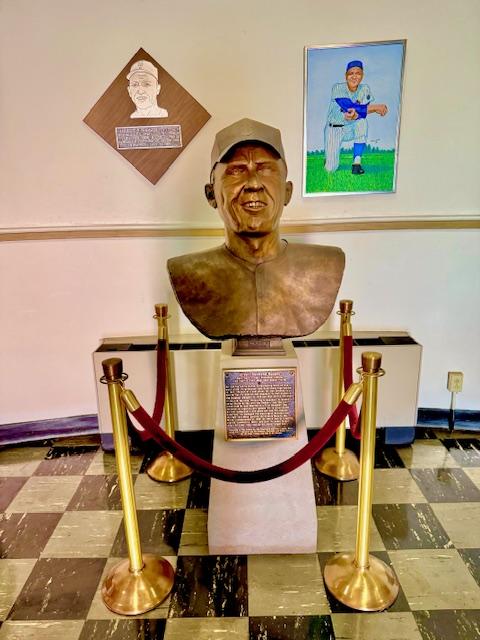
Pike County Courthouse to see the bronze bust of Gil Hodges in the rotunda,
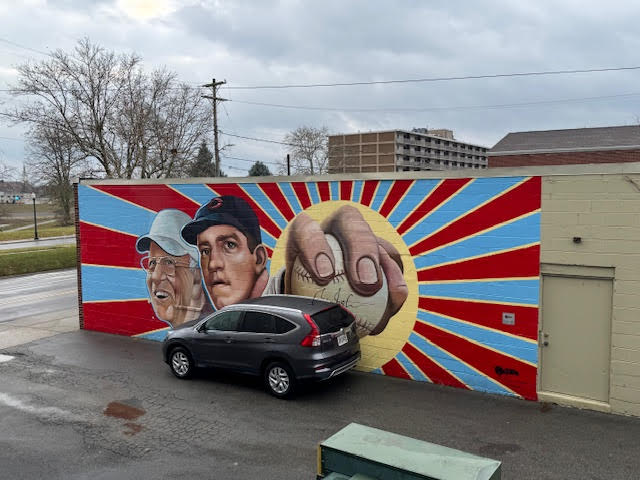
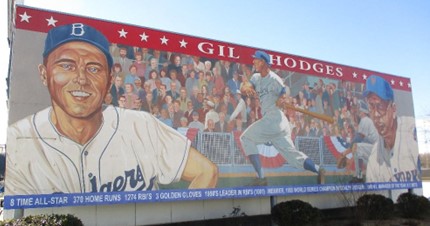
Mural of Gil Hodges that is across the street from the Courthouse,
Bridge that is named for Gil Hodges, and
Boyhood home of Gil Hodges.
I’ll tell you a little bit about each and share pictures and videos that I took that day.
In Princeton, I visited the ballpark that is named for Gil Hodges. I’ll show you pictures and a video that I took there, too.
Gil Hodges Bronze Bust in the Pike County Courthouse
The bust is on the main level of the courthouse. It was created by sculptor Don Ingle and dedicated on June 14, 1997. Randy Harris, Mayor of Petersburg at the time, led a two-year fundraising project and was instrumental in getting the bust made and placed at the courthouse.
One thing to remember if you visit, be sure to go when the courthouse is open (weekdays) if you want to be able to get inside to see the bust!
Gil Hodges Mural
The Gil Hodges mural is across the street from the courthouse. You can’t miss it! It’s fantastic to see and very well done. The 52’ X 16’ mural was first completed and dedicated in 2009. Again, then-Mayor Randy Harris had a hand in this project. In 2022, following Gil’s induction into the National Baseball Hall of Fame, the mural was updated to include the HOF logo and a plaque commemorating Gil’s enshrinement. For some reason, these features were missing on the day that I visited. The mural was created by artist and Petersburg High School graduate Randall Heddon. Heddon also created the picture of Gil in his Mets uniform that hangs on the wall next to the bronze bust in the courthouse.
Gil Hodges Bridge
The Gil Hodges Bridge is on State Road 57 as it crosses the East Fork of the White River, on the north edge of Pike County. The bridge is only about a 10-minute drive from downtown Petersburg. This picture below provides a view of the sign on the south side of the bridge (looking in a northerly direction).
Gil Hodges Boyhood Home
I learned from visiting with people in Petersburg that the boyhood home of Gil Hodges is located at 1401 E. Main Street. The home is only a few blocks east of the courthouse (at the SE corner of Main and 14th Streets). I learned that when Gil’s mother passed away, the house was sold. The same family that purchased the house from the Hodges family seemingly still owns the property.
Gil Hodges Ball Park (Princeton, Indiana)
Gil Hodges Ball Park is centrally located in Princeton adjacent to Lafayette Park. The street address is 700 N. Lafayette Park Drive. The ball park looks to be in awesome condition.
If you’re looking for a place to eat or get a milkshake, I highly recommend Dick Clark’s Family Restaurant at 702 N. Prince Street in Princeton.
Wrap Up
Gil Hodges was born on April 4, 1924. As of the day of my trip, he would have been 100 years old. I am a really big fan of the New York baseball teams and players from the era in which Gil Hodges played. I love reading and learning about the Boys of Summer, Willie Mays and the New York Giants, and of course Mickey Mantle, Whitey Ford and some of those Yankees teams. What a great era for baseball. While I didn’t get to see these players and teams in person, I have been fortunate to make friends with people who did.
I’ve learned so much from being part of the New York Giants Preservation Society. I encourage you to check them out if you don’t already follow them. One more thing about the Brooklyn Dodgers…..I was lucky to shake Carl Erskine’s hand on an airplane once. He boarded a flight in Denver (to Indianapolis) after I had already taken my seat. As he passed by my seat, He could tell by the expression on my face that I recognized him. He reached out, smiled, and shook my hand. Neither of us said anything, but we both knew. What a thrill for me. Erskine…. another baseball hero of mine from Indiana. Anderson, Indiana (hometown of Carl Erskine) is likely the next place I’m heading for a day trip!
I almost forgot to tell you about the man I met from Petersburg. His name is Randy Harris. Randy is a former Mayor of Petersburg. He currently sells real estate and has an office on Main Street (just a couple blocks west of the courthouse). For a time, Randy owned and operated a restaurant called Randy’s Americana Café. I called and introduced myself to Randy. Not knowing about his personal connections to Gil and the Hodges family, I called and told him I was coming to town to visit sites and wanted to make sure this café was going to be open. Mr. Haris explained that he had sold the restaurant but told me I was welcome to stop by his real estate office when I was in town. I could not have imagined getting so lucky. Randy told me stories about growing up in Evansville and Petersburg, and about Gil and his family. Randy knows all about the bust and mural. I encourage any of you that visit Petersburg to see Gil Hodges sites to call Randy Harris. He’s a great guy with great stories.
It is very nice to see that Gil’s legacy is celebrated in Petersburg and Princeton. Gil passed away at 47 years-old from a heart attack. During his very short life, he seemingly had a significant impact on the people he knew.
Clem Labine is quoted as saying “Not getting booed at Ebbets Field was an amazing thing. Those fans knew their baseball, and Gil was the only player I can remember whom the fans never, I mean never, booed.”
Pee Wee Reese is quoted as saying “If you had a son, it would be a great thing to have him grow up to be like Gil Hodges.”
Arthur Dailey of the New York Times is quoted as saying “He (Hodges) was such a noble character in so many respects that I believe Gil to have been one of the finest men I met in sports or out of it.”
Gil’s plaque at the courthouse concludes “Gil was a man of integrity, dignity, community, family and God. He never forgot where he came from, and we will never forget him.”
Thanks Gil for being a great ballplayer. Thanks for giving us great baseball memories and for being such a good teammate and person.
This is my first blog. Thanks for reading.
So happy I made this trip!
Greg Phegley
Links to the videos I made during my trip are below.


















 The Hardball Voyager