
2022 year marked the 30th anniversary of the highest grossing baseball film of all time, A League of Their Own. Countless screenings were held and other events were scheduled to celebrate this landmark film in the weeks before the release of the new Amazon television series of the same name. For me, a trip to Indiana that summer was both a figurative and literal homecoming to embrace the movie that has had a significant impact on my life for the past three decades.
I have been to Evansville’s Bosse Field and Huntingburg’s League Stadium many times. Both are about a 40-minute drive in different directions from my hometown in western Kentucky. I was 12 years old when filming began in the summer of 1991 and could still recognize what a big deal it was to have a Hollywood production come to southern Indiana. My brother and dad actually drove over to be extras late in the filming schedule for what would end up being the World Series scenes. The end result had a huge impact on me. Already fascinated (and still am) with World War II, I started reading anything I could find on baseball during the war, the home front, and this All-American Girls Professional Baseball League that I had never heard of (before seeing the movie five times in the theater). Decades later, I’m working with the International Women’s Baseball Center, creating Women in Baseball Week, and presenting at conferences on my research into women in the game. It’s safe to say I’m hooked, so imagine my excitement when heading home for a family visit, I saw both stadiums had games scheduled for the week I would be in town. What better way to relive all that film has given me than to pay them back-to-back visits?

Leading off was a trip to Bosse Field in Evansville. Located at 23 Don Mattingly Way, Bosse Field (pronounced “bossy” for those who might not know) opened in 1915 and is believed to be the third oldest professional ballpark still in use behind only Fenway Park and Wrigley Field. Though situated on the edge of Garvin Park, the stadium is nestled in a neighborhood of homes, factories, and warehouses, many dating back to the World War II era when Evansville was a leading armaments manufacturer for the war effort.

Location scouts for the film would have been hard pressed to find a more suitable ballpark for the production’s needs. The stadium is encompassed by a red brick wall, presenting a classic look, with lighting situated inside this outer wall but beyond the outfield fence and on top of the grandstand roof. Approaching the stadium, visitors are met by an impressive three-story tall main gate of brick, stone, and windows. For movie fans, this is where Jimmy meets Dottie’s husband post-World Series and they all exchange pleasantries before boarding the bus back to the hotel.
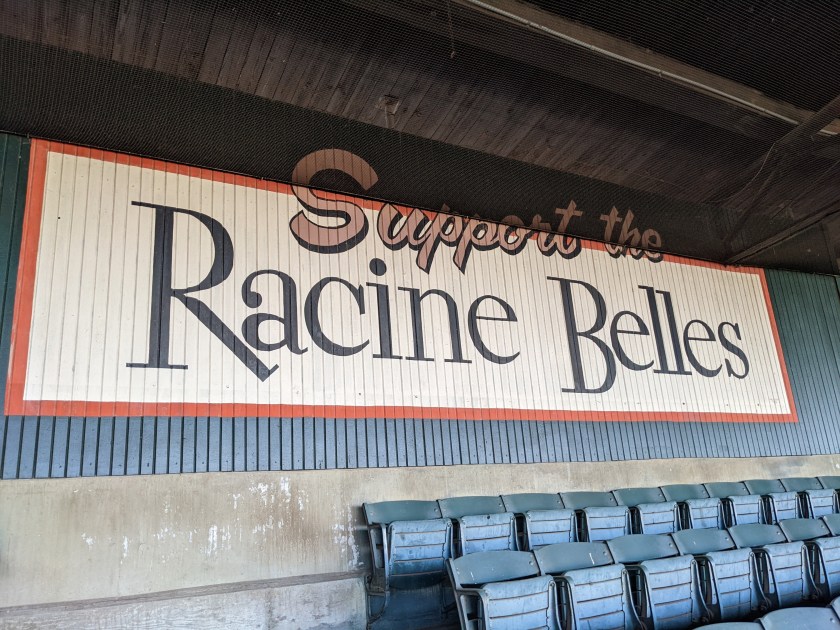
The area wrapping around the outside of the stadium in either direction of the main gate constitutes the concourse where most concessions and merchandise are sold. At both ends are additional entrances to the stadium and stepping through these North and South Gates, visitors will find more fun holdovers from the film. Just above these gates are old fashioned advertising for shoes and coffee used in filming and further up from each gate toward the back of the grandstand are two large, identical signs reading Support the Racine Belles. They look great and I am glad to see the stadium still embraces their role in its history 30 years later. The stadium seats just over 5,100 in green metal and wooden chair backs, situated in a smooth half circle and mostly under roof coverage. As always, I find myself moving to a new location every inning just to get a different look at the field.
Bosse Field has been home to the Frontier League Evansville Otters since 1995 and I’m lucky to still have trading cards, programs, and ticket stubs from that first season. On my visit, however, the Otters were on the road and the Women’s Professional Fastpitch tour was in town. A couple thousand people turned out to watch the USSSA Pride take on the Smash It Sports Vipers and the atmosphere was absolutely electric. Having been a softball fan for the past 30 years as well, I was experiencing a most unique opportunity to watch Shelby Pendley play live (for me, the first time in six years) and see Olympic gold medalist Kelly Krestchman coaching. Reigning NCAA home run queen Jocelyn Alo, on the heels of graduating from another national championship season at the University of Oklahoma, went yard on the first pitch of her first at bat. The crowd went wild and so did I.
On top of A League of Their Own filming, I know the AAGPBL played an exhibition game or two here in the late 1940s. How cool to see women pro ball players in Bosse where all of that had happened before. A small gift shop caught my eye on the way out where I bought a large book on the history of Bosse Field. Seemingly half the photos were contributed by Justin Sheller, who played Stilwell Angel in the film, which is fine by me.
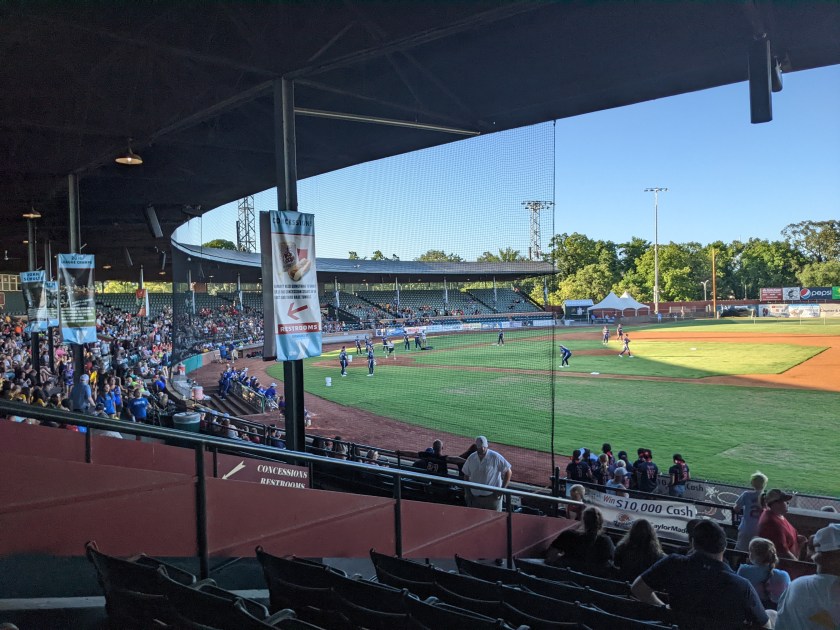
The following day’s plans were extra special in that I brought my mom along to League Stadium for that evening’s game and my brother and niece would be driving down from Indianapolis to join us. My first trip to League Stadium would have been 1993 when, also with my mom, we stopped to see where the movie was filmed on our way to Bloomington, Indiana. We had a brief tour with a local volunteer, took a lot of pictures, and even bought a folding chair used in the film, which still sits in my office. New chair backs were obtained from the old Atlanta-Fulton County Stadium and installed in the late 1990s in time for the Dubois County Dragons of the Frontier League to take up residence. On this night, we would be watching the current tenants, the Dubois County Bombers of the summer collegiate Ohio Valley League play my hometown Owensboro RiverDawgs.
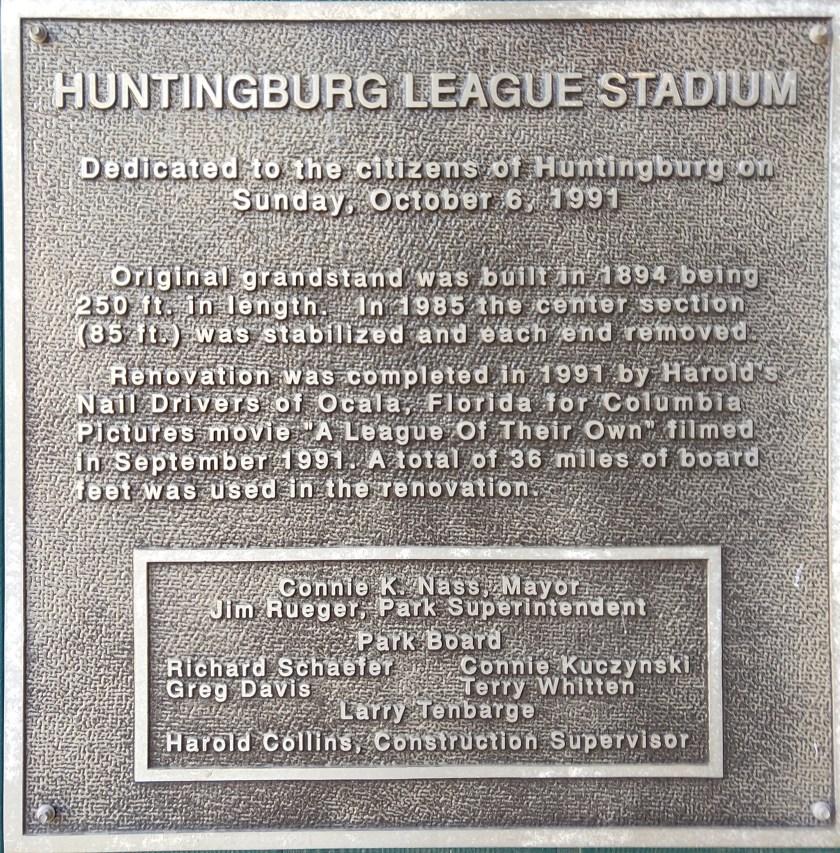
Similar to Bosse Field, League Stadium is situated in a city park, but surrounded by tennis and basketball courts, a playground, pool, and youth baseball and softball fields. A replica Rockford Peaches bus greets visitors at the park’s entrance. The ballpark does not have quite as grandiose of a main gate as Bosse, although this is understandable. The original rectangular grandstand dates back to the 1890s and it wasn’t until the location was chosen in 1991 for A League of Their Own that it was renovated to its current, more traditional ballpark shape. Movie fans will note that no scenes in the film feature the outside of this park.
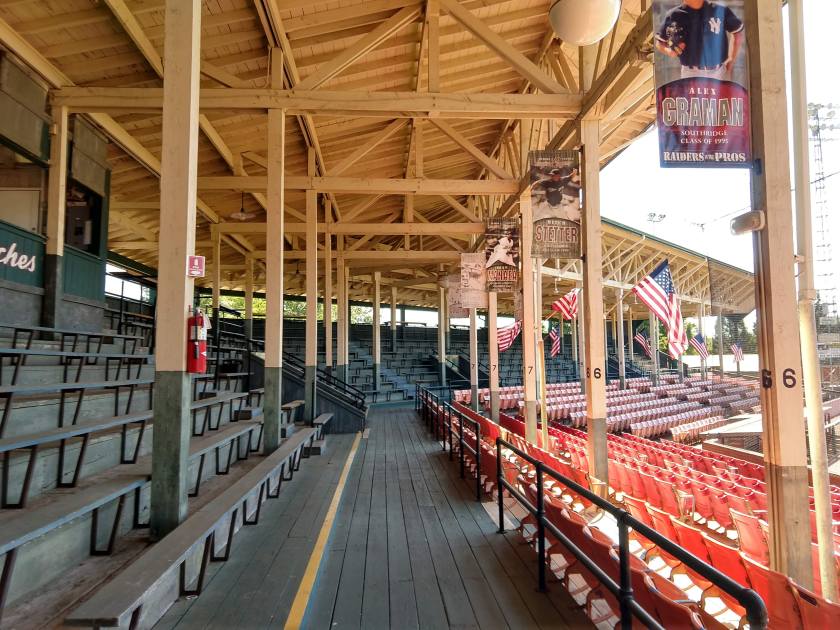
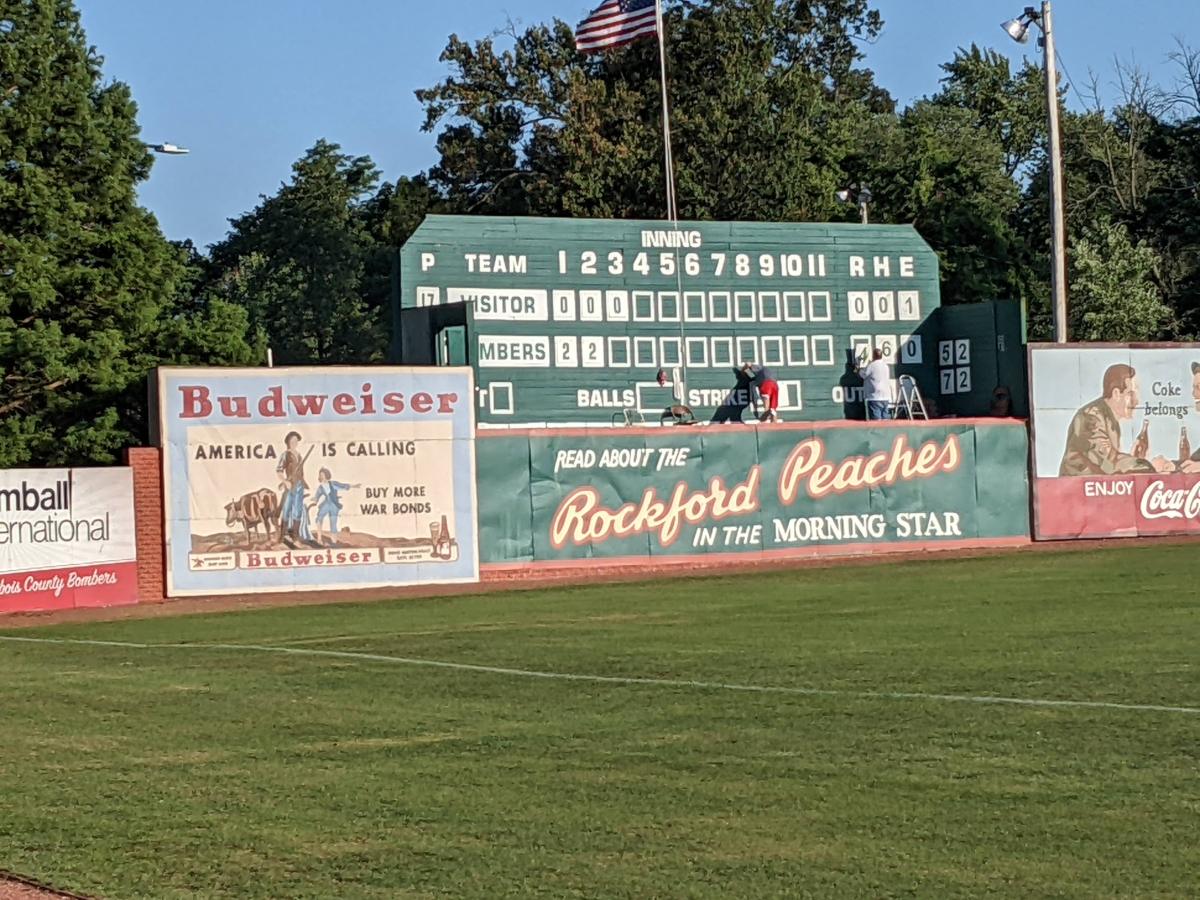
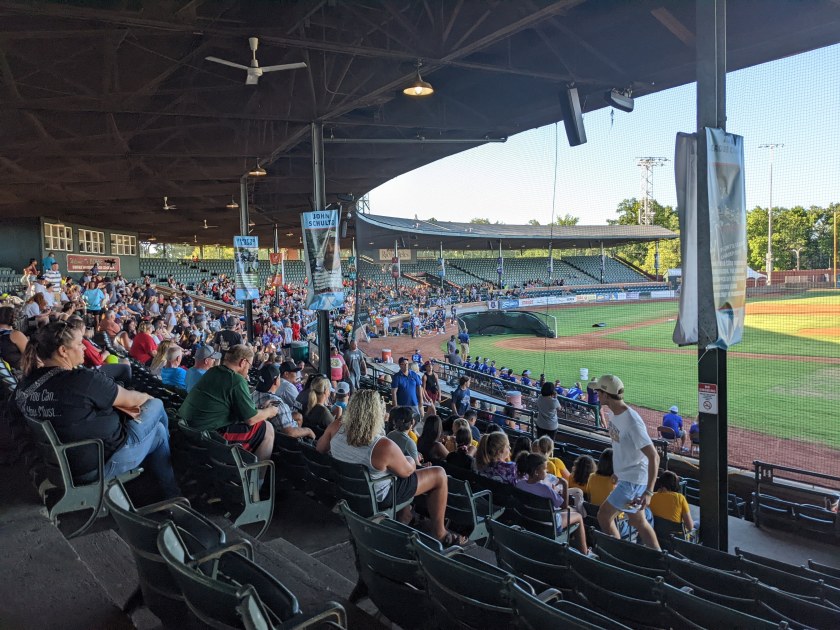
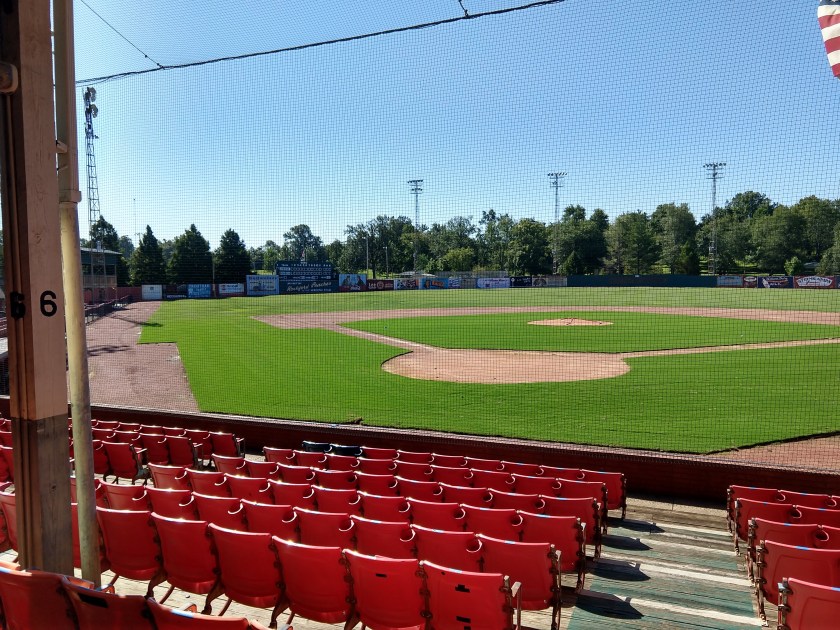
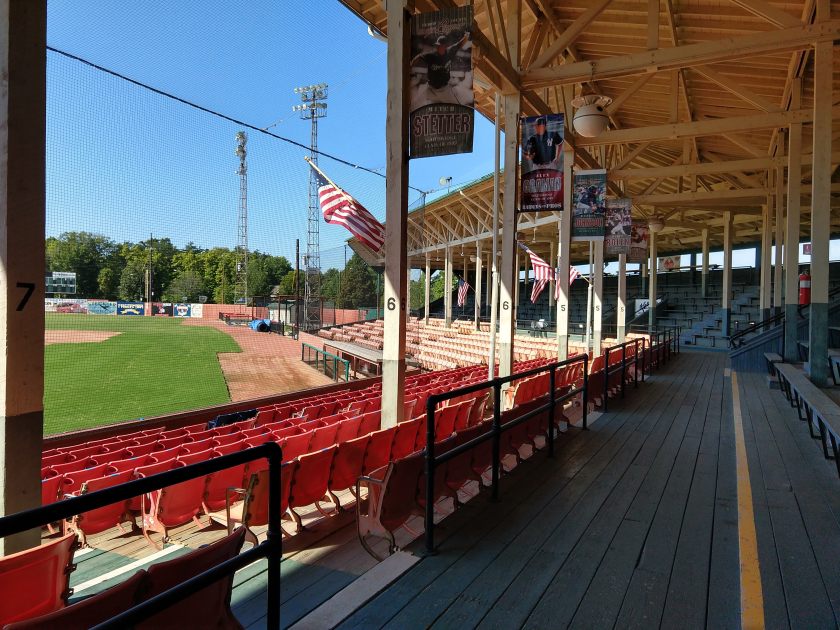
The inside, however, is a nostalgic marvel. The aforementioned seats from Atlanta fill the lower area at field level, but the upper level near the press box remains the same bench seating from the film. At nearly 2,800 seats, League Stadium’s capacity is just over half that of Bosse Field. There is still a sign for Harvey Bars on the outfield fence and both the press box and left field scoreboard feature the same “Rockford Peaches” in script. A newer electronic scoreboard used for games sits just behind the right field fence. Like Bosse, food and merchandise are located outside of the stands. There is a small exhibit area with plaques, props and costumes from A League of Their Own and HBO’s Soul of the Game, also partially filmed here and released in 1996. Our tickets for the game had us about eight rows behind home plate, but from the looks of the stadium, there is not a bad seat in the house.
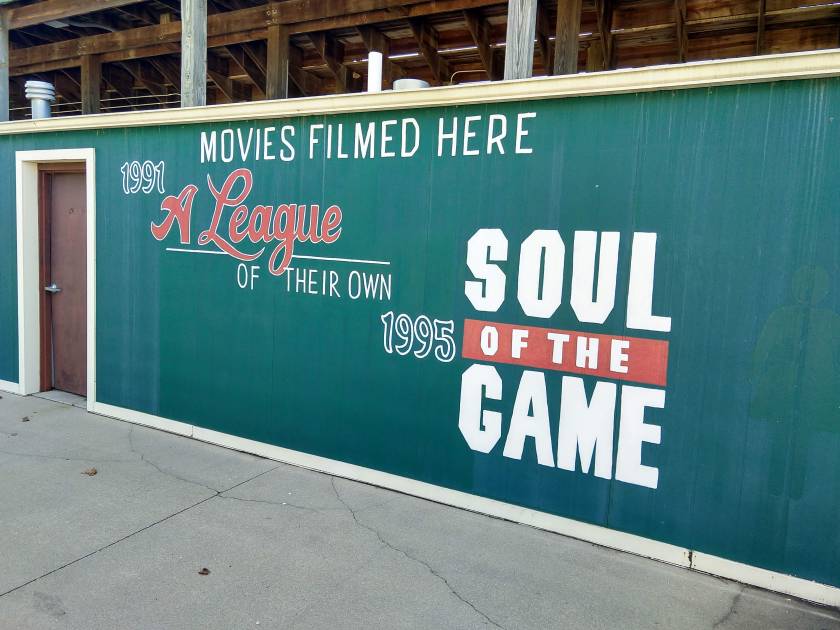
Many of the “amenities” found in current minor league stadiums are absent at both Bosse Field and League Stadium. You won’t find chain restaurant outlets, bar seating along the outfield wall, or a splash park for the kids. What League Stadium expertly delivers is a trip back through time, which I am sure appeals to a lot of us. The team’s nickname is derived from a World War II bomber and the players wear 1940s style uniforms. Female staff follow suit in replica Peaches uniforms and hand write seat assignments on ticket stubs. Flags and banners hang from the columns supporting the roof and most of the music played between innings is either Big Band or from the A League of Their Own soundtrack. Fans of both baseball and the film almost need multiple visits to take it all in and fully appreciate the total experience curated by both stadiums. First, there’s exploring the history and architecture of the spaces and witnessing the game in such a classic environment.

Next, you have the games themselves. Evenly matched summer collegiate baseball or professional softball will do it for me every time. Finally, there’s the movie aspect. Literally everywhere you look can be a reference to a favorite part of the film whether it’s the final collision at home in the World Series, Stilwell Angel getting nailed in the face with a glove, or the legendary “There’s no crying in baseball” scene.

My family’s visit to League Stadium was fun, although a bit sad. My dad passed away in October of 2019, leaving this mini-family reunion feeling incomplete. On the way home, I realized something that now has cemented A League of Their Own as a film, baseball or otherwise, that will always hit close to home. My absolute favorite shot of the entire film is during Kit’s at bat in the World Series. After driving a high one into right field, we see her rounding first heading straight toward the camera for a turn at second. Her skirt is flying, her cleats are kicking up dirt in the base path, and there is a wall of excited people in the stands behind her, punctuated by the giant Support the Racine Belles sign. It is a beautiful, classic shot. And then I made a new connection – my dad is there. Maybe not exactly in the shot as it’s difficult to pick out anyone specifically and I only know he was in the back of the first base / right field end of the stands. He had watched the whole scene being filmed and was a part of it, and now he’s forever a part of my favorite shot in a favorite movie about a sport and history that I love. It’s a bittersweet, but welcomed feeling every time I have watched the movie since.
A few months ago, I had the unique opportunity to watch the USA Baseball Women’s National Team play back-to-back games at former AAGPBL ballparks in Rockford and Kenosha, both of which are also on the SABR Landmarks Baseball Map. Watching these games, alongside AAGPBL players no less, was a unique experience that I never anticipated. I never thought I would write blogs for SABR or have dinner with actors, writers, and directors connected to A League of Their Own, both the film and the series. There is a beauty to never having specific expectations toward an interest or hobby and just letting it flow. I never anticipated A League of Their Own affecting me so profoundly, but thanks a visit home in 2022, I realize I’ve been living my best baseball life for 30 years.


 The Hardball Voyager