My first time in the Baltimore area will always be a once in a lifetime experience. David Stinson, Vice President of the Baltimore Chapter, invited me to the area to show me historical sites.
As the person who spearheaded the effort to get the first SABR historical marker in the state of South Dakota paying homage to the old Baltimore Orioles minor league team the Aberdeen Pheasants, there was a lot to see.
The first area that I had to see was the hometown in which the Ripkens lived – Aberdeen, Maryland. The first location we visited was the home of the Ripkens at 410 Clover Street in Aberdeen. The next area that we visited was the gravesite of Cal Ripken Sr., which was located at Baker Cemetery 3641 Churchville Road in Aberdeen.
Coincidentally, the same day that I was in Aberdeen (Friday, August 22) the Orioles minor league team the Aberdeen Ironbirds were in town, so we went to a game. Peter Coolbaugh, Balitmore’s Chapter President, joined David and me for the game. The day was full of fun and excitement, but there was even more to follow the next day.
The next day we went to the former site of Memorial Stadium. Some notable Aberdeen Pheasants who either managed or played at Memorial Stadium after being called to “The Show” include Cal Ripken Sr., Earl Weaver, and Jim Palmer.
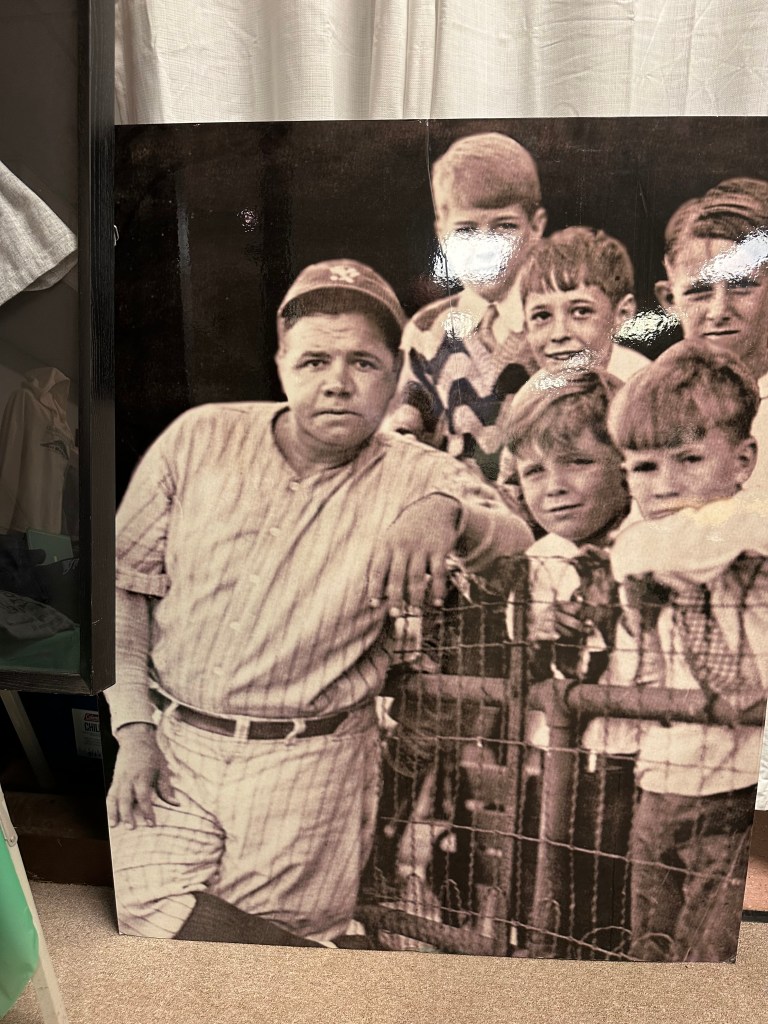
It is truly remarkable what the Cal Ripken Sr. Foundation did to the area so future kids can still play on that field. After that we had to go to, “Just a long fly ball from Oriole Park at Camden Yards” aka the Babe Ruth Museum. It was truly an awe-inspiring experience to see all of the old items that the museum has.
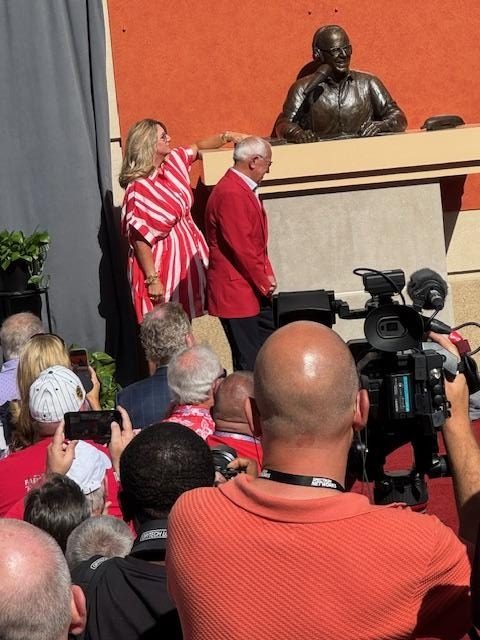
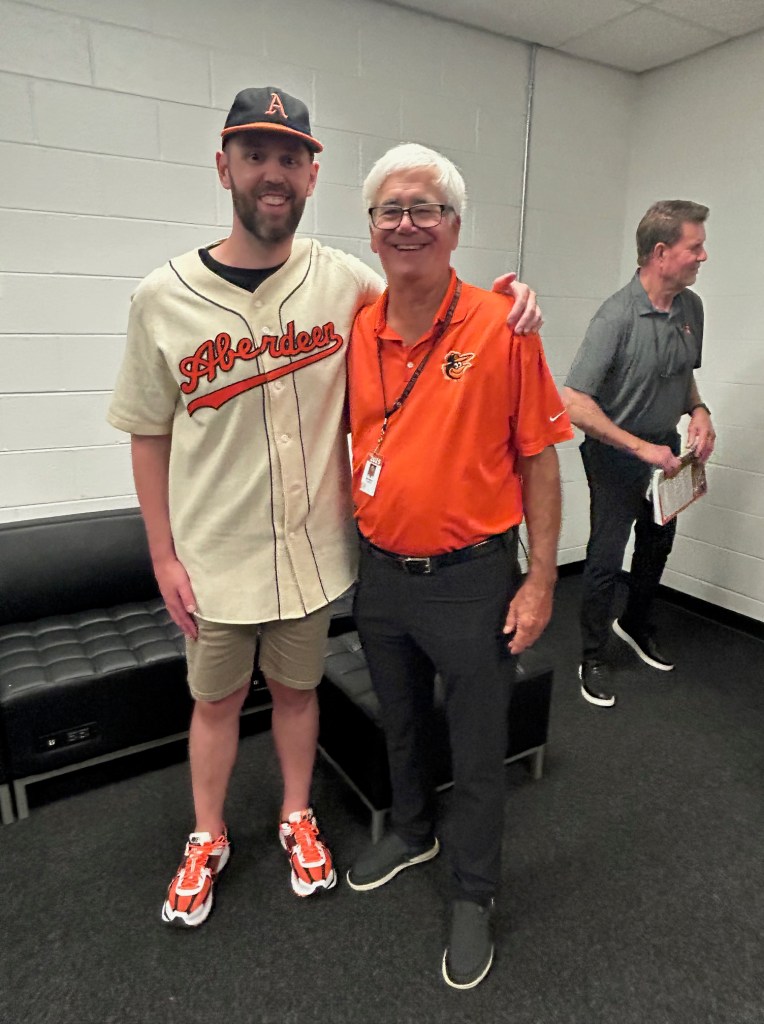
After that we went to the ballpark in which (on Saturday August 23) was Jim Palmer jersey giveaway day. David and Peter got in contact with fellow SABR member Bill Stetka. Bill Stetka is the Director of Orioles Alumni & Team Historian. Bill got in contact with Jim Palmer, and told him about the SABR historical marker. Jim gave us permission and we were able to meet with him before the game. It was truly a dream come true experience being able to meet the only Aberdeen Pheasant player ever in the Hall of Fame.
I am truly grateful to David, Peter, Bill, Jim, and the SABR organization. Dreams can come true, and this will always be a fond memory for me.
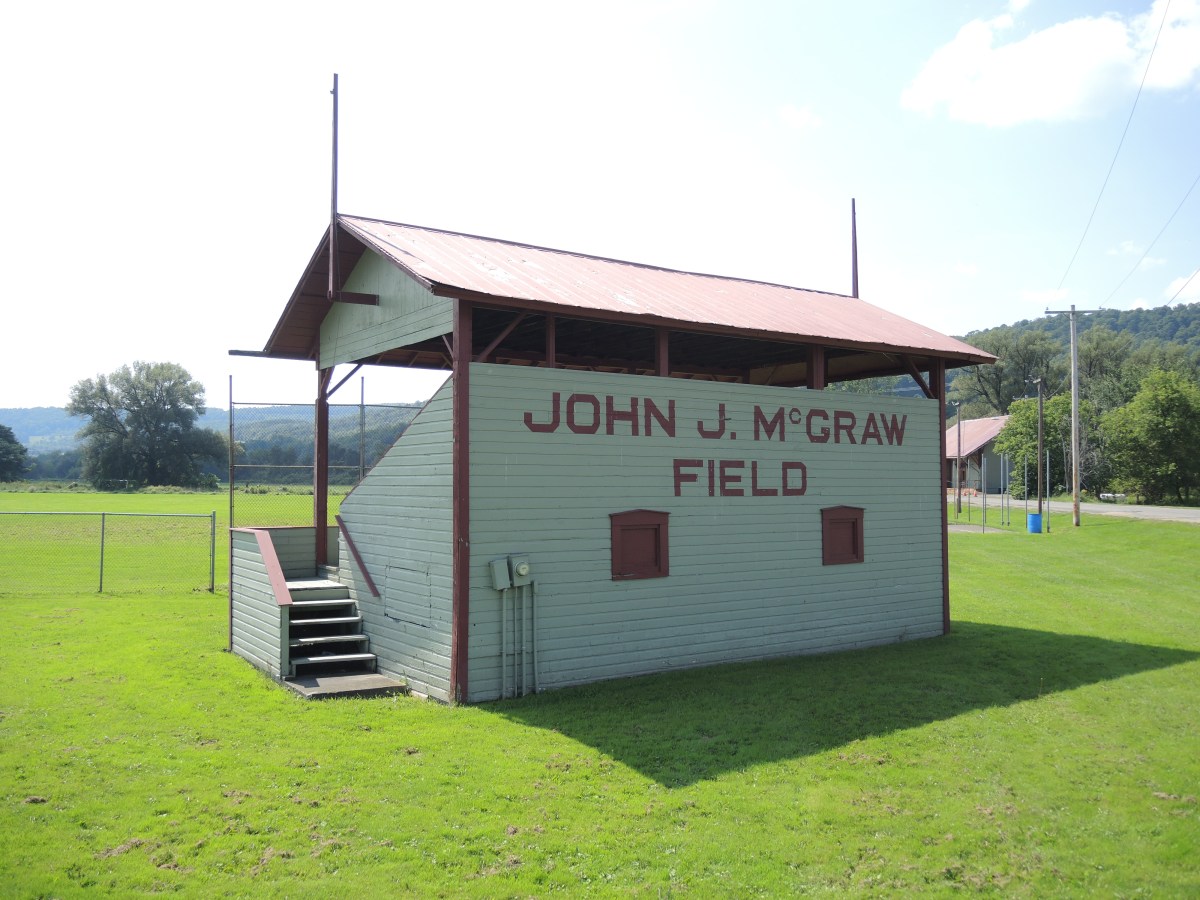
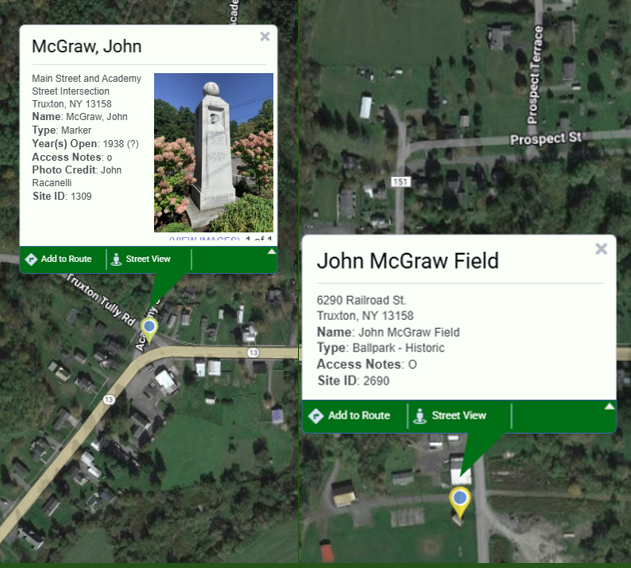
A new historical marker will be installed in Truxton, New York, at John J. McGraw Field on August 2, 2025. McGraw grew up in Truxton, and many of his family members are buried in a nearby cemetery. The marker commemorates a game played at John J. McGraw Field on August 8, 1938, between the New York Giants and a local town team.
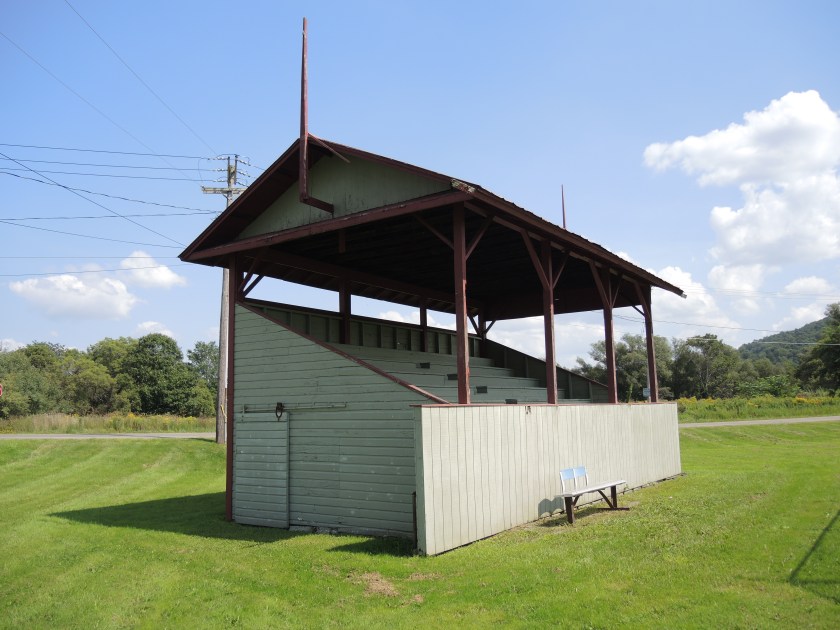
The original grandstand and field remain on site at 6290 Railroad Street. The August 2 event will include the unveiling of the historical marker, replication of activities from the 1938 game, and speeches by local representatives. A local exhibition baseball game will be played after the ceremonies. William Swisher, a resident of the area since 1966, and his wife Sarah have funded and designed the historical marker. https://www.facebook.com/people/John-J-McGraw-Historic-Field-Marker-Dedication/61574628082416/
In Search of McGraw Relatives
Amy Swisher Lozupone contacted the Baltimore Babe Ruth Chapter earlier this year requesting help in getting the word out about the marker ceremony and asking whether any members knew of any living relatives of John McGraw. If any SABR Landmarks Committee members have access to online ancestry records, we could use your help in locating a living relative of McGraw.
This information may prove useful: John and his second wife, the former Blanche Sindall, are buried in Baltimore’s New Cathedral Cemetery in a mausoleum with the remains of Stephen Joseph Van Lill Jr. and his descendants. Blanche’s sister Jannette S. Sindall Van Lill is interred there as well (which is possibly why McGraw and Blanche were buried there). During the 1900s, the S.J. Van Lill Co. manufactured and sold various food products in Baltimore.
[EN] The John McGraw monument is located just northwest of McGraw Field near the Truxton Corner Station at 3674 NY-13 (the intersection of NY-13, Academy Street, and Truxton Tully Road).
I’ll admit when I think of the Landmarks Committee and the SABR Baseball Map, what I love most is the mapping and chronicling of the obscure, out of the way spots that–like the brush dabs of a Monet–are so easily overlooked but collectively amount to a the masterpiece that is the geography of our National Pastime. Drive three hours south to see the pedestal a Jim Bottomley statue once stood atop? I’m there! An abandoned ballpark where minor league history was made? Count me in! A home plate inside a hospital? Why not!
Forgive me then for writing about the absolute least off the beaten path landmark of them all: Yankee Stadium. “Ah, you almost had us, Jason. Surely you mean the footprint of the old Yankee Stadium, the original House that Ruth Built!” Nope. “Good one then. Old Hilltop Park, home of the Highlanders? Nice!” Nope again. I’m talking about the Yankee Stadium the actual New York Yankees play in right now. “Sublime! We can’t wait to read about the obscure features and history only a top notch SABR researcher like yourself might uncover!” Oh, how I wish!
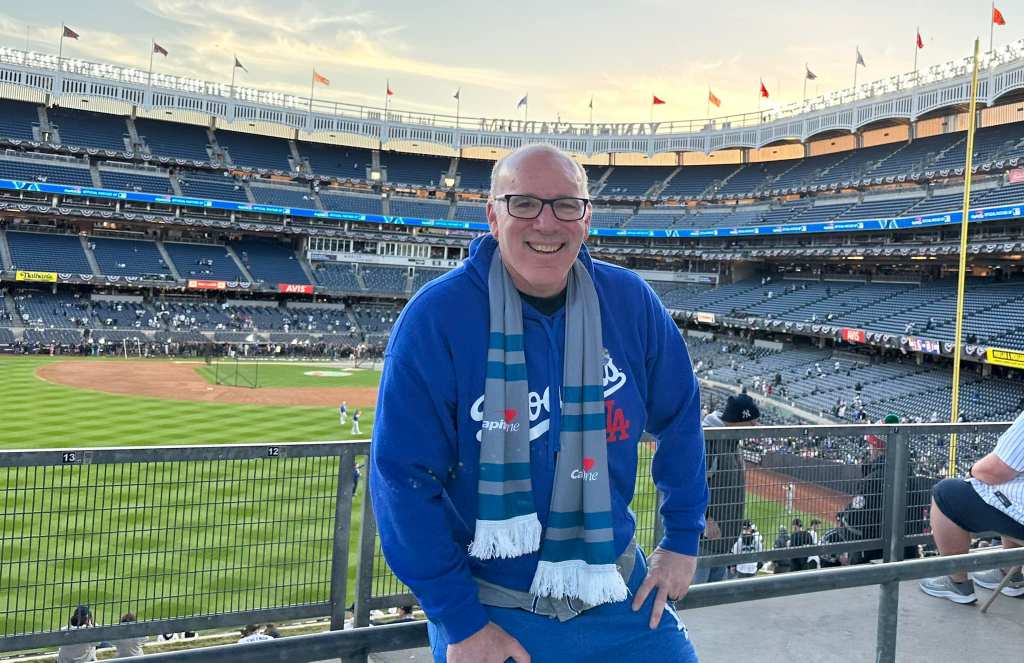
No big reveal awaits, only one fan’s reaction to visiting the most famous baseball site in the world for the very first time. The occasion was Game 3 of the 2024 World Series between (of course) the New York Yankees and my beloved Los Angeles Dodgers. Having never been to a World Series, much less one matching these two titans, some prodding from a friend convinced me this would be the year to cross off the ultimate baseball bucket list item. Plan A would naturally be to fly to Los Angeles, crash with friends, and cheer for my team surrounded by my fellow Dodger fans. However, various family and work commitments meant that Game 3 in New York was my only option. Framed differently, however, my rigid schedule was actually a blessing since it meant I’d also cross off a second bucket lister, Yankee Stadium itself.
Though I landed in Newark clad head to toe in Dodger Blue, I was not entering enemy territory. Apart from its sports teams, I am a New York super fan. I love everything else about the city, and most of all I love its people. In the same way that tourists used to visit the Los Angeles I grew up in and get excited if they saw a celebrity, I get excited just looking out the window of a cab (a New York taxicab!) or walking down the street and seeing ordinary New Yorkers and their unmatched mix of class, cool, and attitude.
My friend found us a hotel near Central Park and West 94th Street, about 4 miles from the Stadium. It wasn’t much to look at inside or out, but that was no matter. Our total stay in New York would be less than 24 hours before I’d head back to Chicago and she’d head back to L.A. Rather than take the subway right by the hotel, which would involve a transfer we might screw up, we opted to walk half a mile and catch the “B” line, which had its 161st Street exit right outside the Stadium.
As you might expect our train was filled with other fans heading to the game, though none in Dodger gear. The baseball nerd in me loved seeing various jersey numbers and guessing the player. Of course, most were gimmes like “2” and “99.” For most of the quick ride made conversation with a dad who was taking his two kids to their first World Series. As excited as I was for this game, I can’t even imagine how magical it would have been to me as a kid when even a meaningless Dodgers-Astros game in May was the kind of thing I looked forward to for a month and couldn’t stop talking about for months afterward. Lucky kids.
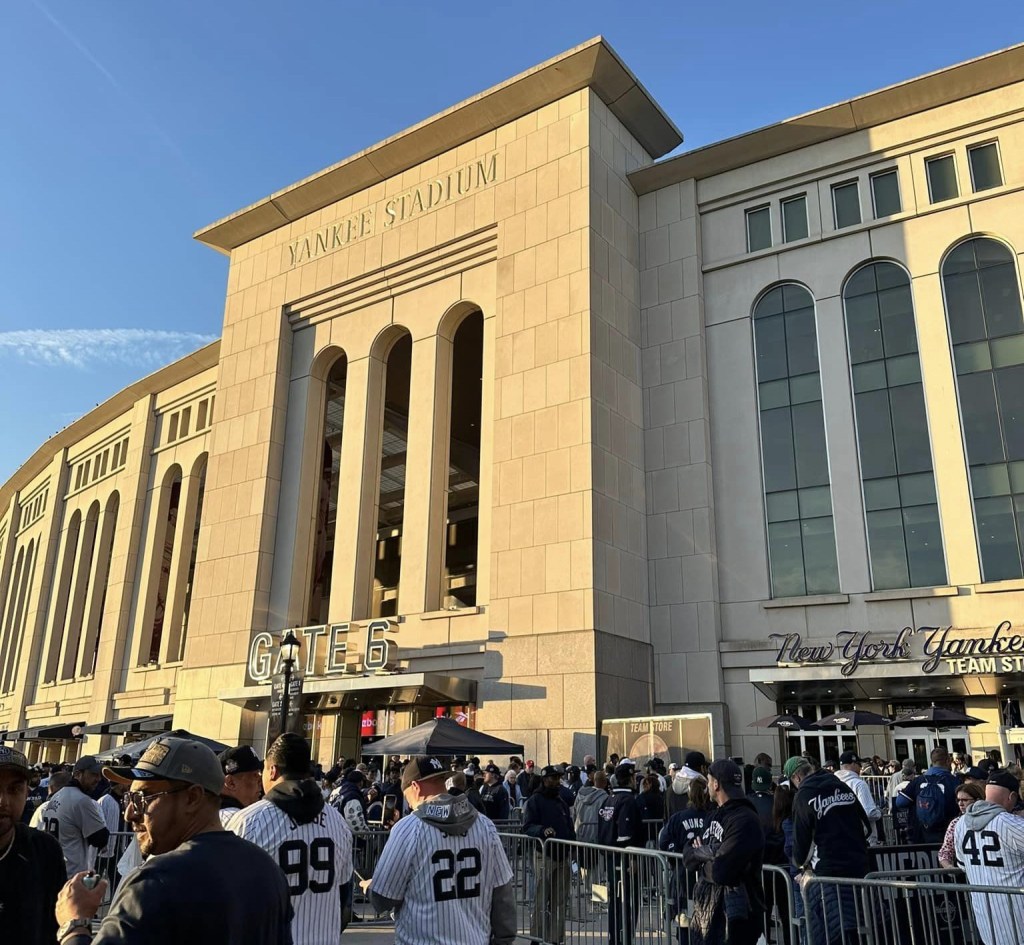
I believe our train was underground the entire time, so there was no real scenery to speak of beyond the sea of pinstriped jerseys. However, this was a feature, not a bug, as it meant we had no approaching view of the ballpark. Rather, when we exited the station and stepped into the light for the very first time, the majesty of Yankee Stadium hit us all at once. Bam! It was awesome, and I don’t really have words for its full frontal assault on the senses. Let’s just say the ballpark 100% makes its presence felt.
We entered through Gate 6 to a vista without subtlety. On banners above us there were Yankee legends lined up as far as the eye could see. Even knowing the history of the franchise, I stood there in disbelief at the number of absolute legends who have worn the pinstripes. This is literally a team where a healthy debate could be had as to whether Joe DiMaggio belongs on its Mount Rushmore. Joe DiMaggio.
As we made our way to Monument Park, we passed all the things you expect to pass at any modern ballpark: restrooms, sushi stands, gift shops, etc. However, like much in New York, the ordinary took on a magnitude not found elsewhere. This wasn’t just a men’s room. This was a MEN’S ROOM AT YANKEE STADIUM!
The fans were spectacular too. The jerseys I saw most were of the modern greats: Jeter, Judge, and Mariano, and they served as a reminder that the Yankees “big three” of this century alone could hold their own against the all-time big three of many baseball franchises. Of course, just to remind everyone that the Yankees had other great players too, there was the occasional 3, 5, or 7, not to mention deeper cuts like 15, 20, and 26. Oddly, I don’t recall seeing a single 44, which is THE jersey to wear if you’re looking to petition the baseball gods for postseason miracles.
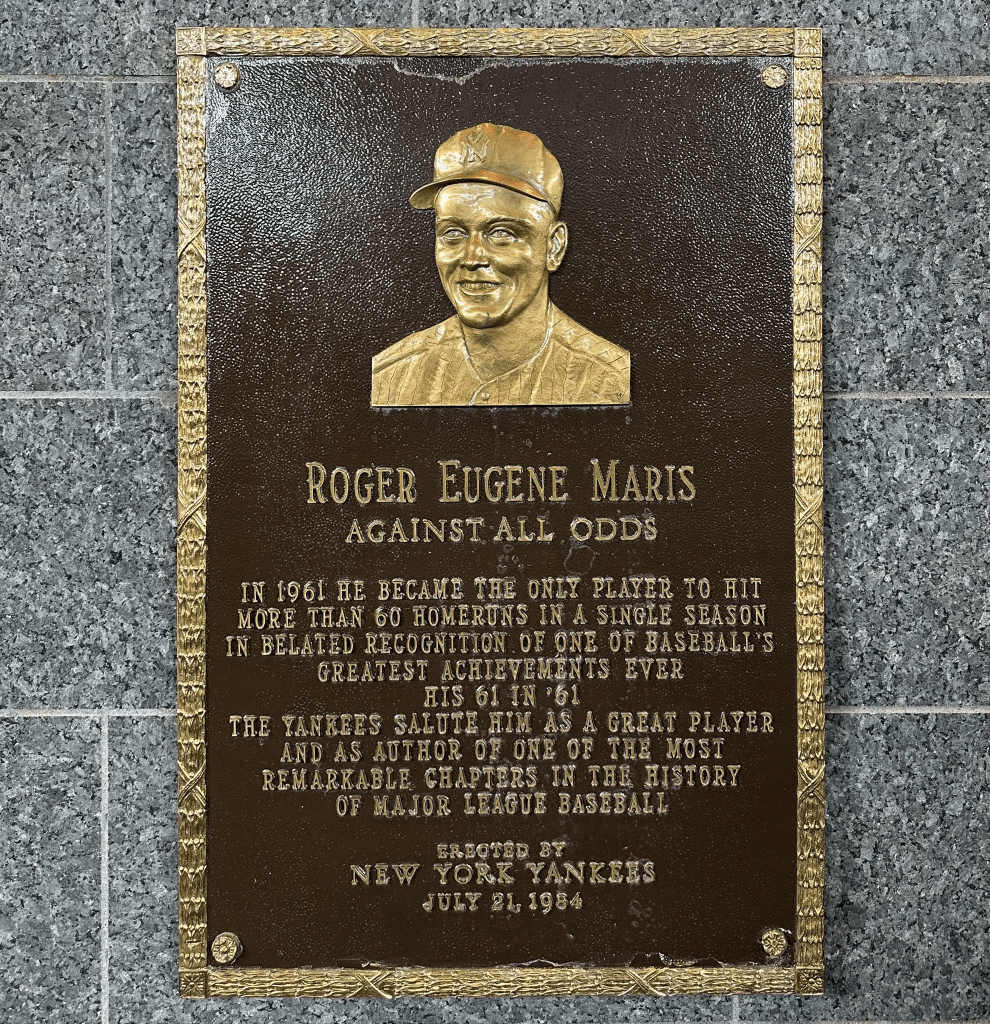
Monument Park itself was essentially where the random bombardment of Yankee greatness gave way to order. So famous is the Yankee pantheon that there was no reason to even read the plaques. Our very DNA as baseball fans is constituted from the stories and achievements of these men. Ask most fans to tell you about a player on their team who won five World Series and they quickly realize there aren’t any. Ask a Yankee fan, and they ask “Which one?” or “Only five?”
Roger Maris plaque at Monument Park
That said, Monument Park was not without welcome surprises, including plaques honoring Nelson Mandela, Stonewall, 9/11, and various Papal visits. However, an unwelcome surprise was that the largest monument by far belonged neither to Ruth nor Gehrig nor Mantle but to George Steinbrenner. Could there be any greater blasphemy in Baseball’s holiest temple? I get it that the Yankees won some titles under his tenure, but what Yankees owner hasn’t won titles? Yankee fans will have to let me know what they think of this. I suppose the Dodger equivalent would be a statue of Walter O’Malley four times the size of our Jackie Robinson and Sandy Koufax statues. I just don’t get it.
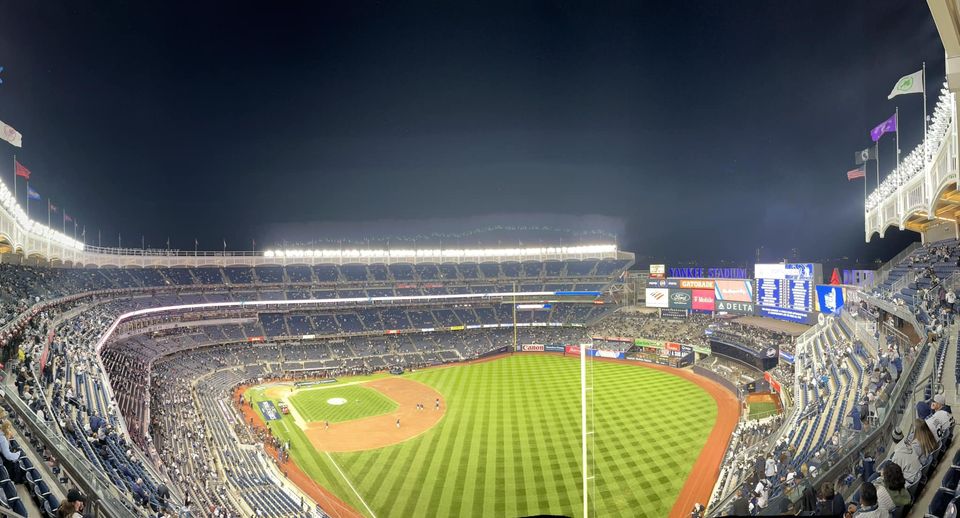
Our next stop might have been the Yankee Museum, but we opted instead to grab dinner and head to our seats, which were by no means close. We were in Section 408, which technically qualified as in the ballpark but equally felt halfway to the Moon. Had the Goodyear blimp made a flyover, we might have had to duck. We would have sooner been struck by a comet or asteroid than a foul ball.
View from our seats
Without a doubt the ballpark had seats with better views of the playing field, but I’m not sure any had better views of the Stadium itself. I sure wasn’t going to complain. I was at Yankee Stadium for the World Series. If this wasn’t living the dream, it was at least living the movie, specifically “Arthur.” For one thing, the film came out in 1981, the last time the Yankees and Dodgers met in the Fall Classic. For another, its theme song was essentially an ode to our seats.
When you get caught between the moon and New York City I know it’s crazy, but it’s true If you get caught between the moon and New York City The best that you can do The best that you can do Is fall in love
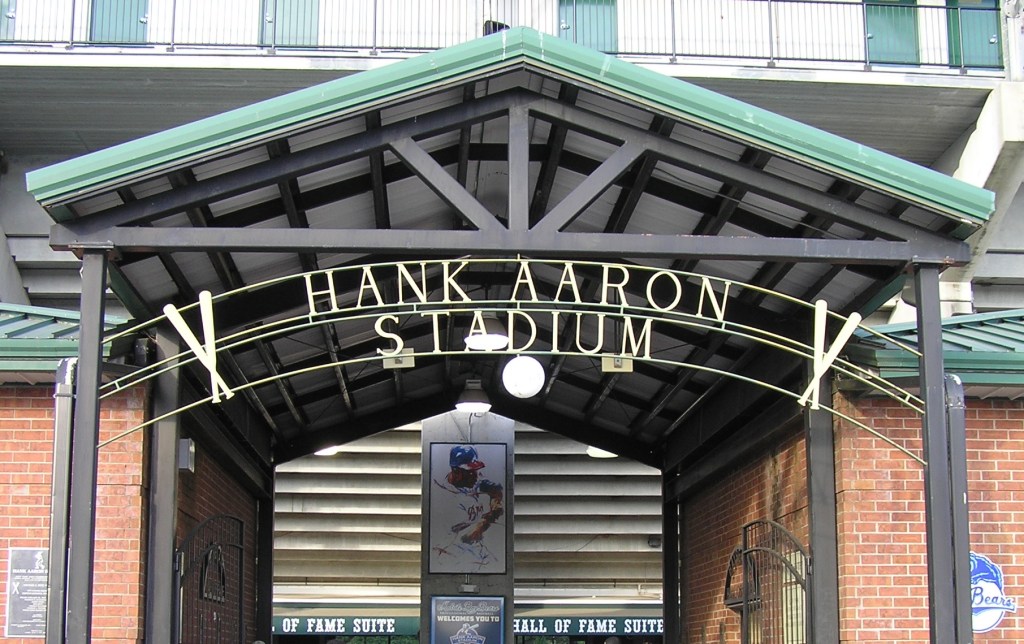
A wedding brought my family to Mobile, Alabama, for the weekend. While time did not permit many baseball adventures, we did carve out just enough of a Saturday morning to check out two landmarks of Hank Aaron’s Mobile.
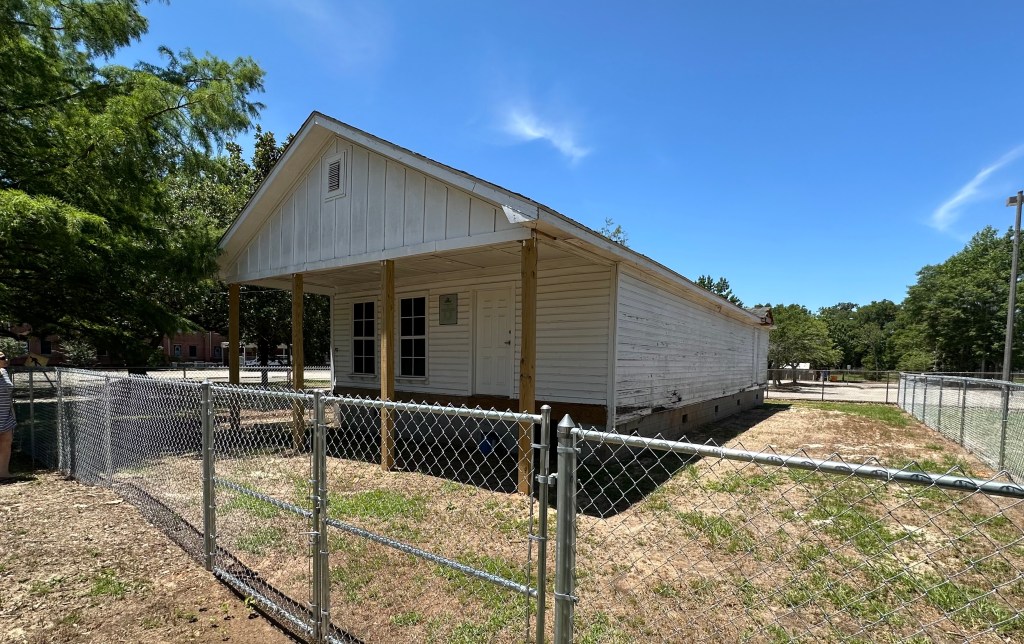
First up on our tour was the Hammer’s childhood home, which for several years doubled as a museum. Though the Baseball Map had this landmark located at Hank Aaron Stadium, Mobile’s minor league ballpark, I was glad to have queried SABR local Patrick Bone in advance.
In fact, the Aaron house no longer resides at the park but instead in the Aaron family’s old Toulminville neighborhood, outside the Mobile Police Department’s Third Precinct where it sits indefinitely closed and inaccessible to the public.
I don’t think this is the city’s permanent plan for the landmark. At the moment I think there is simply no plan. Personally I have no idea what it would cost in terms of dollars and time to give the museum a more permanent home and open it to the public. Still, I have to imagine some combination of private and public support would be out there the second the city asked.
Anyone wondering why the house left its ballpark location in the first place would quickly find the answer upon pulling up to 755 Bolling Brothers Blvd.
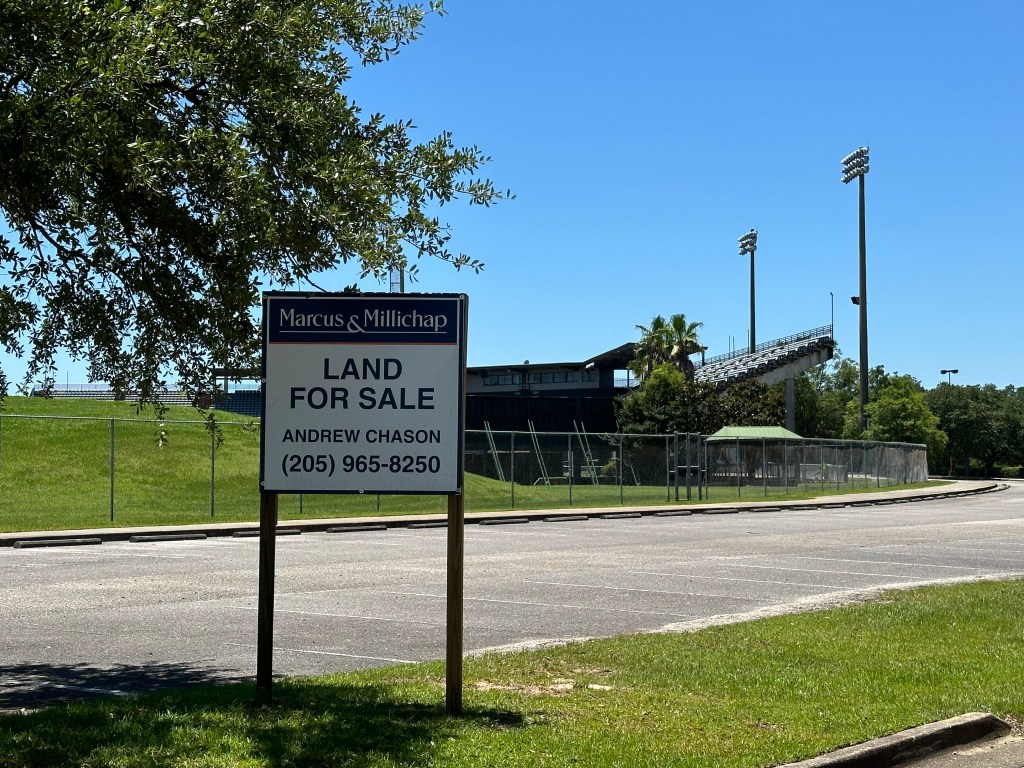
The ballpark, like its former tenants, the Bay Bears, are no more. Instead we have the Rocket City Trash Pandas up in Madison, Alabama, and a whole lotta land for sale.
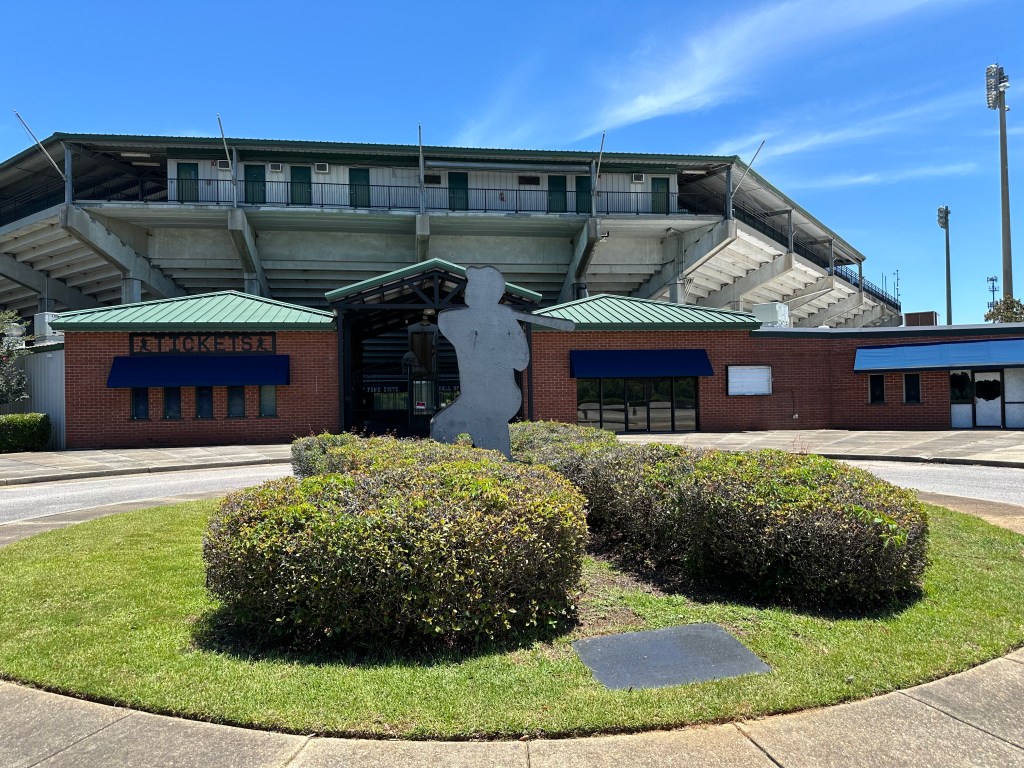
Fortunately, there are still some signs of the Hammer, for however short a time they’ll survive vandals, scavengers, or a next owner’s future plans. Though inaccessible by car, a short walk takes you to the front of the stadium where an Aaron stand-up and ground site marker are quickly found situated on a well manicured patch of grass.
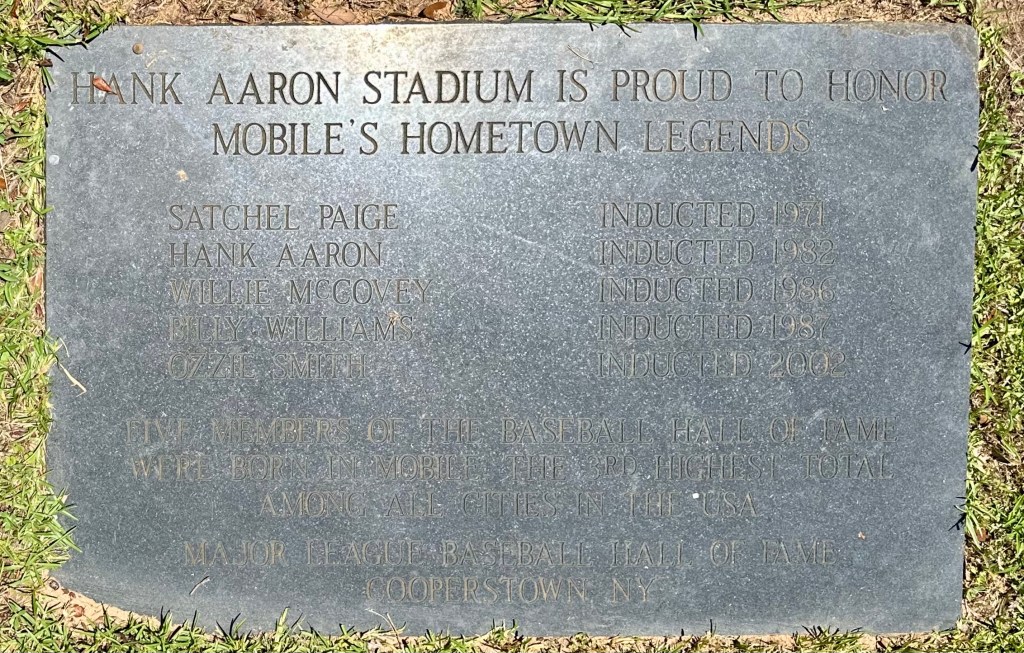
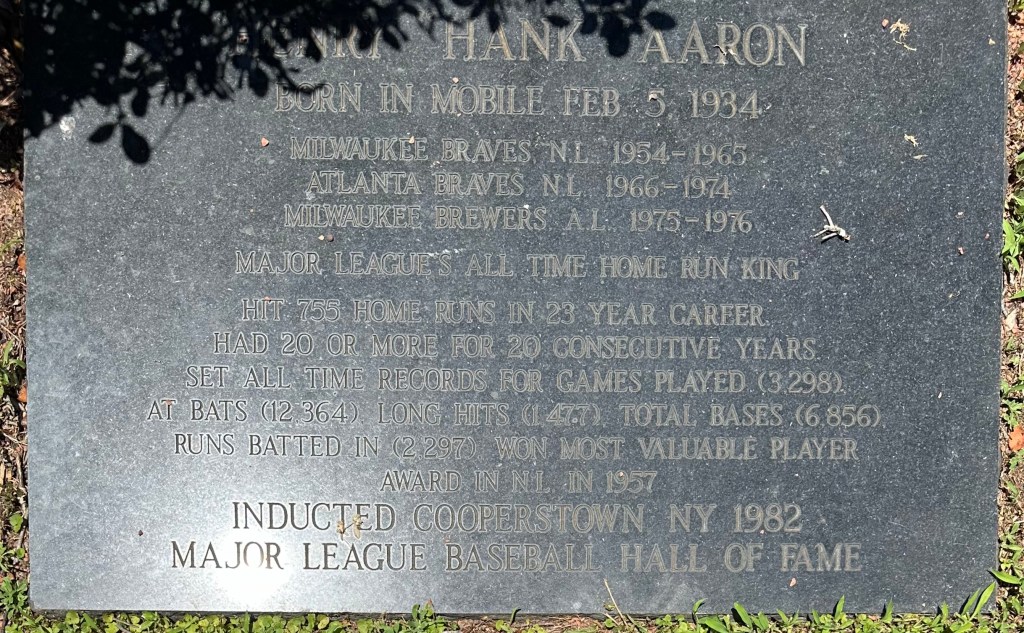
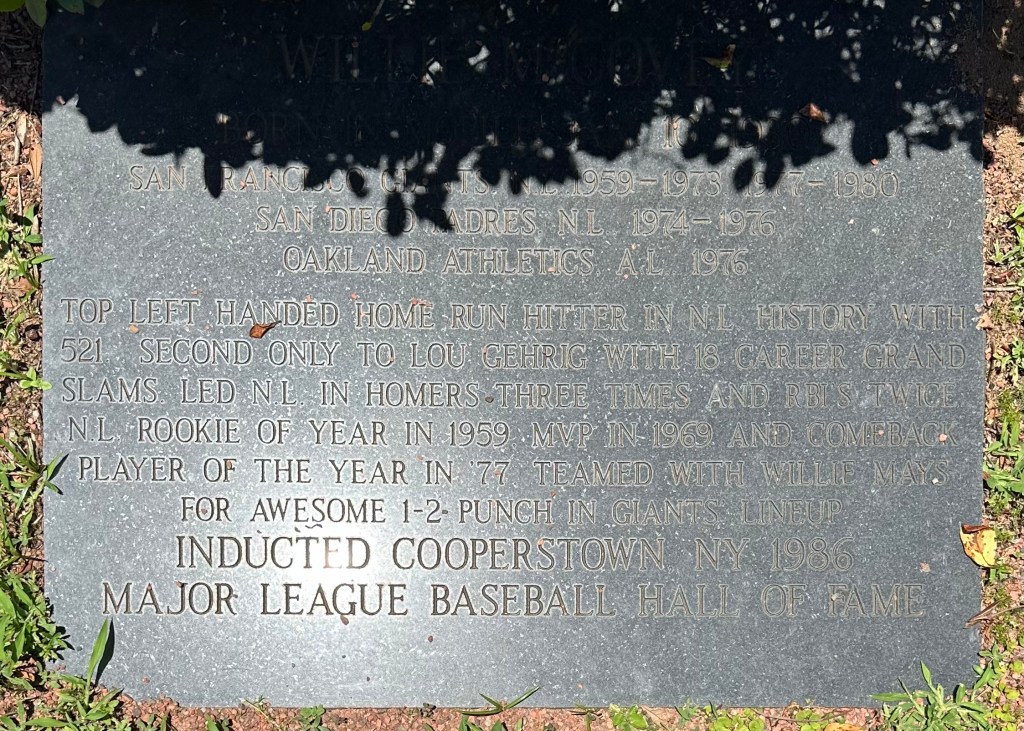
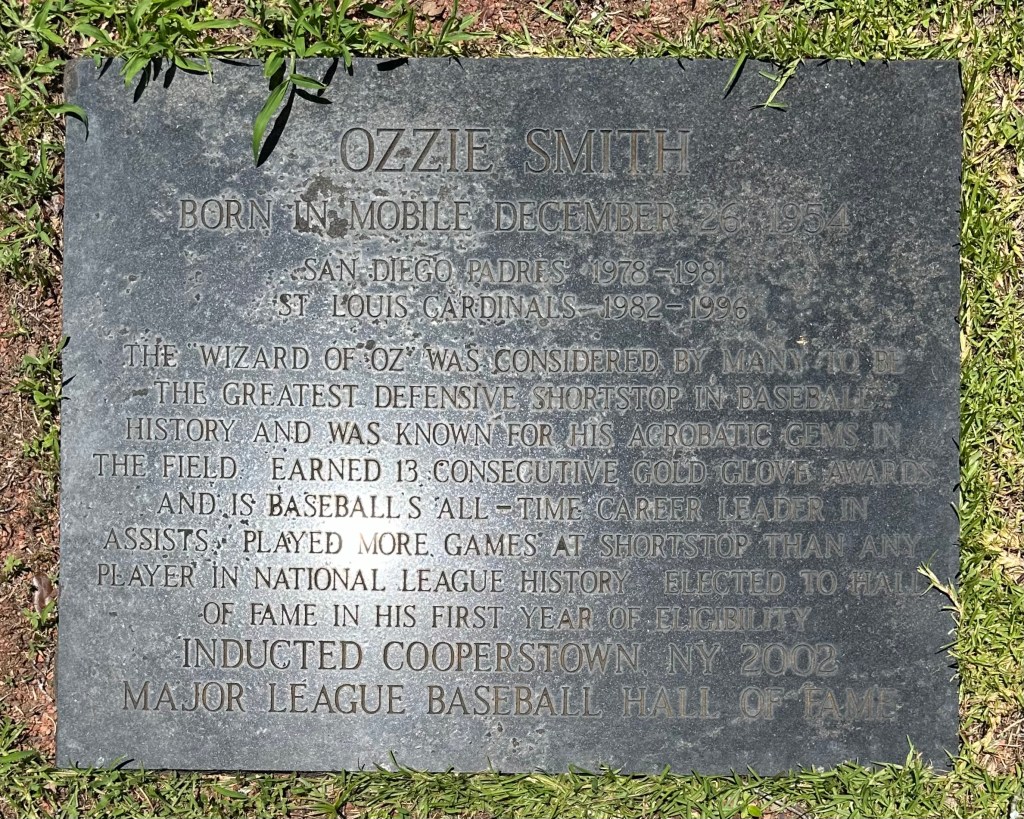
Here is a close-up of the marker itself, which honors the five Hall of Famers born in Mobile: Satchel Paige, Hank Aaron, Willie McCovey, Billy Williams, and Ozzie Smith.
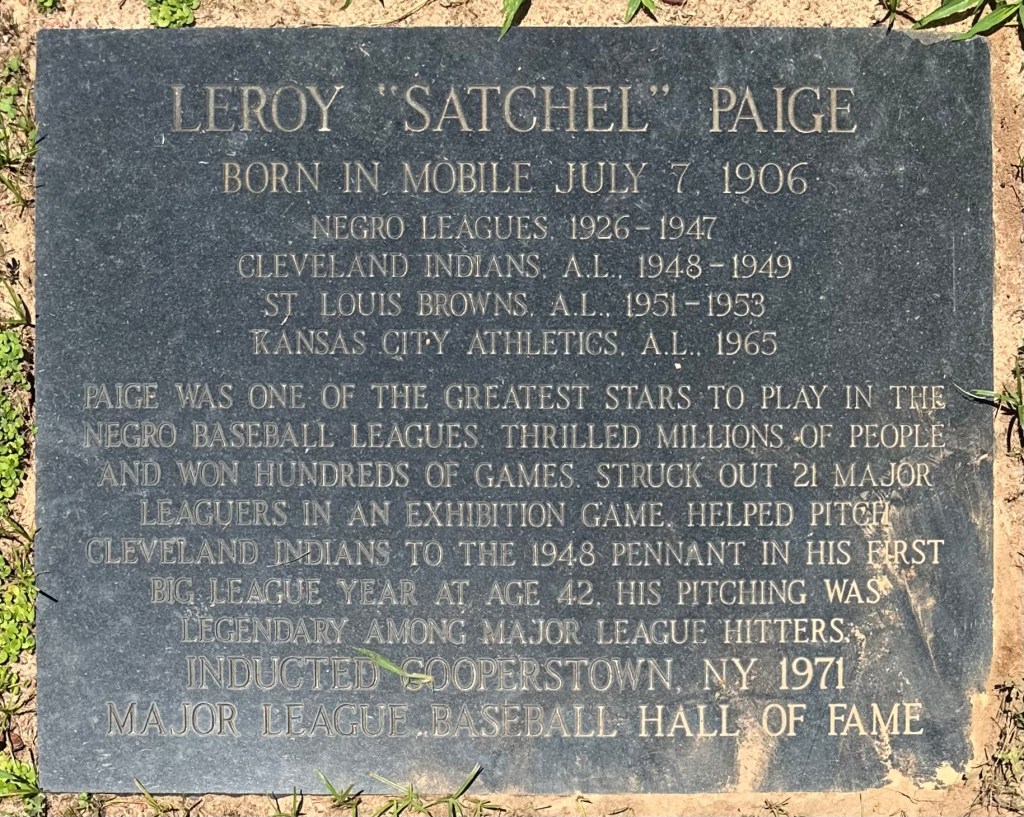
On the other side of the circular patch of grass are individual plaques for these same five Mobile legends. (Though of interest to nobody but me, I can’t help but remark here that the first plaque honors Leroy Robert Paige, and the wedding that brought us here was that of Robert and Paige.)
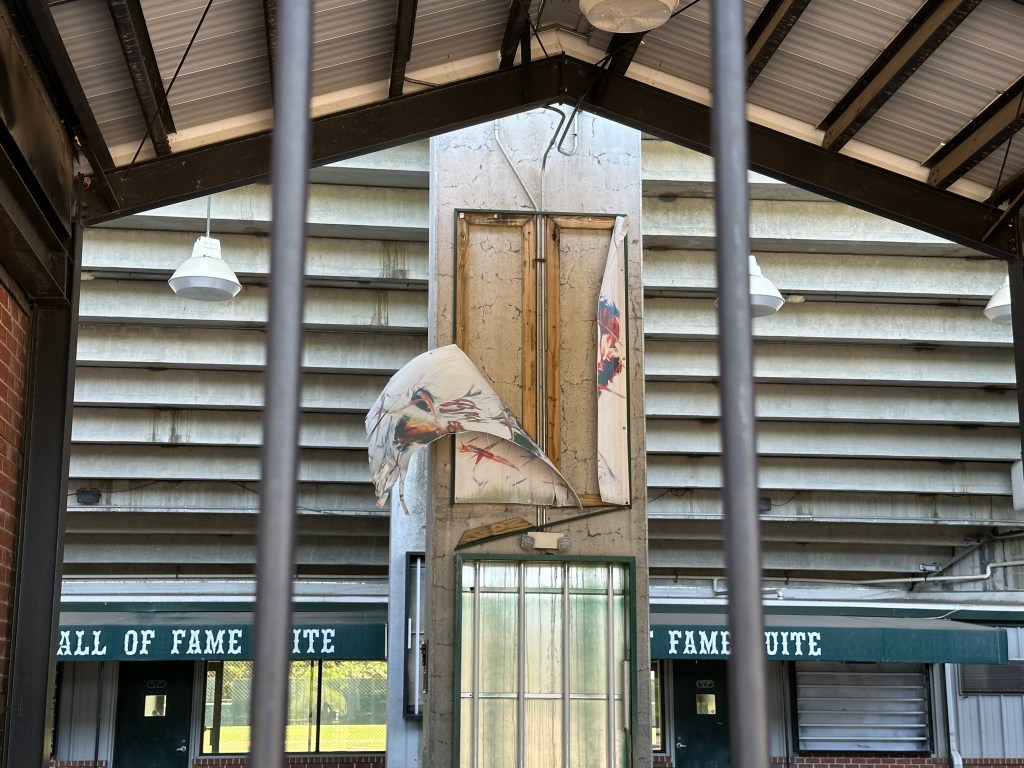
The landscaping of this patch of grass along with the excellent condition of the plaques definitely belies what becomes apparent upon approaching the stadium entrance. So much for the once grand Hank Aaron poster that greeted visitors!
And what of the “Hank Aaron Stadium” marquee once perched above the entrance? My wife’s keen eyes spotted it unceremoniously ditched behind a gazebo.
Here are the poster and marquee in better days.
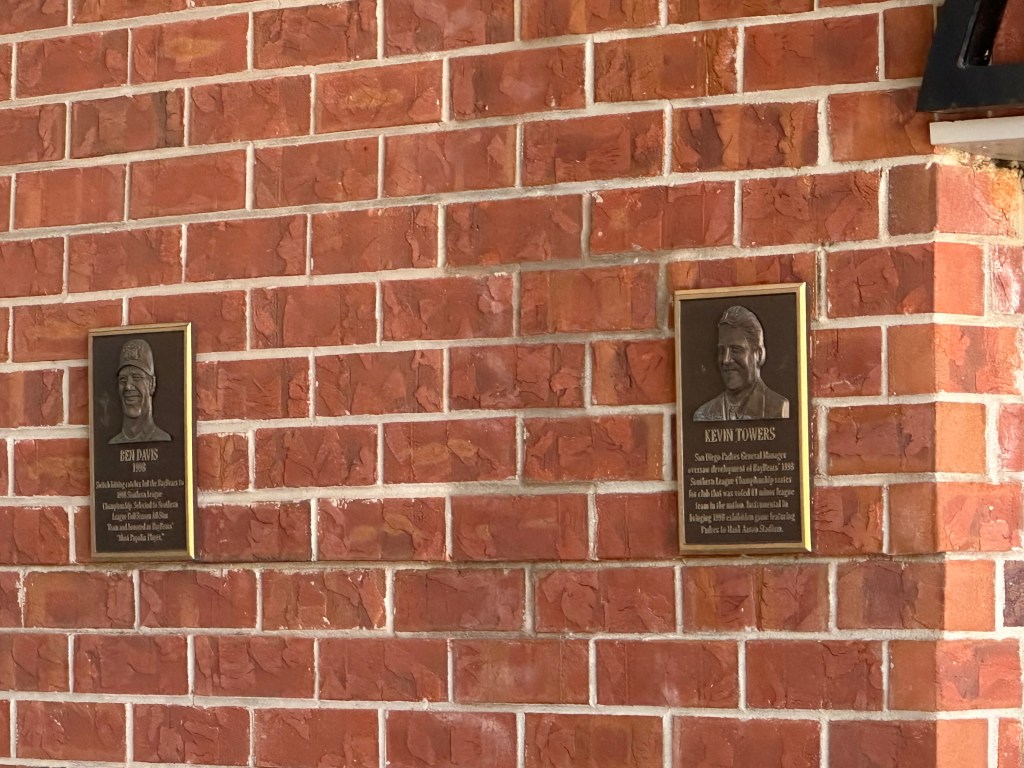
Landmark czars Racanelli and Kamka will have to let us know if the ballpark’s Hall of Fame keeps its status given that one can no longer enter but can peep some plaques through the fence. Here are the plaques for Ben Davis and Kevin Towers, for example. About eight such plaques are visible in all.
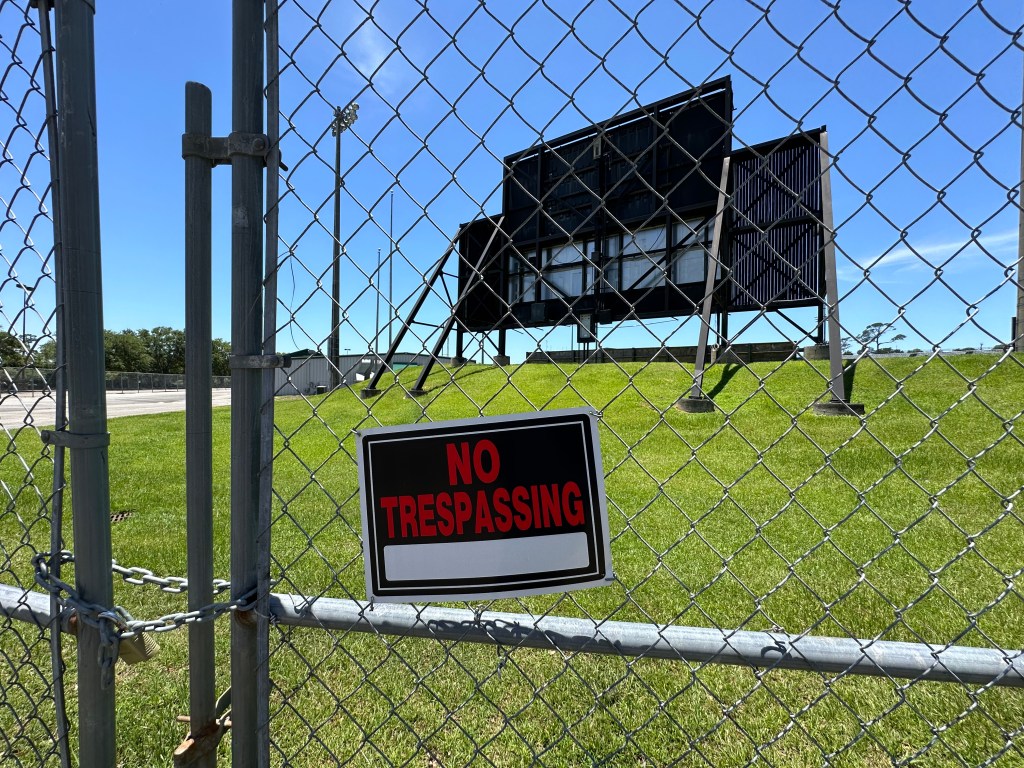
Continuing past the entrance, you are able to see the back of the stadium’s scoreboard, which I’ll regard generously as the last of the site’s highlights, before returning to the main road.
More or less going 0 for 2 on my pilgrimage to the birthplace of a baseball demigod, I couldn’t help but grapple with a single thought.
How do you put the Hammer’s name on something and let it die?
That evening we took our seats in the pew as Robert and Paige prepared to wed. Father Jones, in fairness just doing his job, reminded us we were all sinners. As Henry Aaron’s Mobile landmarks stood somewhere between dormant and dying, the truth of these words, for the very first time, hit me and left a mark.
2022 year marked the 30th anniversary of the highest grossing baseball film of all time, A League of Their Own. Countless screenings were held and other events were scheduled to celebrate this landmark film in the weeks before the release of the new Amazon television series of the same name. For me, a trip to Indiana that summer was both a figurative and literal homecoming to embrace the movie that has had a significant impact on my life for the past three decades.
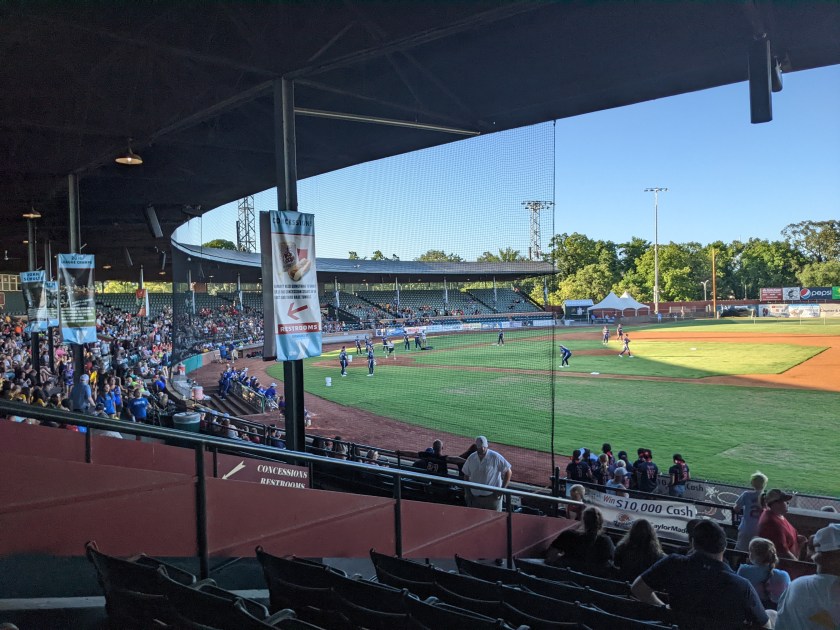
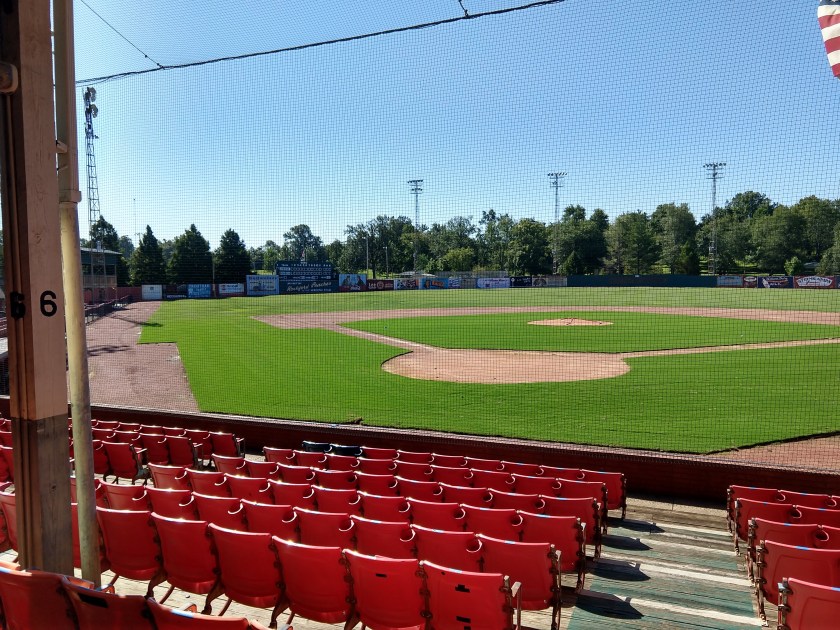
I have been to Evansville’s Bosse Field and Huntingburg’s League Stadium many times. Both are about a 40-minute drive in different directions from my hometown in western Kentucky. I was 12 years old when filming began in the summer of 1991 and could still recognize what a big deal it was to have a Hollywood production come to southern Indiana. My brother and dad actually drove over to be extras late in the filming schedule for what would end up being the World Series scenes. The end result had a huge impact on me. Already fascinated (and still am) with World War II, I started reading anything I could find on baseball during the war, the home front, and this All-American Girls Professional Baseball League that I had never heard of (before seeing the movie five times in the theater). Decades later, I’m working with the International Women’s Baseball Center, creating Women in Baseball Week, and presenting at conferences on my research into women in the game. It’s safe to say I’m hooked, so imagine my excitement when heading home for a family visit, I saw both stadiums had games scheduled for the week I would be in town. What better way to relive all that film has given me than to pay them back-to-back visits?
Leading off was a trip to Bosse Field in Evansville. Located at 23 Don Mattingly Way, Bosse Field (pronounced “bossy” for those who might not know) opened in 1915 and is believed to be the third oldest professional ballpark still in use behind only Fenway Park and Wrigley Field. Though situated on the edge of Garvin Park, the stadium is nestled in a neighborhood of homes, factories, and warehouses, many dating back to the World War II era when Evansville was a leading armaments manufacturer for the war effort.
Location scouts for the film would have been hard pressed to find a more suitable ballpark for the production’s needs. The stadium is encompassed by a red brick wall, presenting a classic look, with lighting situated inside this outer wall but beyond the outfield fence and on top of the grandstand roof. Approaching the stadium, visitors are met by an impressive three-story tall main gate of brick, stone, and windows. For movie fans, this is where Jimmy meets Dottie’s husband post-World Series and they all exchange pleasantries before boarding the bus back to the hotel.
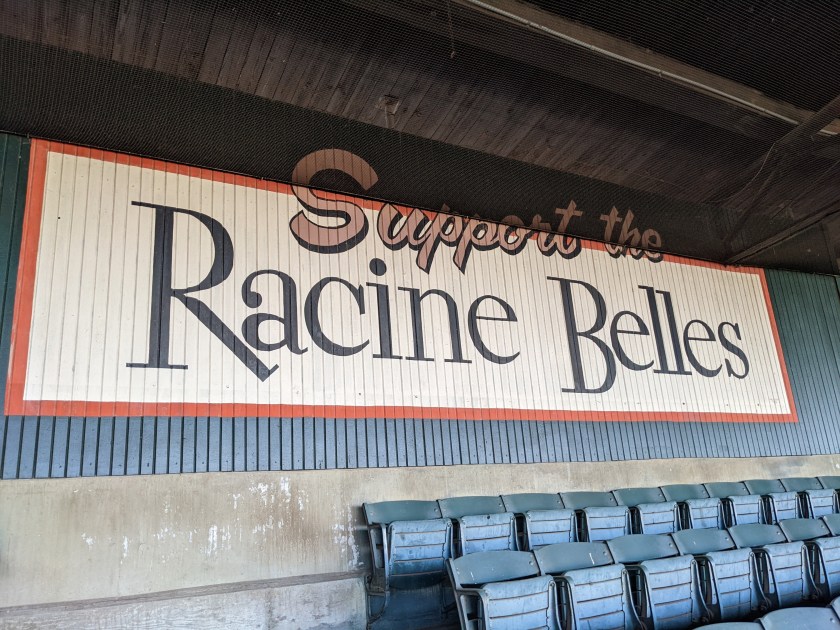
The area wrapping around the outside of the stadium in either direction of the main gate constitutes the concourse where most concessions and merchandise are sold. At both ends are additional entrances to the stadium and stepping through these North and South Gates, visitors will find more fun holdovers from the film. Just above these gates are old fashioned advertising for shoes and coffee used in filming and further up from each gate toward the back of the grandstand are two large, identical signs reading Support the Racine Belles. They look great and I am glad to see the stadium still embraces their role in its history 30 years later. The stadium seats just over 5,100 in green metal and wooden chair backs, situated in a smooth half circle and mostly under roof coverage. As always, I find myself moving to a new location every inning just to get a different look at the field.
Bosse Field has been home to the Frontier League Evansville Otters since 1995 and I’m lucky to still have trading cards, programs, and ticket stubs from that first season. On my visit, however, the Otters were on the road and the Women’s Professional Fastpitch tour was in town. A couple thousand people turned out to watch the USSSA Pride take on the Smash It Sports Vipers and the atmosphere was absolutely electric. Having been a softball fan for the past 30 years as well, I was experiencing a most unique opportunity to watch Shelby Pendley play live (for me, the first time in six years) and see Olympic gold medalist Kelly Krestchman coaching. Reigning NCAA home run queen Jocelyn Alo, on the heels of graduating from another national championship season at the University of Oklahoma, went yard on the first pitch of her first at bat. The crowd went wild and so did I.
On top of A League of Their Own filming, I know the AAGPBL played an exhibition game or two here in the late 1940s. How cool to see women pro ball players in Bosse where all of that had happened before. A small gift shop caught my eye on the way out where I bought a large book on the history of Bosse Field. Seemingly half the photos were contributed by Justin Sheller, who played Stilwell Angel in the film, which is fine by me.
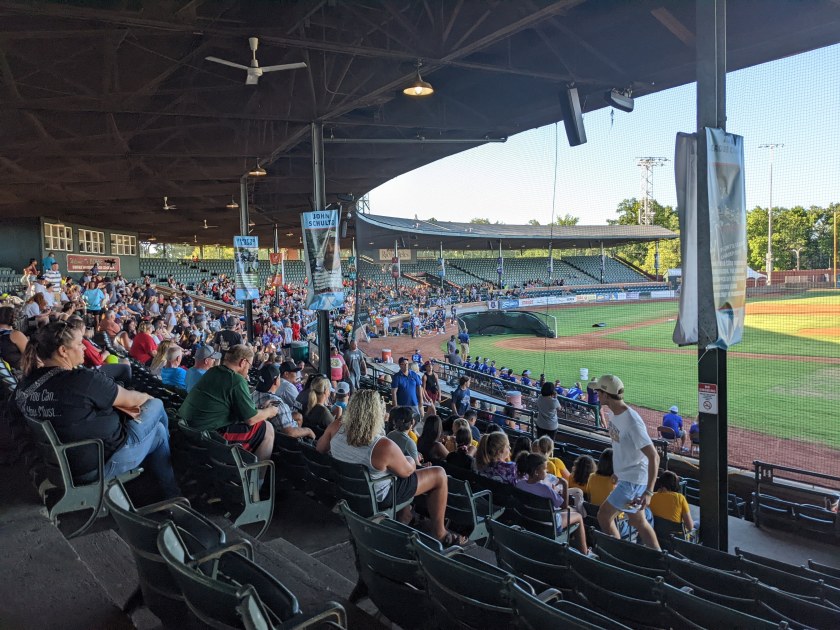
The following day’s plans were extra special in that I brought my mom along to League Stadium for that evening’s game and my brother and niece would be driving down from Indianapolis to join us. My first trip to League Stadium would have been 1993 when, also with my mom, we stopped to see where the movie was filmed on our way to Bloomington, Indiana. We had a brief tour with a local volunteer, took a lot of pictures, and even bought a folding chair used in the film, which still sits in my office. New chair backs were obtained from the old Atlanta-Fulton County Stadium and installed in the late 1990s in time for the Dubois County Dragons of the Frontier League to take up residence. On this night, we would be watching the current tenants, the Dubois County Bombers of the summer collegiate Ohio Valley League play my hometown Owensboro RiverDawgs.
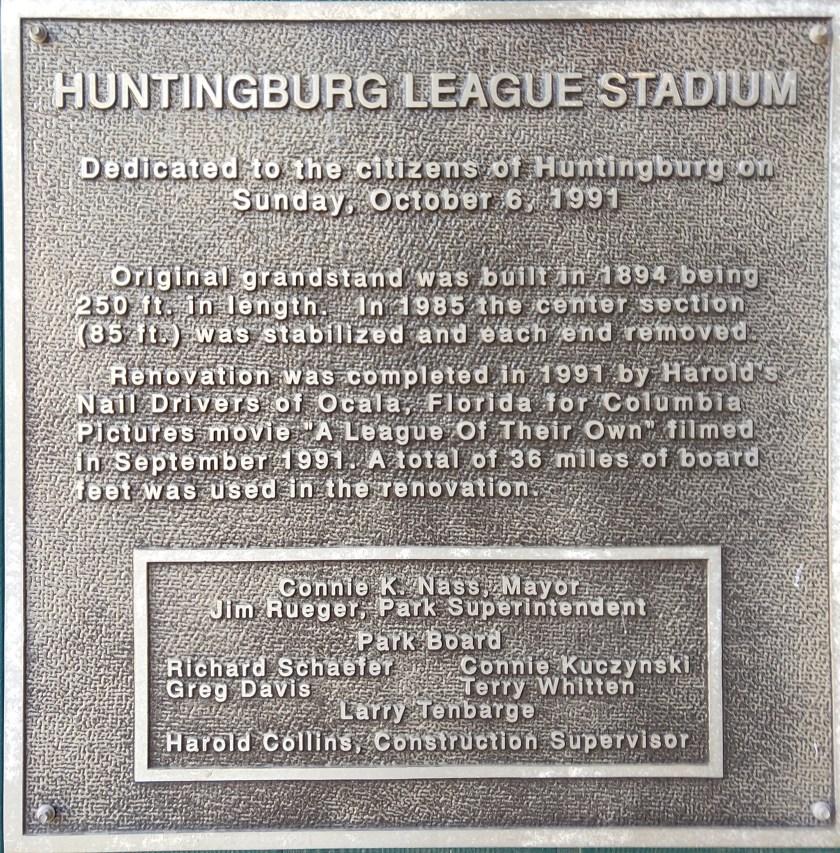
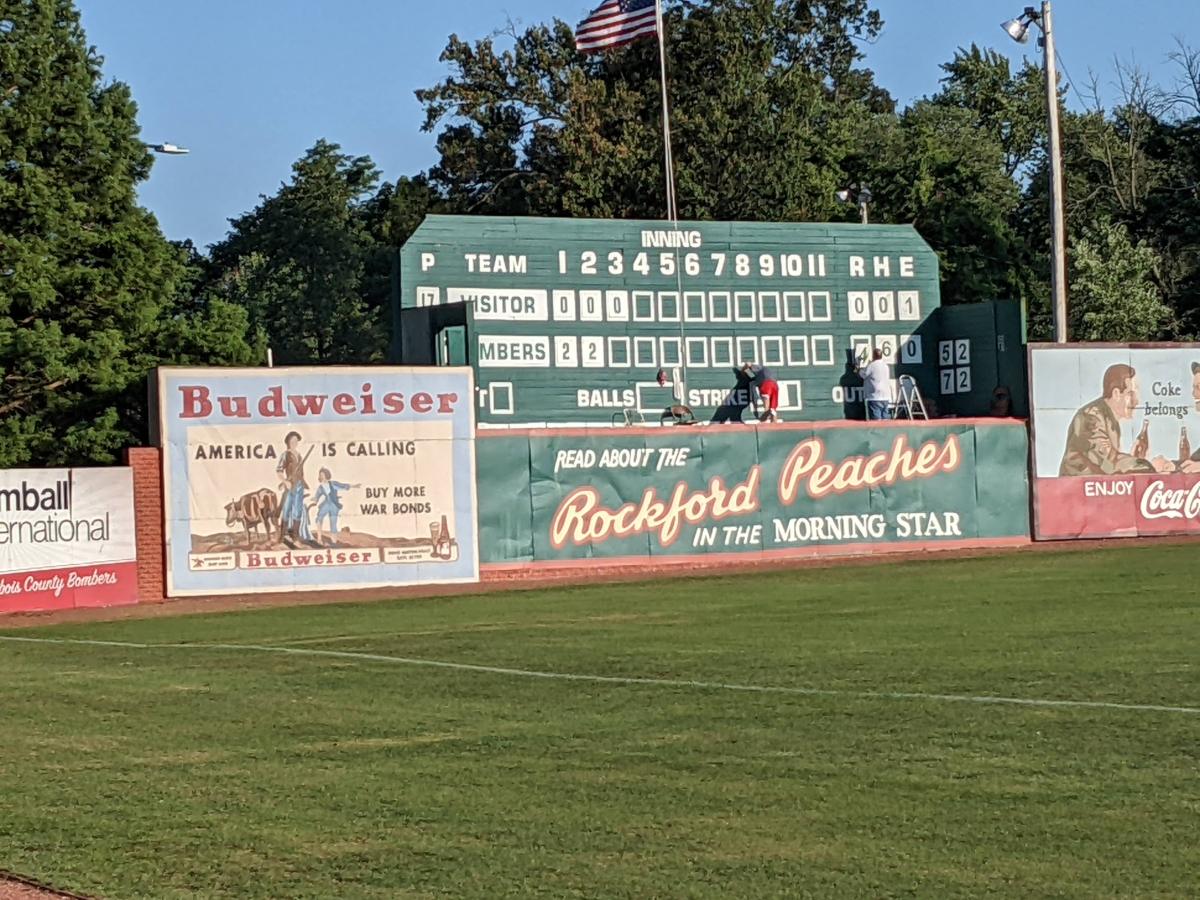
Similar to Bosse Field, League Stadium is situated in a city park, but surrounded by tennis and basketball courts, a playground, pool, and youth baseball and softball fields. A replica Rockford Peaches bus greets visitors at the park’s entrance. The ballpark does not have quite as grandiose of a main gate as Bosse, although this is understandable. The original rectangular grandstand dates back to the 1890s and it wasn’t until the location was chosen in 1991 for A League of Their Own that it was renovated to its current, more traditional ballpark shape. Movie fans will note that no scenes in the film feature the outside of this park.
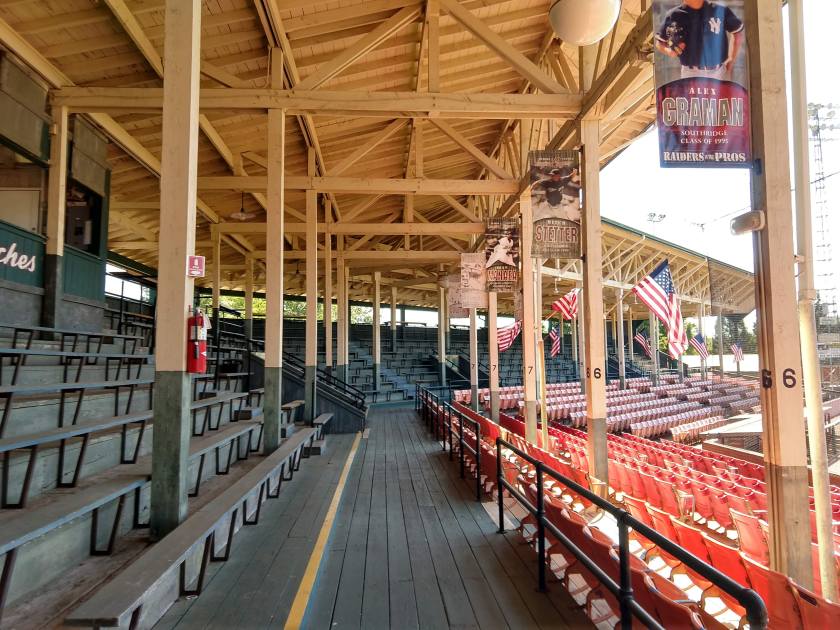
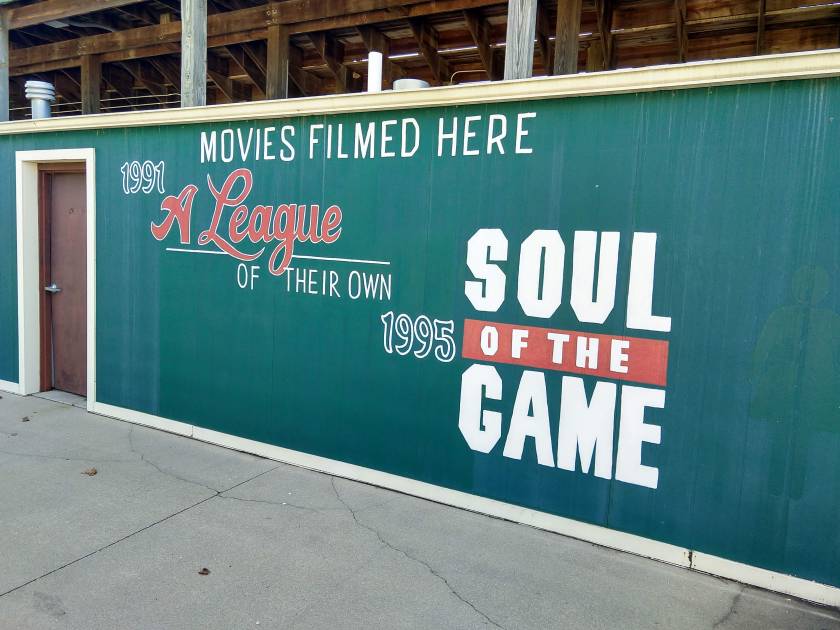
The inside, however, is a nostalgic marvel. The aforementioned seats from Atlanta fill the lower area at field level, but the upper level near the press box remains the same bench seating from the film. At nearly 2,800 seats, League Stadium’s capacity is just over half that of Bosse Field. There is still a sign for Harvey Bars on the outfield fence and both the press box and left field scoreboard feature the same “Rockford Peaches” in script. A newer electronic scoreboard used for games sits just behind the right field fence. Like Bosse, food and merchandise are located outside of the stands. There is a small exhibit area with plaques, props and costumes from A League of Their Own and HBO’s Soul of the Game, also partially filmed here and released in 1996. Our tickets for the game had us about eight rows behind home plate, but from the looks of the stadium, there is not a bad seat in the house.
Many of the “amenities” found in current minor league stadiums are absent at both Bosse Field and League Stadium. You won’t find chain restaurant outlets, bar seating along the outfield wall, or a splash park for the kids. What League Stadium expertly delivers is a trip back through time, which I am sure appeals to a lot of us. The team’s nickname is derived from a World War II bomber and the players wear 1940s style uniforms. Female staff follow suit in replica Peaches uniforms and hand write seat assignments on ticket stubs. Flags and banners hang from the columns supporting the roof and most of the music played between innings is either Big Band or from the A League of Their Own soundtrack. Fans of both baseball and the film almost need multiple visits to take it all in and fully appreciate the total experience curated by both stadiums. First, there’s exploring the history and architecture of the spaces and witnessing the game in such a classic environment.
Next, you have the games themselves. Evenly matched summer collegiate baseball or professional softball will do it for me every time. Finally, there’s the movie aspect. Literally everywhere you look can be a reference to a favorite part of the film whether it’s the final collision at home in the World Series, Stilwell Angel getting nailed in the face with a glove, or the legendary “There’s no crying in baseball” scene.
My family’s visit to League Stadium was fun, although a bit sad. My dad passed away in October of 2019, leaving this mini-family reunion feeling incomplete. On the way home, I realized something that now has cemented A League of Their Own as a film, baseball or otherwise, that will always hit close to home. My absolute favorite shot of the entire film is during Kit’s at bat in the World Series. After driving a high one into right field, we see her rounding first heading straight toward the camera for a turn at second. Her skirt is flying, her cleats are kicking up dirt in the base path, and there is a wall of excited people in the stands behind her, punctuated by the giant Support the Racine Belles sign. It is a beautiful, classic shot. And then I made a new connection – my dad is there. Maybe not exactly in the shot as it’s difficult to pick out anyone specifically and I only know he was in the back of the first base / right field end of the stands. He had watched the whole scene being filmed and was a part of it, and now he’s forever a part of my favorite shot in a favorite movie about a sport and history that I love. It’s a bittersweet, but welcomed feeling every time I have watched the movie since.
A few months ago, I had the unique opportunity to watch the USA Baseball Women’s National Team play back-to-back games at former AAGPBL ballparks in Rockford and Kenosha, both of which are also on the SABR Landmarks Baseball Map. Watching these games, alongside AAGPBL players no less, was a unique experience that I never anticipated. I never thought I would write blogs for SABR or have dinner with actors, writers, and directors connected to A League of Their Own, both the film and the series. There is a beauty to never having specific expectations toward an interest or hobby and just letting it flow. I never anticipated A League of Their Own affecting me so profoundly, but thanks a visit home in 2022, I realize I’ve been living my best baseball life for 30 years.
If you’re reading about SABR Landmarks research projects, you undoubtedly love seeing historical roadside markers. The more specific and local, the better. George Washington slept here. Teddy Roosevelt lived there. First Roman Catholic Church in the area. You get it. We see them when we’re least expecting and are probably driving too fast half the time to read every word, but we immediately appreciate that someone took the time to research and get that marker placed so that patrons of future generations know why that exact spot is special.
Before we get to baseball history on Long Island, it’s worth mentioning my origin story with historical markers. Without the work we did through the Press Club of Long Island (PCLI), no sports history markers would exist. PCLI is the local pro chapter of the Society of Professional Journalists (SPJ), the oldest organization representing journalists in the United States. As the longest-serving president of PCLI from 2014-2018, I constantly sought interesting ways to put the organization on the map and have it stand out from hundreds of other chapters nationwide. Our projects had to relate to our core values of education, advocacy, and ethics.
I noticed that SPJ had an application to apply for a chance to get a historical marker related to local journalism history for your region. I applied, and we didn’t get selected. In speaking with a longtime board member, local historian, and journalist, Bill Bleyer, I suggested we put up our own historical marker. He had experience doing it, the board agreed, and we sought our first location, which happened to be in Hempstead, NY, where Newsday was first printed in 1940. What better way to start than the spot where the island’s most recognizable news source came to life? We erected four markers during my tenure as PCLI president.
The journalism marker project began in 2015. I became President of the Suffolk County Sports Hall of Fame in 2017. The Hall originated in 1990 and has honored people of significance related to sports, from coaches and pro players to journalists and athletic administrators. From Craig Biggio, Carl Yastrzemski, and Henry Chadwick to Frank Catalanotto and Sal Agostinelli, there is no shortage of baseball people from Suffolk County who have reached the pinnacle of the sport.
After rebranding the Hall, creating a digital archive of all Hall artifacts and documents, reimagining the induction ceremony and process, and evolving several satellite exhibits in the county, I wanted to make a splash with another purpose by enhancing our mission. Since then, the Suffolk Sports Hall of Fame has developed a marker project honoring places of historical significance.
So much history has happened on our 118-mile-long stretch of land. If it were a state, Long Island would be the 13th most populated in the country. It’s common to see markers designating where George Washington visited during the Revolutionary War, especially since he ran a spy ring in the area, and the Battle of Long Island was the first conflict following the signing of the Declaration of Independence on July 4, 1776. But did you know Satchel Paige pitched here in 1950? Imagine seeing Babe Ruth and Lou Gehrig in a barnstorming game on the south shore in 1930, just three years after the 1927 New York Yankees built a reputation as one of the greatest teams in history. Ever think about where Yasztremski played his high school ball?
There is no shortage of sports history, so I set out to spread the love and educate with one marker at a time.
Independent Baseball on Long Island
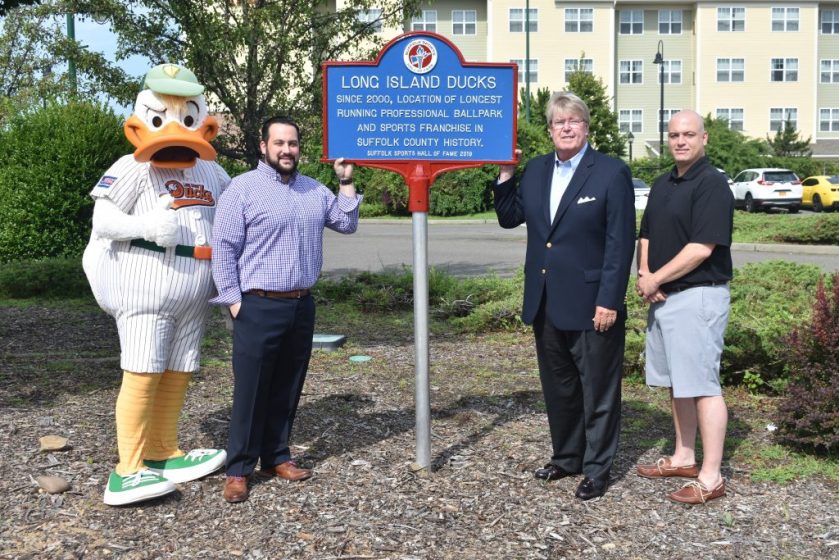
The Long Island Ducks, who play in the Atlantic League, have been synonymous with the area for over 20 years. Families and kids have made it a right of passage to attend Ducks games in Central Islip, NY, since 2000. In 2019, during the 20th season of Ducks baseball, we put up our first marker to commemorate the longest-running pro sports organization in the county. It felt right as the Ducks were celebrating their anniversary to mark it with this placard next to Fairfield Properties Ballpark.
“When Frank Boulton began this journey, many did not think a minor league ballpark in Suffolk County would work,” said Ducks President/GM Michael Pfaff. “Then, with the initial great success of the Ducks, others predicted it would not last. This marker celebrates the success and longevity of Long Island’s hometown team, a tradition we look forward to continuing.”
The Ducks baseball team got its name from the Long Island Ducks hockey club that played at Long Island Arena from 1959 through 1973. The Ducks have had some good talent, including big leaguers Rich Hill, Carl Everett, Edgardo Alfonzo, Danny Graves, Lew Ford, and Daniel Murphy.
Celebrating Yaz’s High School Stomping Grounds
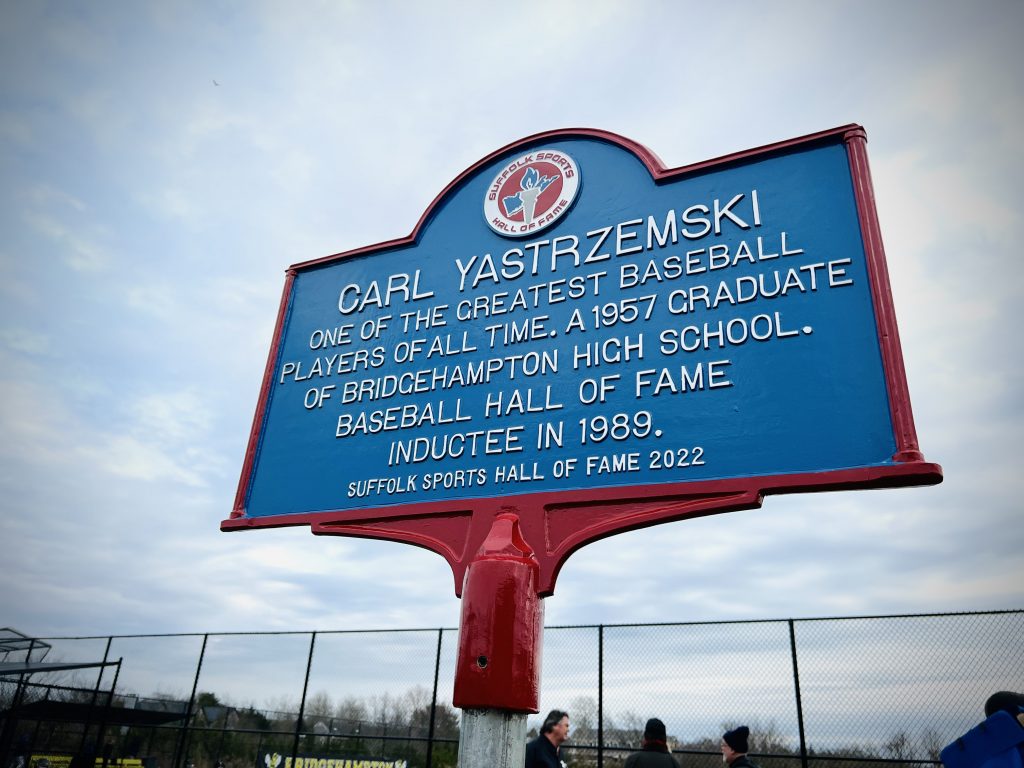
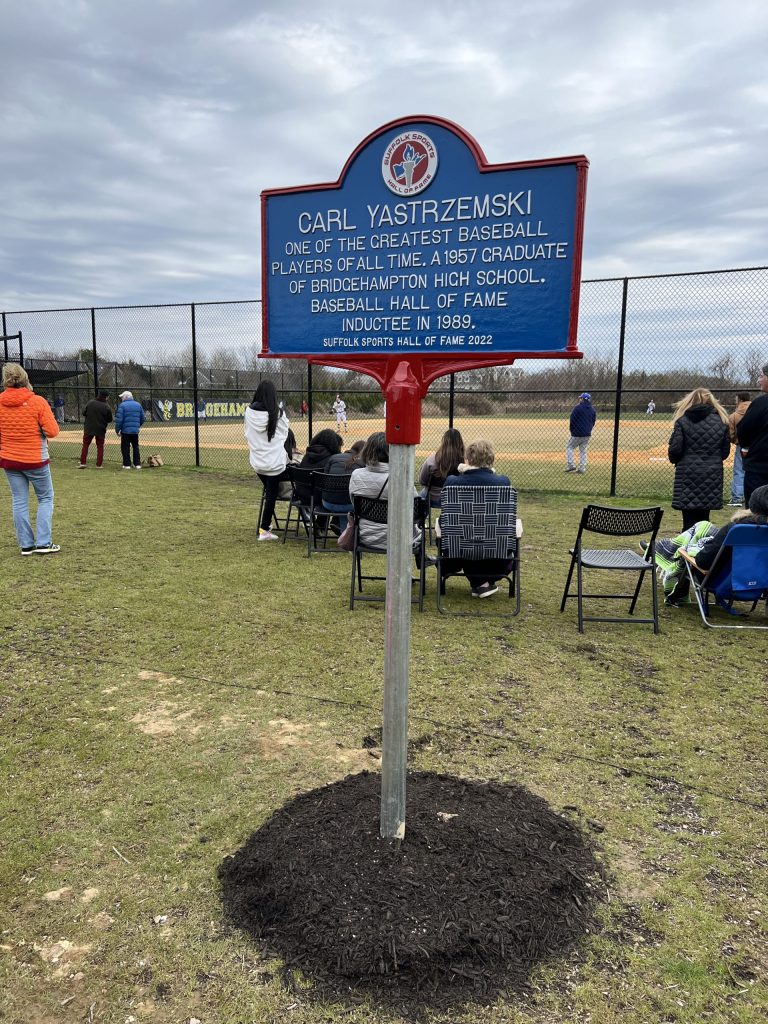
We were delayed in 2020 and 2021 due to the pandemic but picked up with our second marker at Bridgehampton High School on Tuesday, April 5, 2022. The historical marker to honor where Baseball Hall of Famer Carl Yastrzemski played prep ball was timed with the resurrection of the baseball program in Bridgehampton, which returned after a 43-year hiatus.
Yastrzemski was inducted into the Suffolk Sports Hall of Fame in 1990, grew up in Bridgehampton, graduated in 1957, and hit .512 during high school. Yaz, unfortunately, did not come down from Massachusetts for the event.
Yaz’s longtime friend Dan Shedrick of Sag Harbor read a statement during the ceremony written by the local icon: “I truly regret that I am unable to join you today for this special honor. My thanks to my coaches and teammates, and members of the Bridgehampton community for their support. Most importantly, my congrats to the ‘Bridges’ new varsity team — learn from your coaches, play hard and have fun.”
Satchel Paige Barnstorming Moment Immortalized
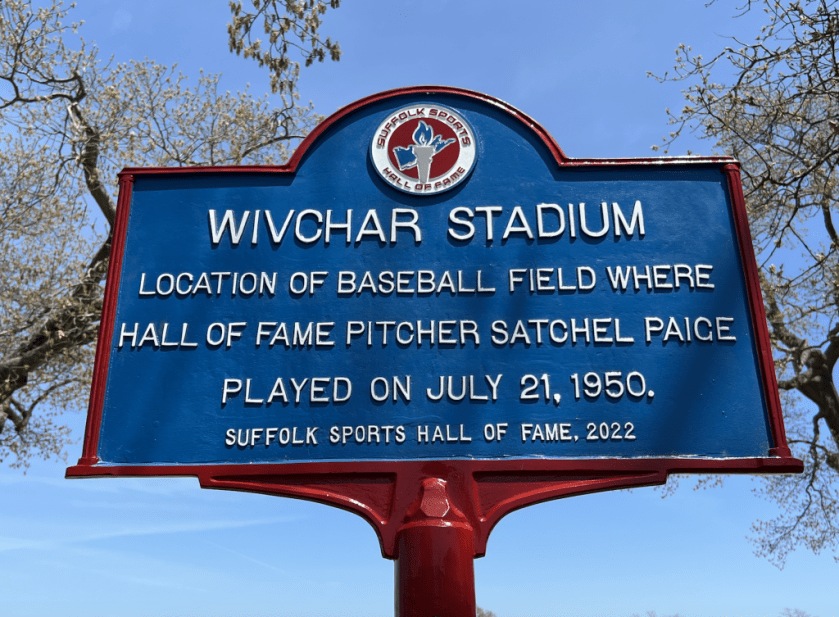
Baseball Hall of Famer Satchel Paige pitched in Riverhead, NY, during a barnstorming game on July 21, 1950. Thanks to Fabio Montella, an assistant professor of library services and history for Suffolk County Community College’s Eastern Campus in Riverhead, this research was brought to my attention, and we circled this spot as the third location deserving a marker, which was erected on May 5, 2022.
The marker was placed on Riverhead Schools’ property on Osborn Avenue, where Wivchar Stadium once stood. Paige pitched for the Philadelphia Stars, a semipro barnstorming team. Also at the game that day was Carl Yastrzemski Jr., a 10-year-old bat boy for the Riverhead Falcons, a team his dad, Carl Sr., played on.
Ruth and Gehrig Come to Lindenhurst
I placed the Hall of Fame’s fourth historical marker at the location where Babe Ruth and Lou Gehrig played a barnstorming game in Lindenhurst, NY, in 1930. We dedicated the marker on October 18, 2023.
Ninety-three years to the day, the marker was placed to designate the location on South Second Street, where the Baseball Hall of Famers played against Addie Klein’s Lindenhurst Nine.
There were more than 4,000 fans in attendance at the game. Ruth hit a monster home run that is believed to have gone at least 500 feet. Gehrig had three hits. After the game, they had a drink at the Plaza, a hotel, restaurant, and bar on Montauk Highway.
What’s next?
The process is different for each location. It depends on who owns the property and who can grant permission to put the marker in the ground. It might be a private owner, a school district, or a village government. I also rely on a maintenance, facilities, or public works team to help do the installation. Finally, none of this is possible without the beautiful craftsmanship from Catskill Castkings, who makes the markers and ships the heavy piece to me directly on Long Island.
You might be asking why we’ve only had baseball markers to date. It’s purely a coincidence, but I’m happy with the theme it presents to support our national pastime. We have a working list of markers for various sports worth considering in the future. Shinnecock Hills (Golf), Bridgehampton Raceway (Racing), Long Island Arena (Hockey), and the Canoe Place Inn (Boxing), where John Sullivan trained before his heavyweight title fight in 1892, to name a few. On the baseball front, we’ve explored the location where an all-woman baseball team, similar to the ones in “A League of Their Own” played, two more spots where Babe Ruth played in Riverhead and Kings Park, the field in Sag Harbor where Henry Chadwick watched games, and, my favorite, the location where the first all-Black baseball team played in 1885. The New York Cuban Giants were inducted into the Suffolk Sports Hall of Fame in 2019, and there is a large rock at the location of the old Argyle Hotel in Babylon, NY, to commemorate the location. The year 2025 marks the 140th anniversary of the team’s formation, a nice round number to honor with a historical marker.
Here’s to preserving history, honoring the past, and inspiring the future …
I was fortunate enough to spend the start of July in one of the world’s great cities, Montreal, home to the Expos from 1969 to 2004. Of course the baseball history (and baseball card history!) of Montreal stretches back much further than that.
The Montreal Royals joined the International League in 1897 and went on to win seven league titles, all between 1941 and 1958. A Montreal Royal, James “Doc” Casey, is even represented in the 1909-11 American Tobacco Company “White Borders” (T206) set affectionately dubbed “The Monster.”
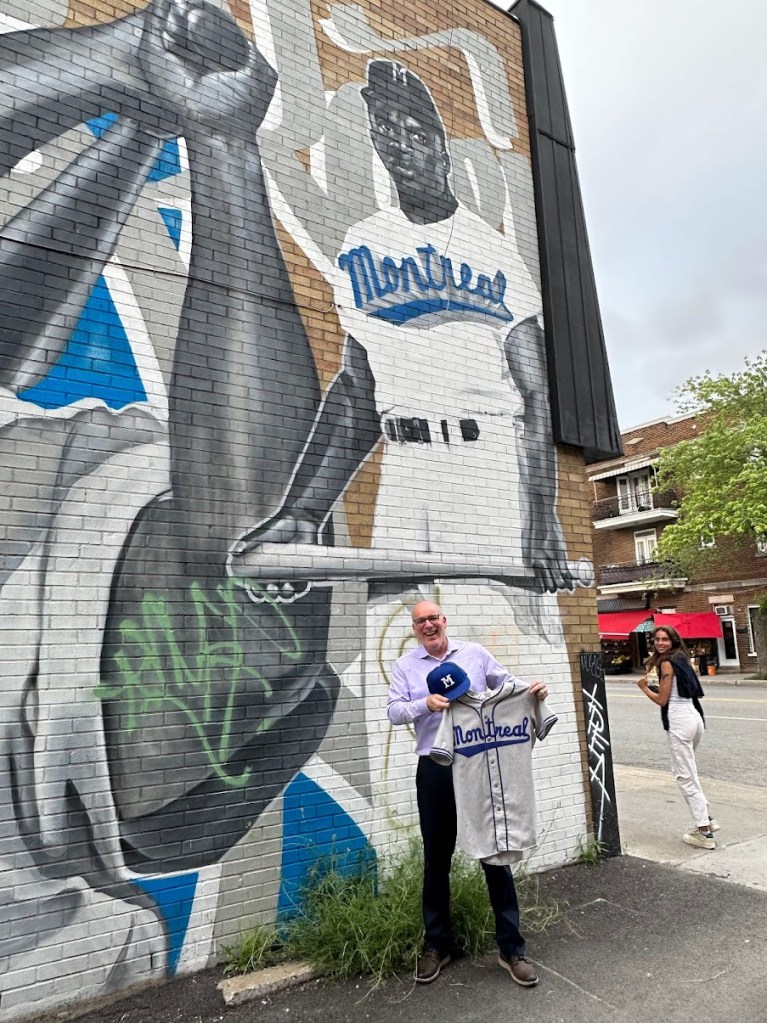
Of course, the most famous Royal of them all played for the 1946 Montreal squad, recognized as one of the top 100 minor league teams of all-time. A pleasant half hour walk through some fun and artsy neighborhoods brought me to his colorful mural at 3907 St. Laurent Blvd.
From there, I had two choices. Walk back to my hotel or walk another 30-40 minutes to hit another Jackie Robinson landmark. I chose the latter.
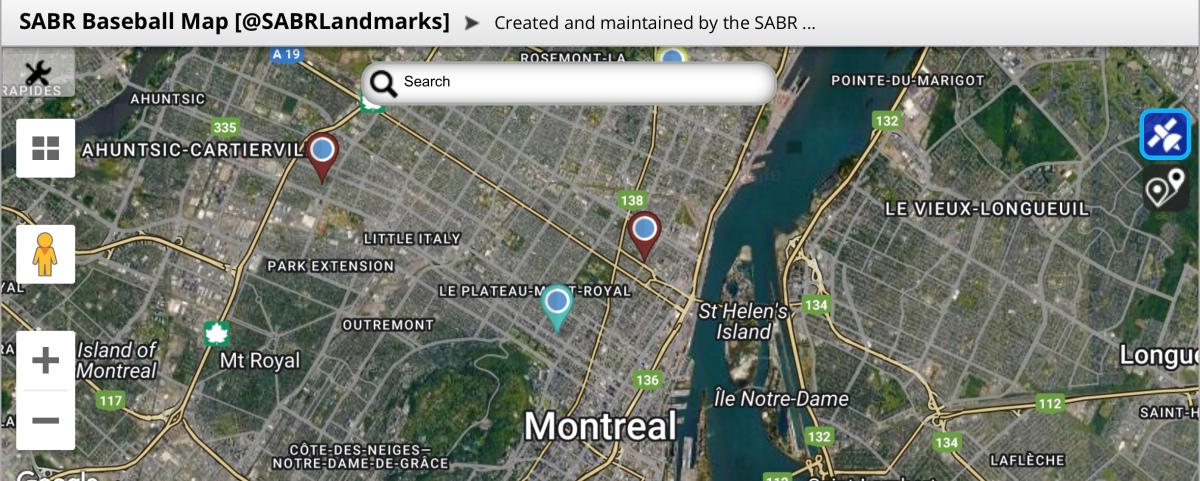
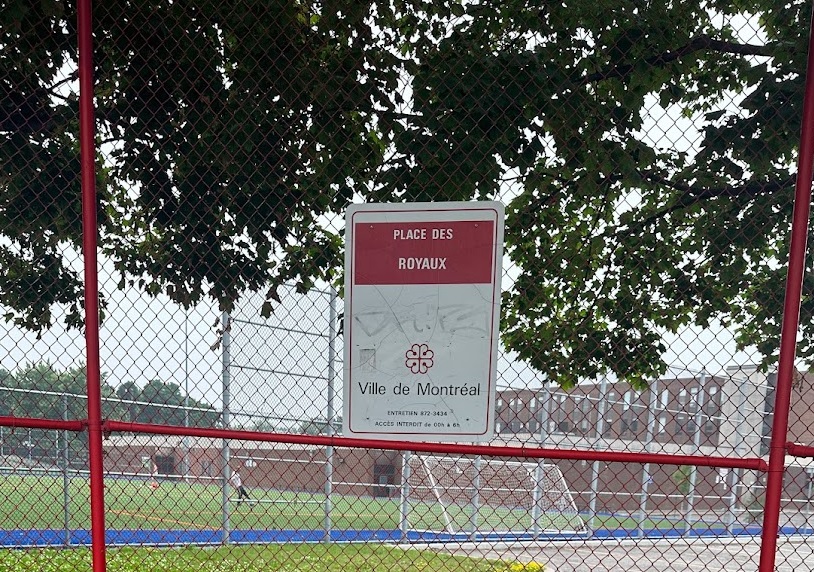
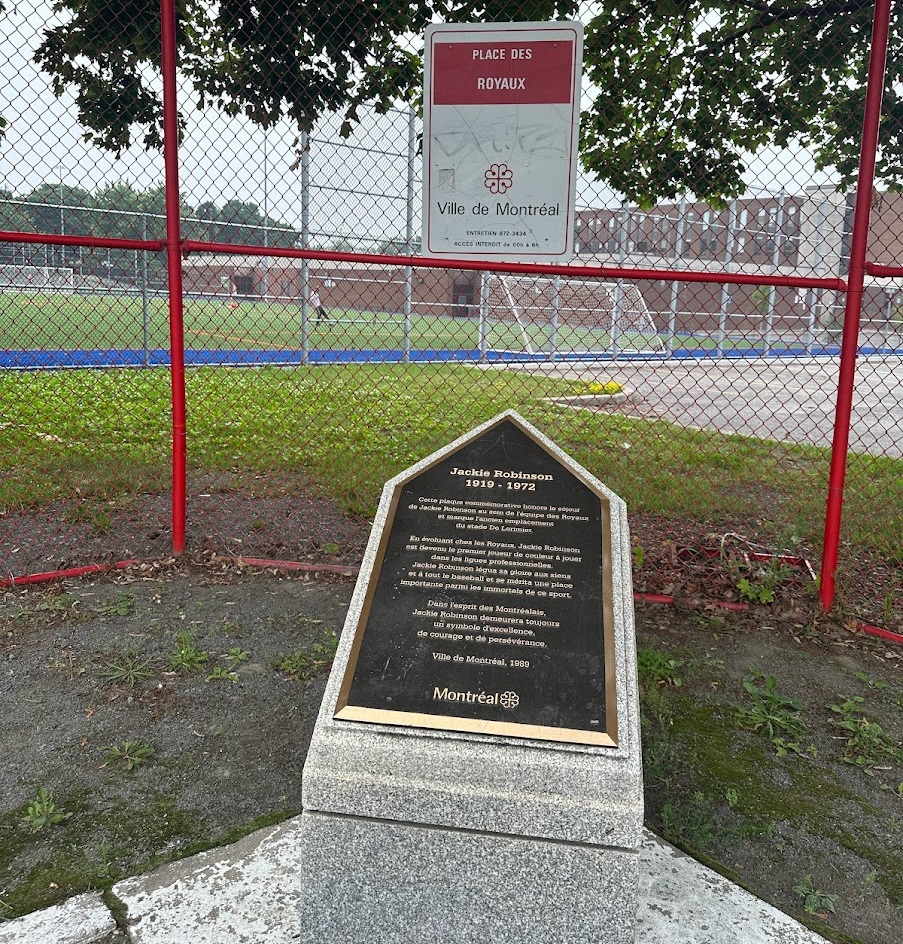
The Montreal Royals of Jackie’s time played their games at Stade De Lorimier (pronounced duh-lor-eem-yay). The ballpark is long gone, but the city has commemorated the “place of the Royals” with a…dingy metal sign?!
Okay, so that’s only half true. Yes, the marker could use an upgrade, but there is also an excellent tribute to Jackie Robinson just below it.
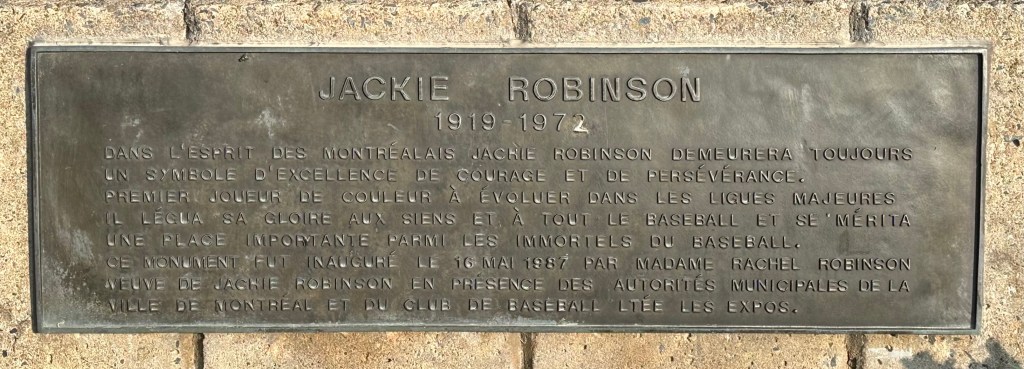
Loosely translated to English, the words on the sign read—
This commemorative plaque honors Jackie Robinson’s stay with the Royal team and marks the former location of De Lorimier Stadium.
By playing with the Royals, Jackie Robinson became the first player of color to play in professional leagues.
Jackie Robinson bequeathed his glory to his family and all baseball and earned an important place among the immortals of this sport.
In the minds of Montrealers, Jackie Robinson will always remain a symbol of excellence, courage and perseverance
City of Montreal, 1989
You may have noticed the plaque takes the form of home plate, and this is no coincidence. In fact, it is part of a larger mini-ballpark, complete with outfield grass and bleachers.
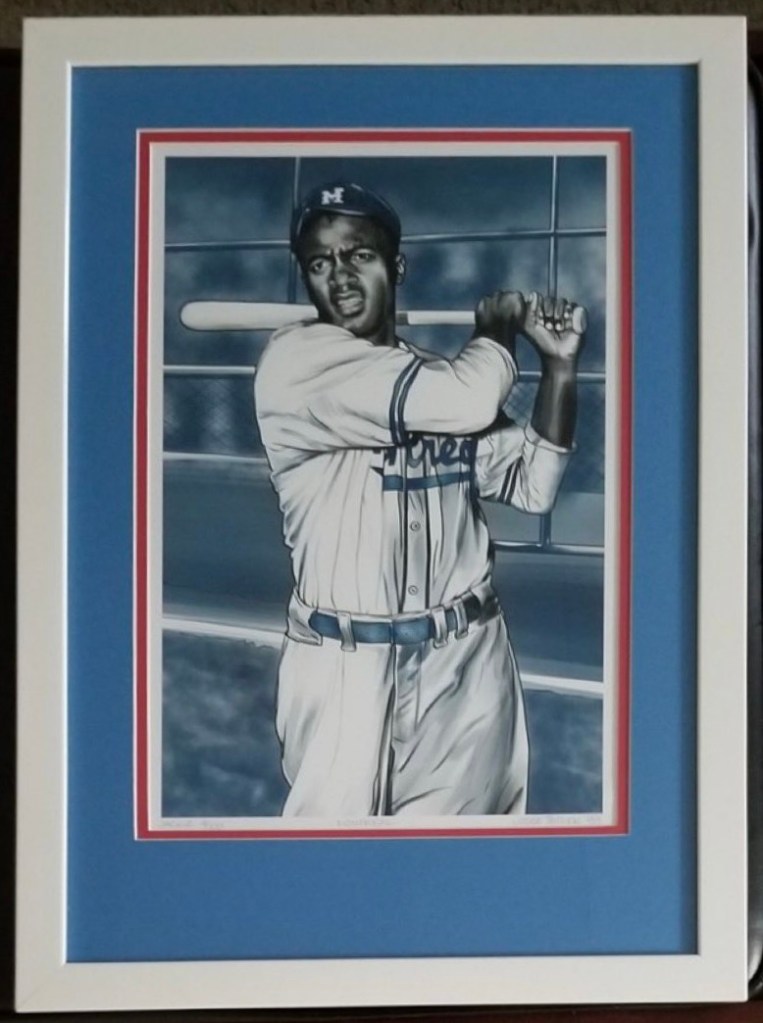
Though there were other landmarks I might have made by foot, I already had plans to tour them the next day with Montreal baseball artist Josée Tellier, whose wonderful Jackie Robinson artwork adorns the entrance to our guest room.
As this second day of landmarks was more distant from my hotel, we caught a cab to their general vicinity before setting out on foot. Our first stop was Jackie’s second mural in Montreal. If you look closely you’ll notice one of the locals totally not thinking what I’m doing is super dorky.
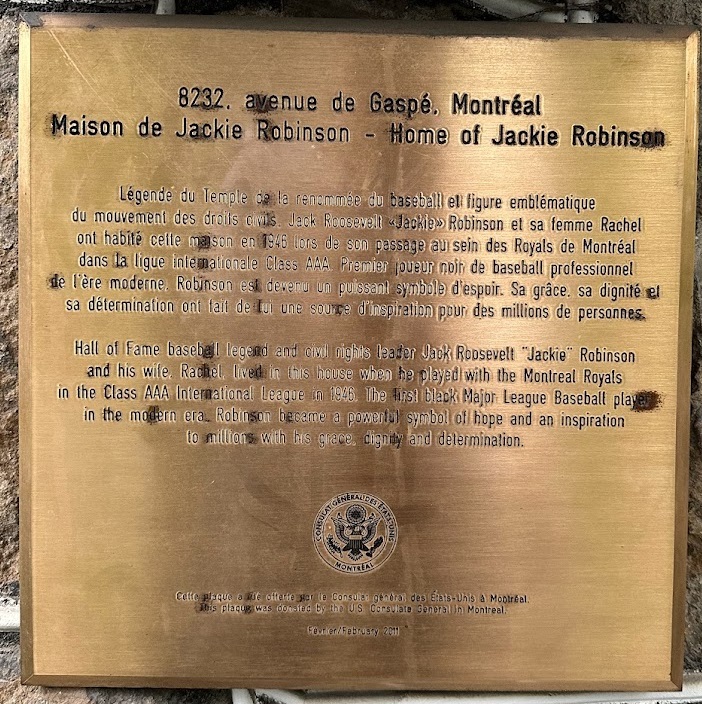
We were definitely in Mr. Robinson’s neighborhood now, or more correctly Mr. and Mrs. Robinson’s neighborhood. As proof, here is the house just a few blocks away that Jackie and Rachel called home in 1946.
Here is a closer look at the plaque by the door. (Note the bottom half presents the English translation.)
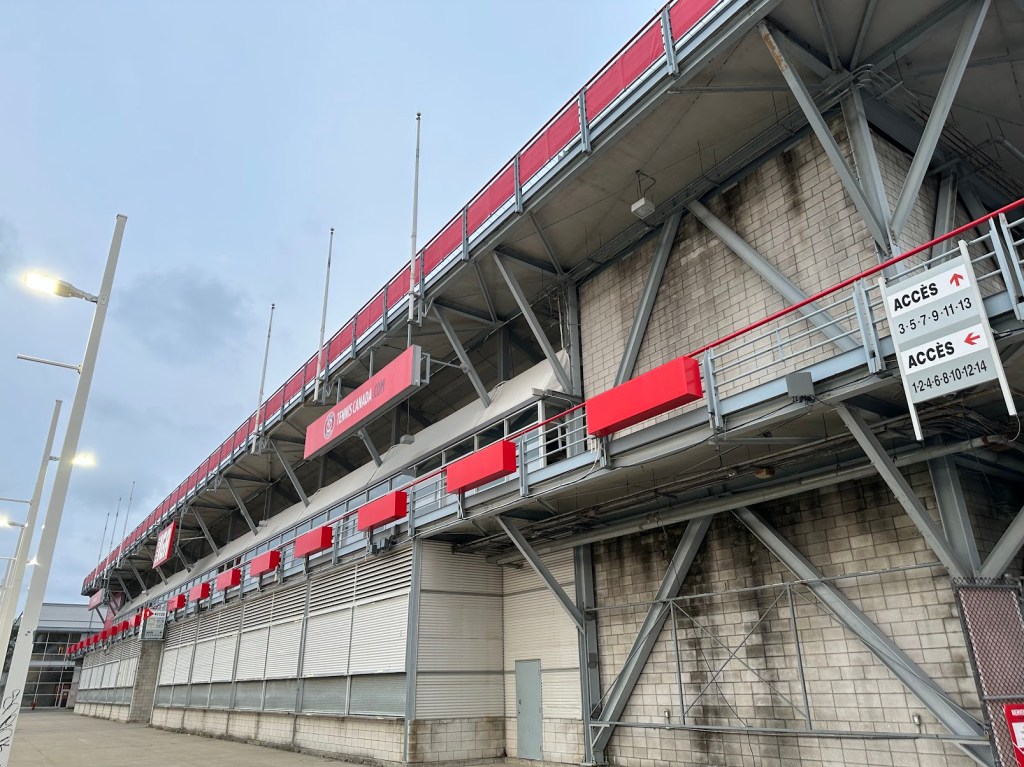
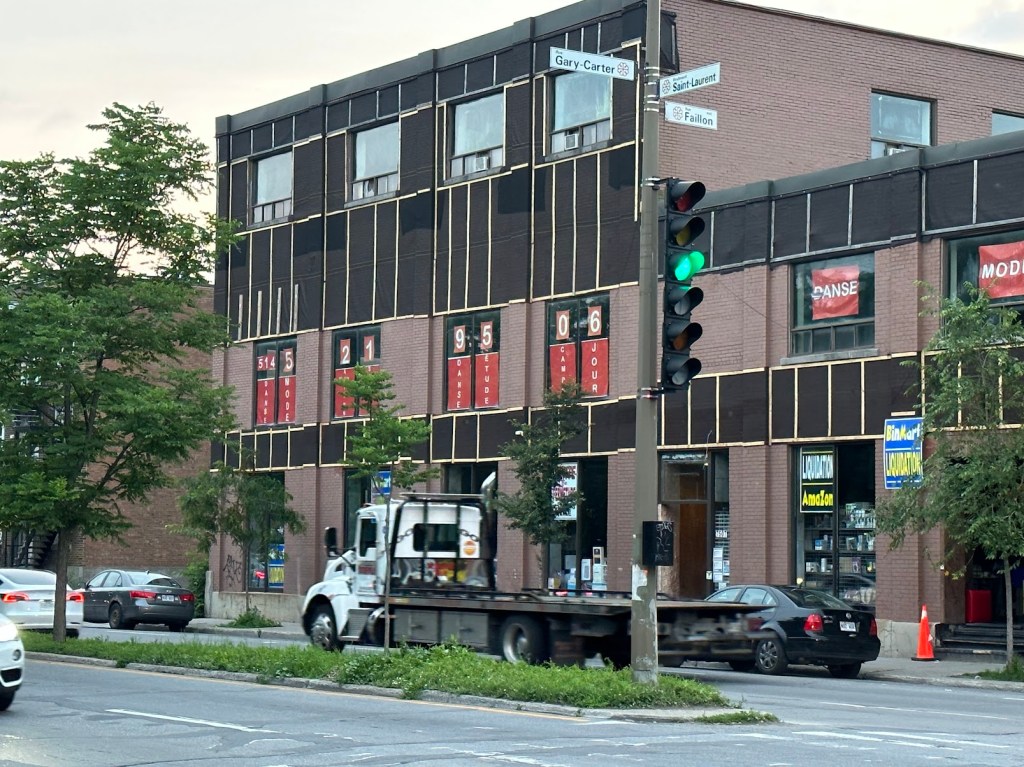
Our final landmark for the evening was nearby Jarry Park, home of the Montreal Expos from 1969-76. A small portion of the original stadium structure still remains as part of a newer tennis facility.
The street name equally serves to remind visitors that a beloved major league team once played here.
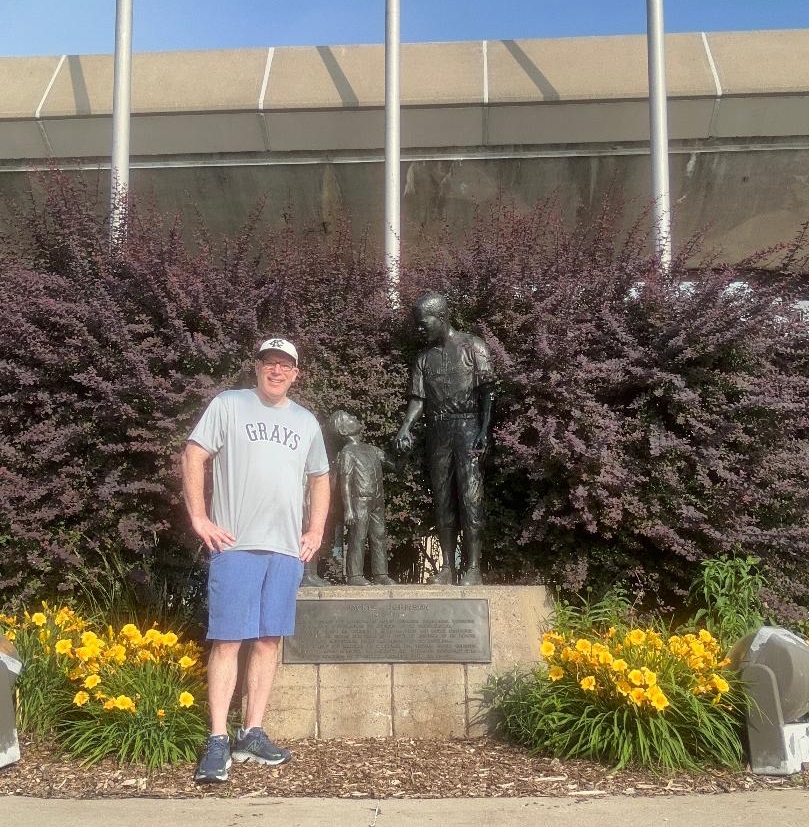
As we wrapped up this round of landmarks, Josée made sure I knew there was one more Jackie Robinson landmark we didn’t cover because it was too far away: the Jackie statue at Olympic Stadium. Lucky for readers of the Hardball Voyager, I got up the next day at 5 AM and decided a 7-mile walk wouldn’t be completely insane.
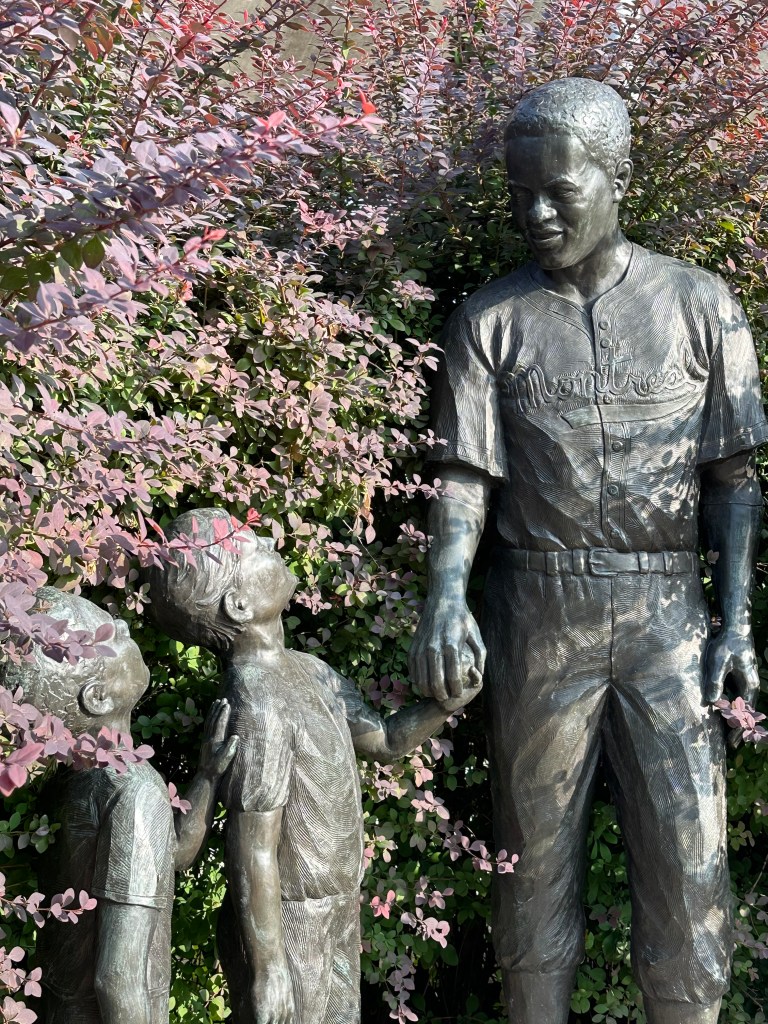
Here is a view of the statue without some guy blocking it.
And here is a close-up of the plaque.
Finally, here is the statue from further away. Olympic Stadium is the giant flying saucer-looking thing behind it.
Olympic Stadium was of course home to the Expos from 1977 until 2004, after which MLB relocated the team to Washington, DC. (Boo! Bud stole the Expos!) Amid all today’s talk of expansion and relocation, there are high hopes in Las Vegas, Nashville, Salt Lake City, and Portland but only the dimmest of forecasts for a return to Montreal.
Still, right in front of this stadium without a team stands Jackie—in what now may be recast as an act of defiance—handing the ball to the next generation, refusing to let the game die. I guess time will tell, at least here in Montreal.
A recent work trip took me to Alabama…Prattville, specifically. If you don’t know exactly where that is, you’re much like I was when it was time to book my travel. About 15 minutes north on 65 from Montgomery, it turns out.
“Schwartz,” I said, as I handed my license to the clerk at the rental car counter. I didn’t imagine it to be an everyday last name in this part of the country.
“And you’re sure you have a car here?”
Like all modern travelers these days I took out my phone to search frantically through emails for my confirmation. Relieved it have found it quickly, I handed my phone to the clerk who would no doubt be a little embarrassed to have lost track of such an organized traveler.
“Sir, this is out of Montgomery.”
“Okay…?”
“And you’re in Birmingham.”
It was at this point that something I’d known intellectually for decades but had never really processed hit me like a ton of bricks. Montgomery and Birmingham, whatever their similarities, are in fact different cities.
Having forfeited all chances to play it cool, I asked the obvious.
“Nope, not far. You could get there in about two hours…”
Long pause.
“…if you had a car.”
“I take it you’re out of cars then?”
“Yep. Whole airport’s out.”
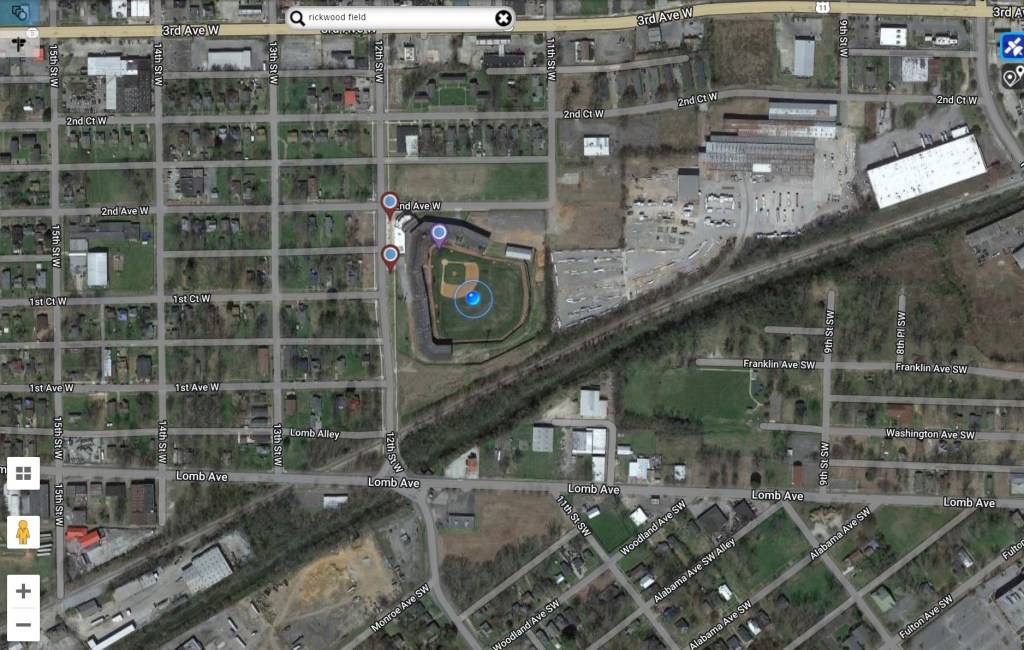
Taking a Lyft into town I was able to procure wheels from an Enterprise with one vehicle remaining, a rather large Dodge Ram pickup, and checked the map—the SABR Baseball Map that is!
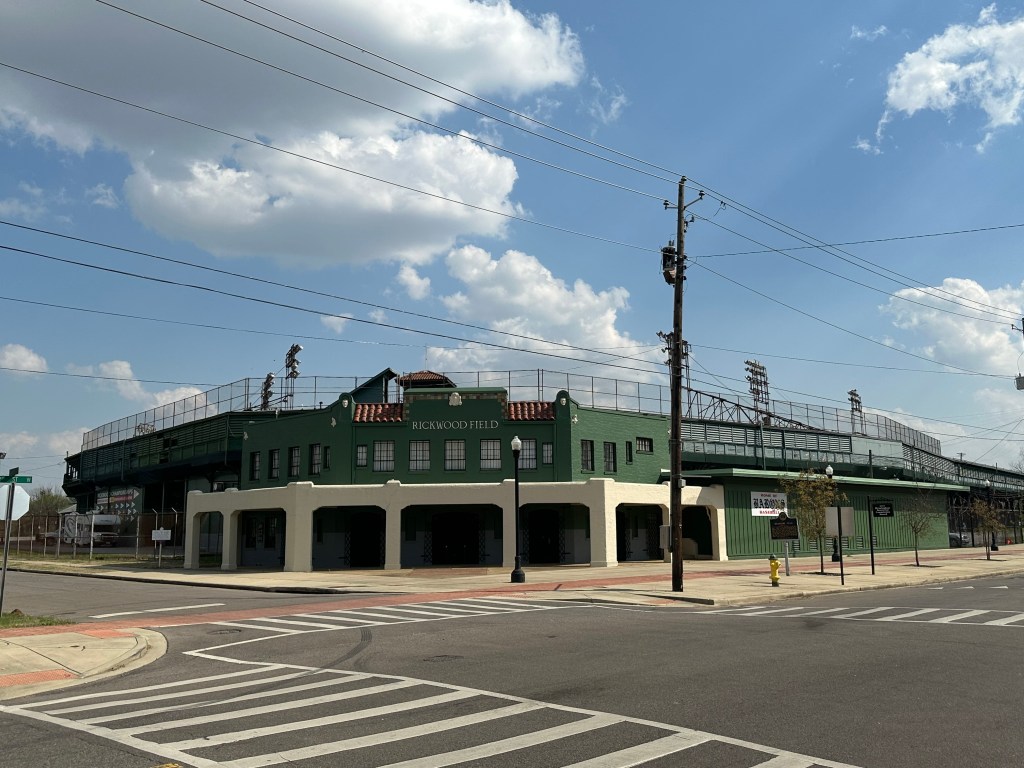
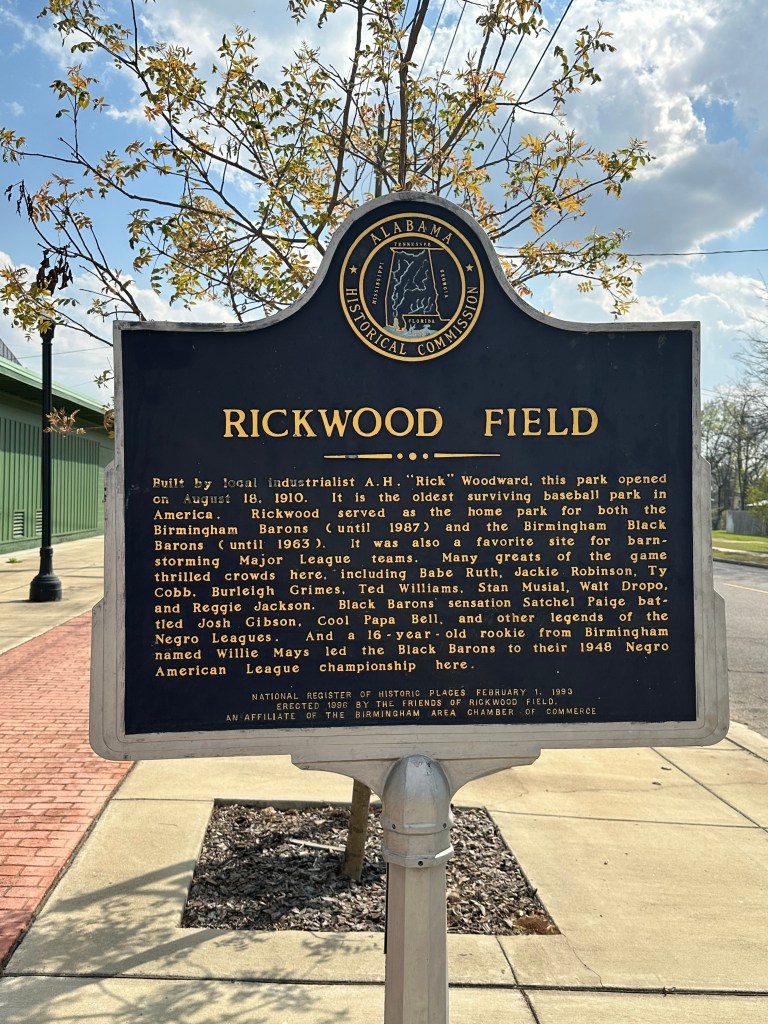
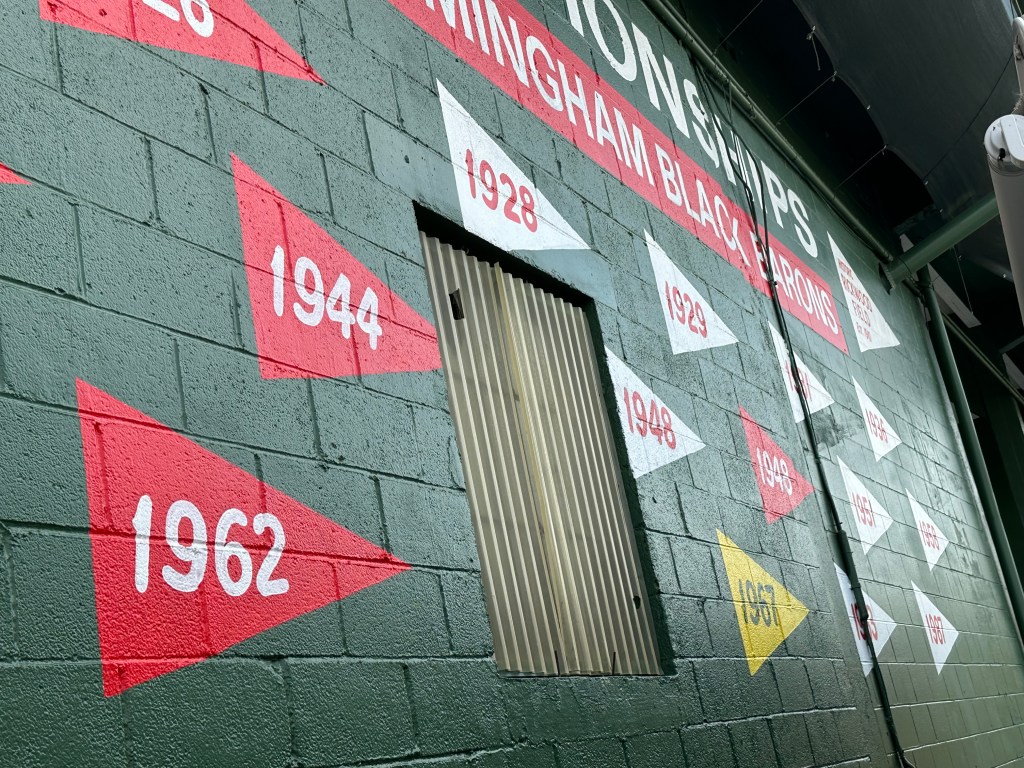
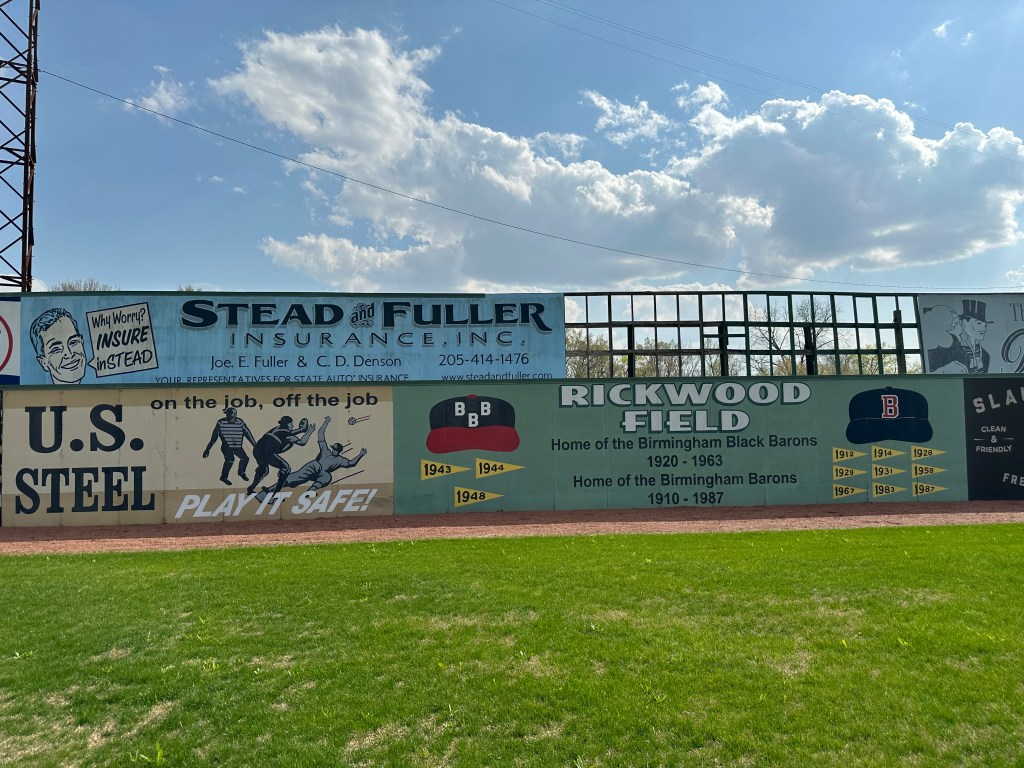
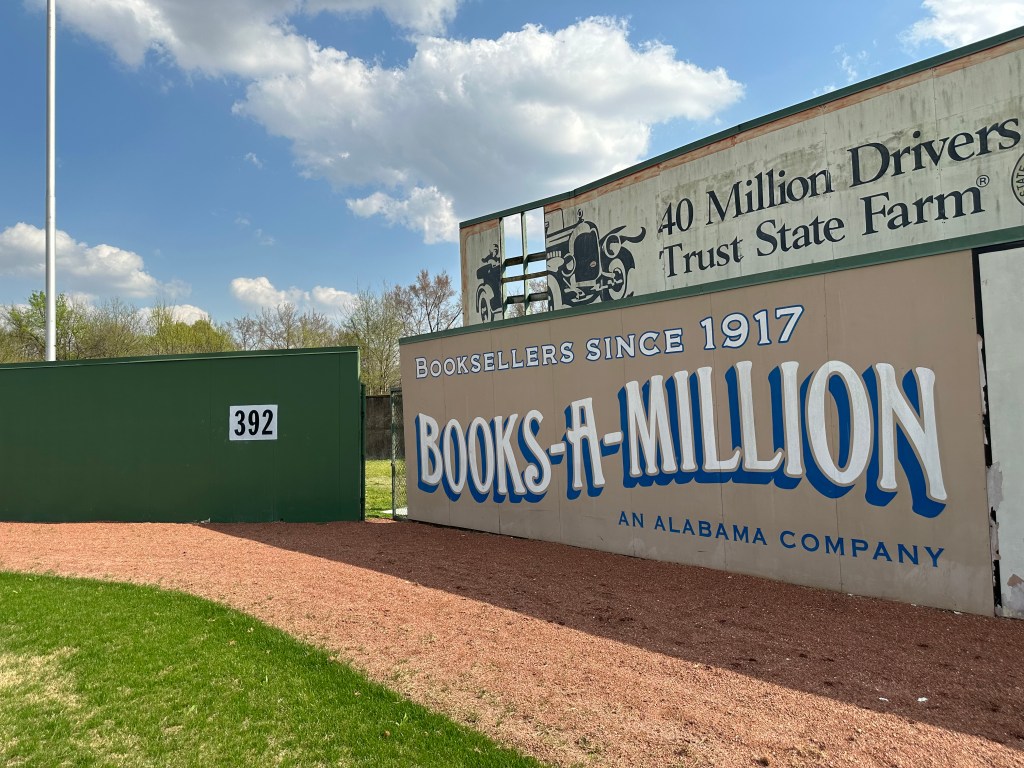
Ten minutes later, there I was. The marker says it all: “The oldest surviving ballpark in America.”
I asked a guy packing baseball equipment into his truck if it was okay to go inside. “Yeah, sure thing. Have fun.”
“Satchel Paige faced Josh Gibson here,” I thought to myself. “I will definitely have fun.”
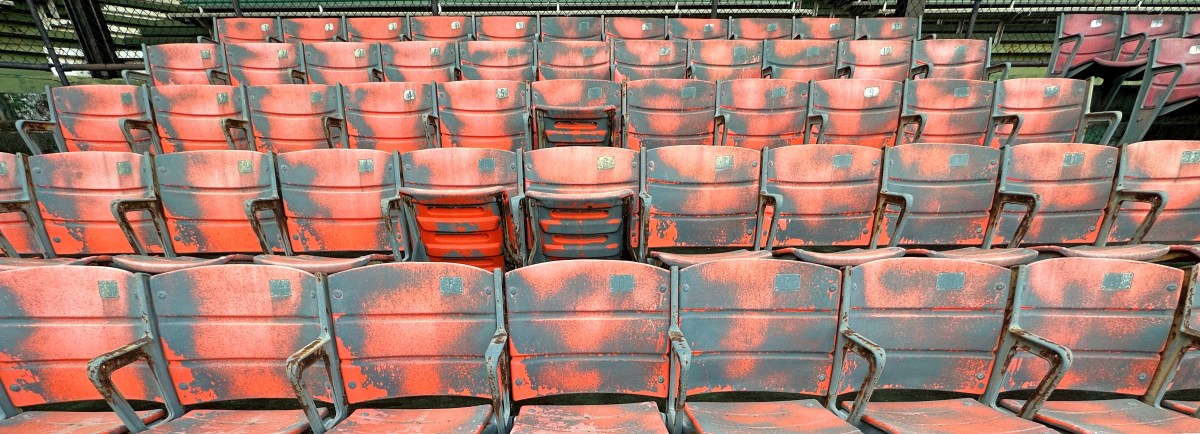
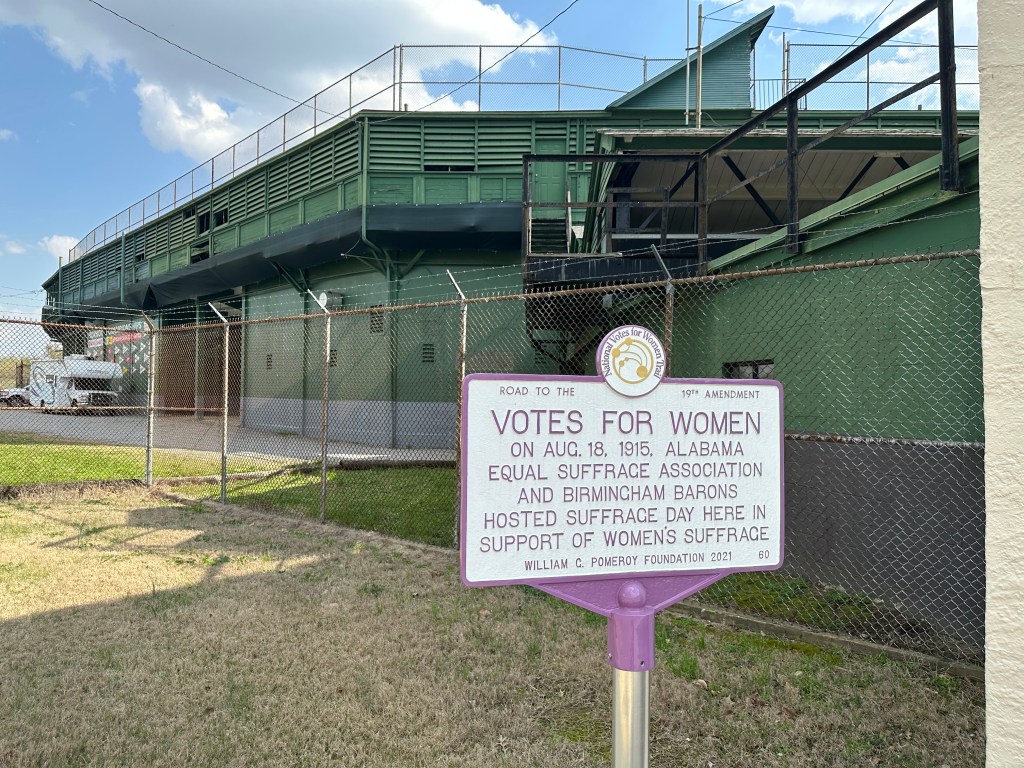
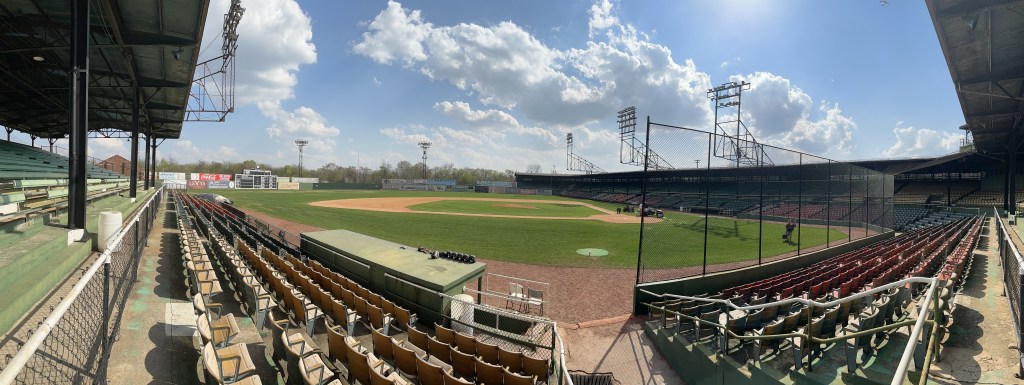
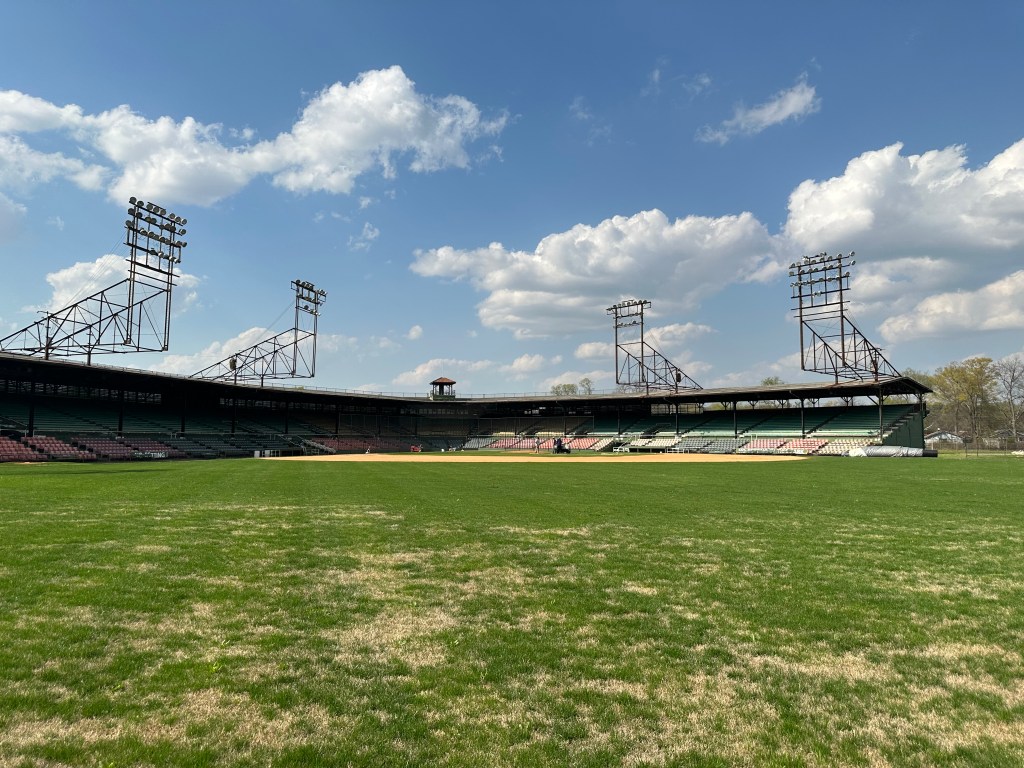
At first I simply stared out at the field. It was a site that shouldn’t exist anymore: a ballpark 113 years old being worked on for a game the same evening. So let me try again. This was a site that should exist. Living history.
The groundskeeper was fine with my walking around the field but asked that I avoid the infield dirt.
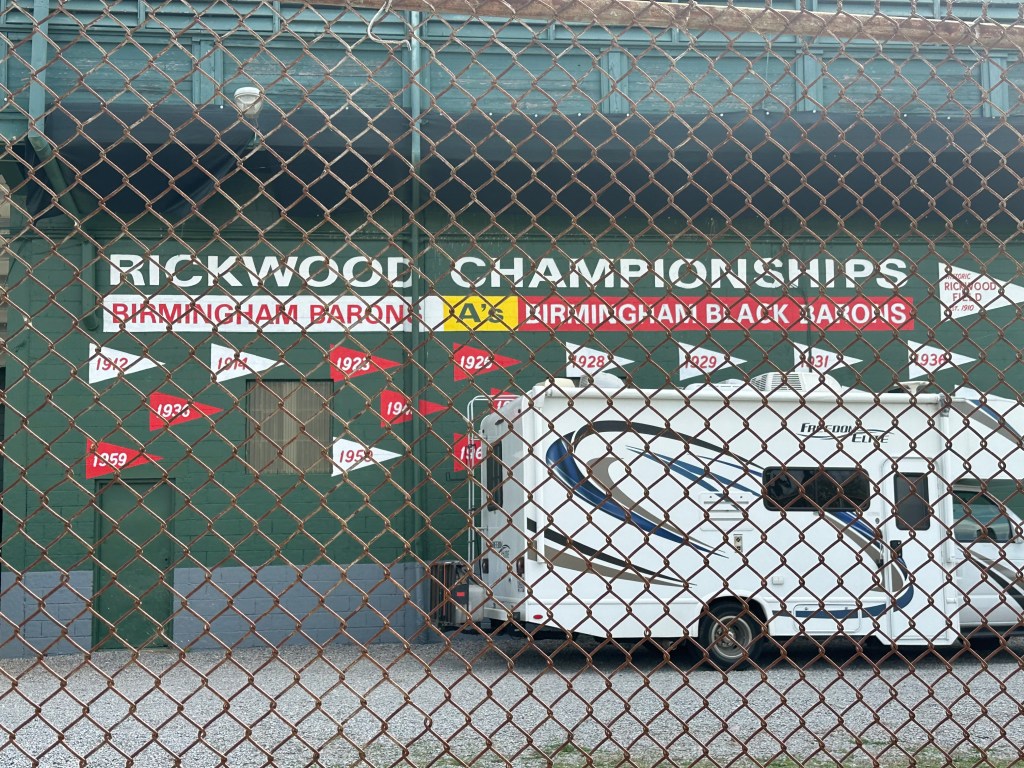
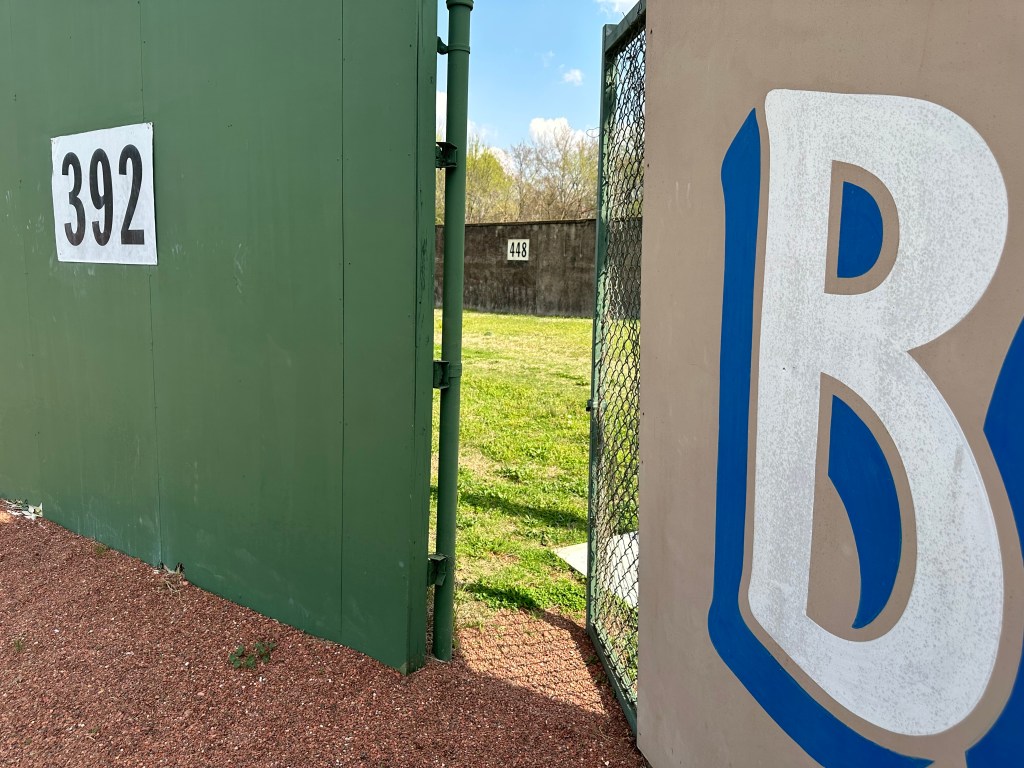
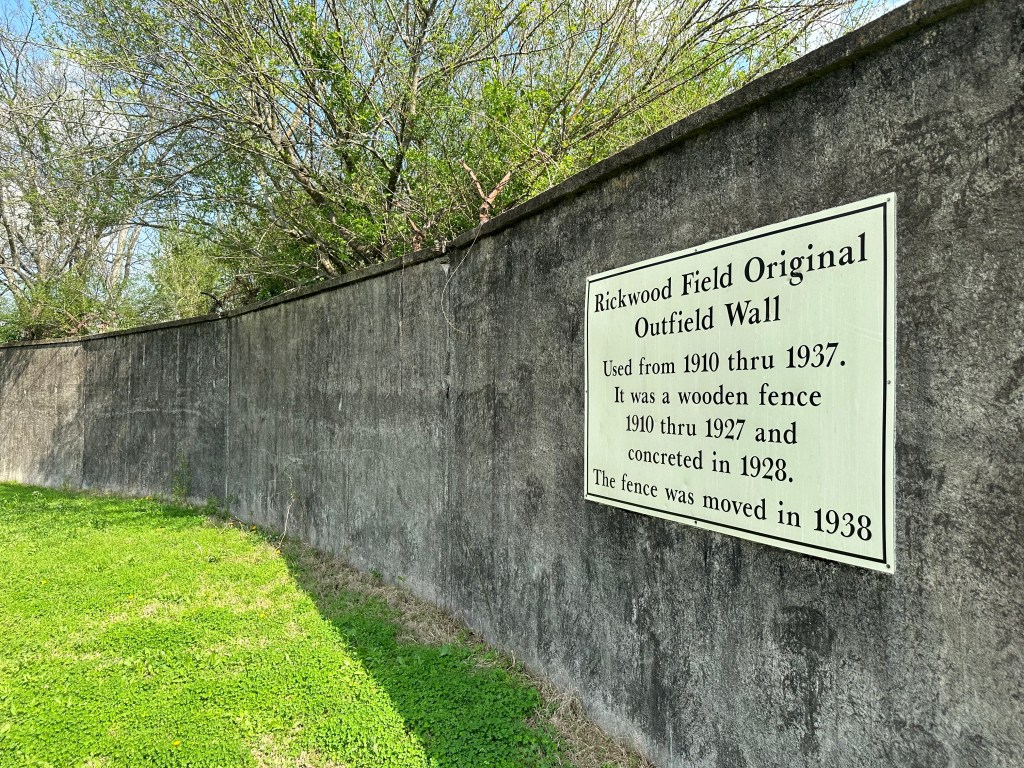
He also gave me a tip I might have missed on my own. “Go through the gate by the 392 marker to see the original wall.”
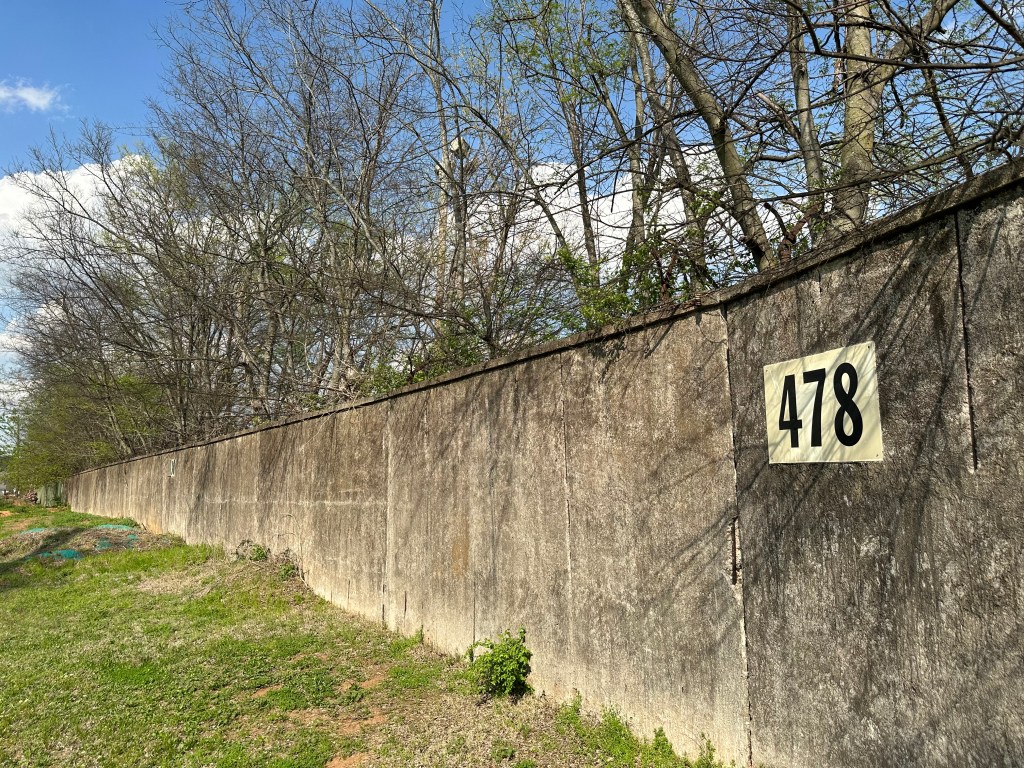
It was here I said goodbye to the spray charts of mere mortals and hello to those of Babe Ruth, Josh Gibson, Willie Mays, and Reggie Jackson. I was venturing into the land of 478-foot homers. Holy f*ck.
If I had all day I might have wandered this stretch for hours, rummaging for old toothpicks I might decide were Oscar Charleston’s or, as if it were possible, a baseball or two. Unfortunately I had to pick up some colleagues at the airport. And that would be Montgomery, not Birmingham. Different cities it turns out.
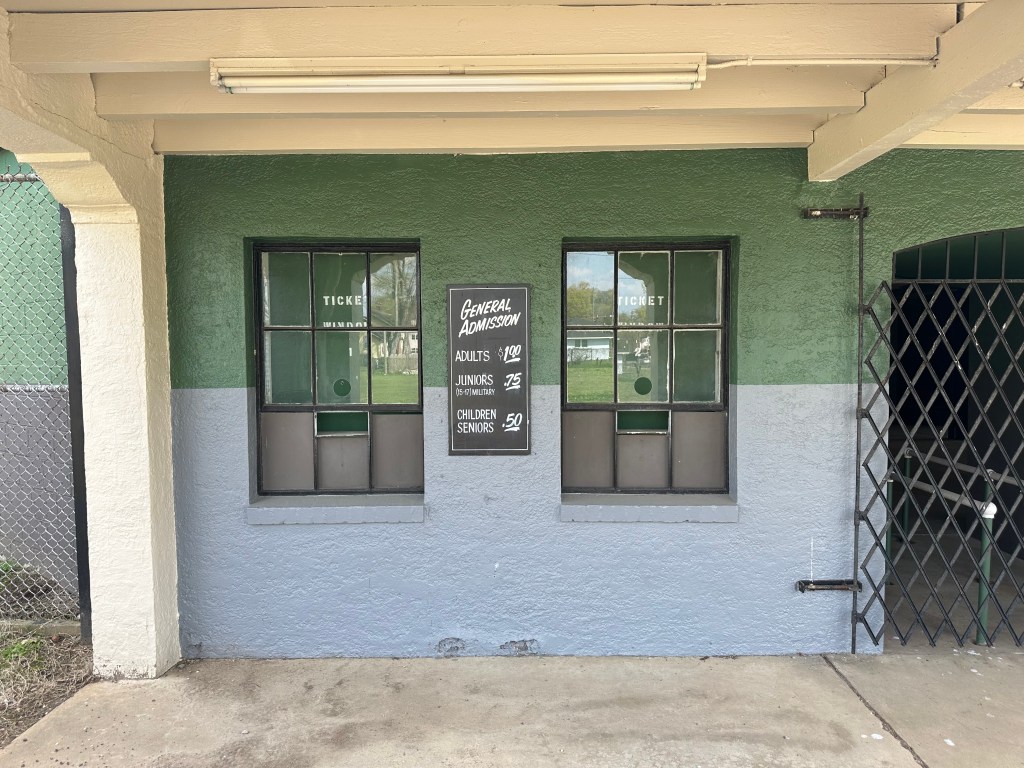
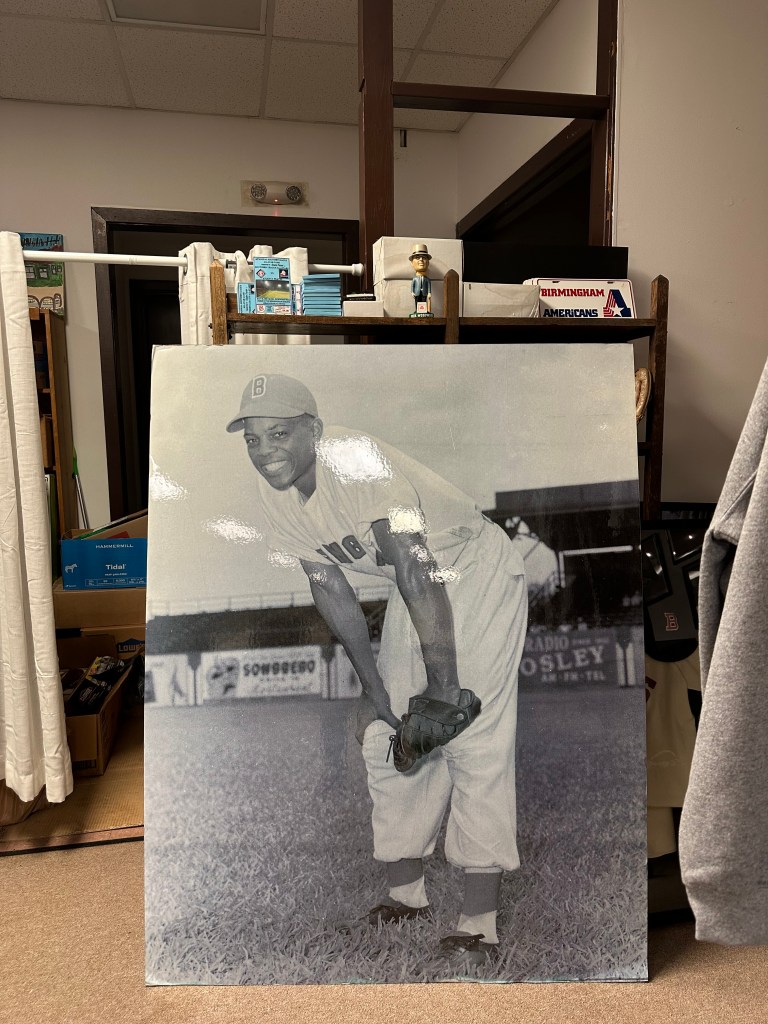
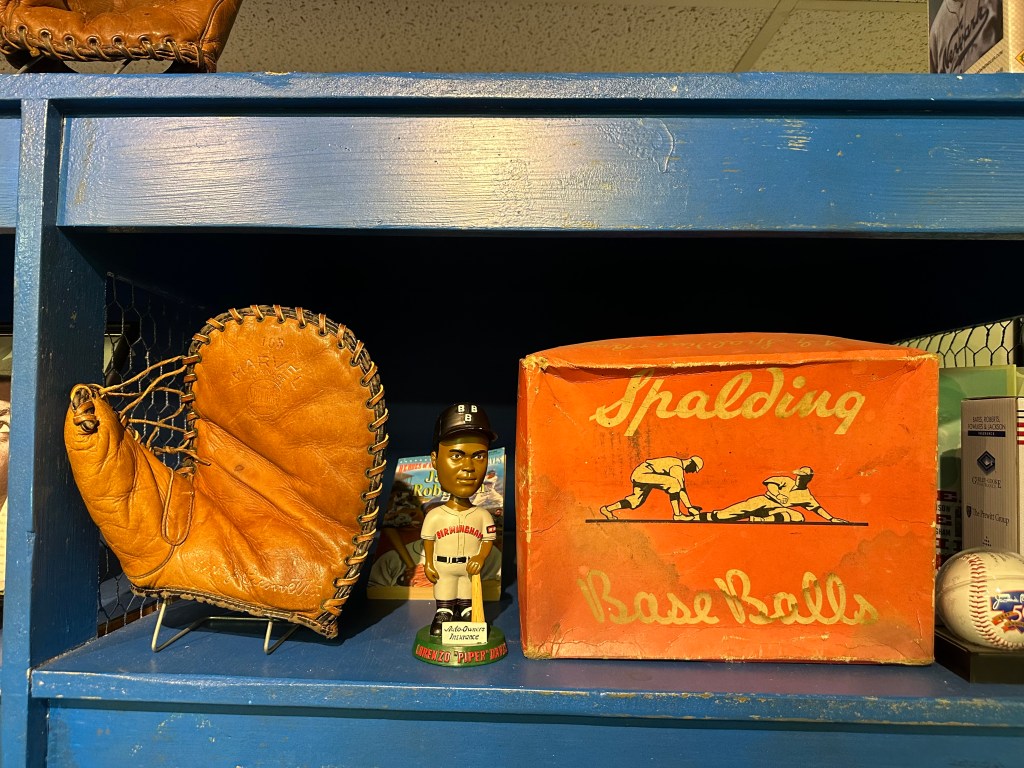
Still, I made some time to visit the gift shop, which doubled as mini-museum.
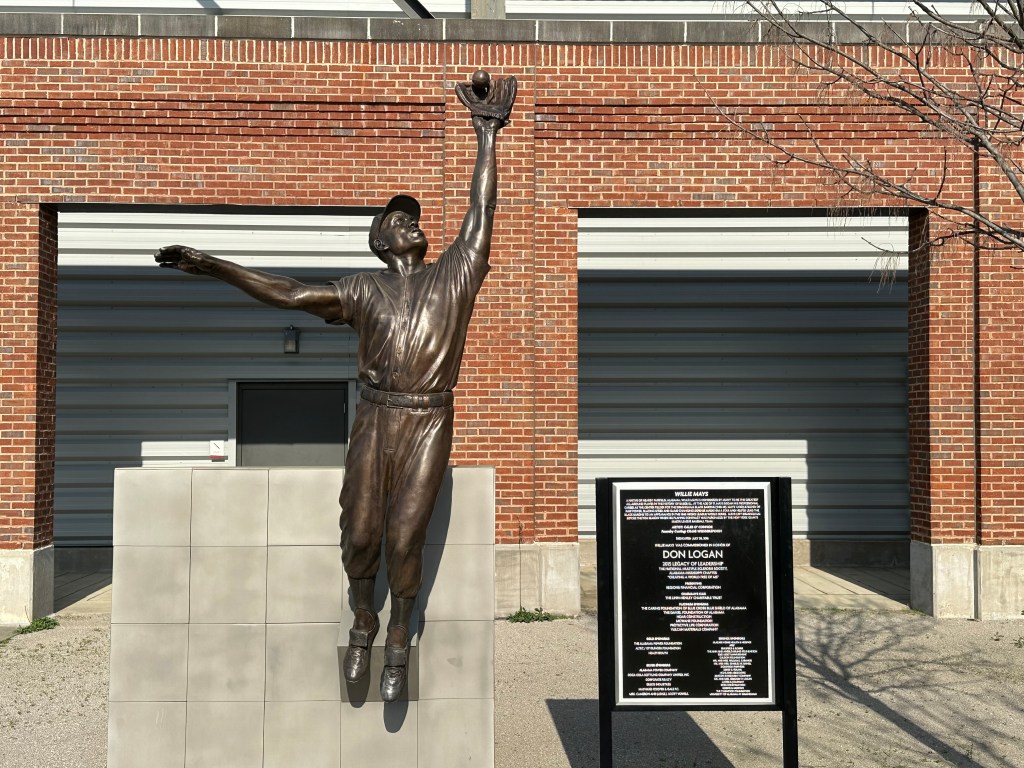
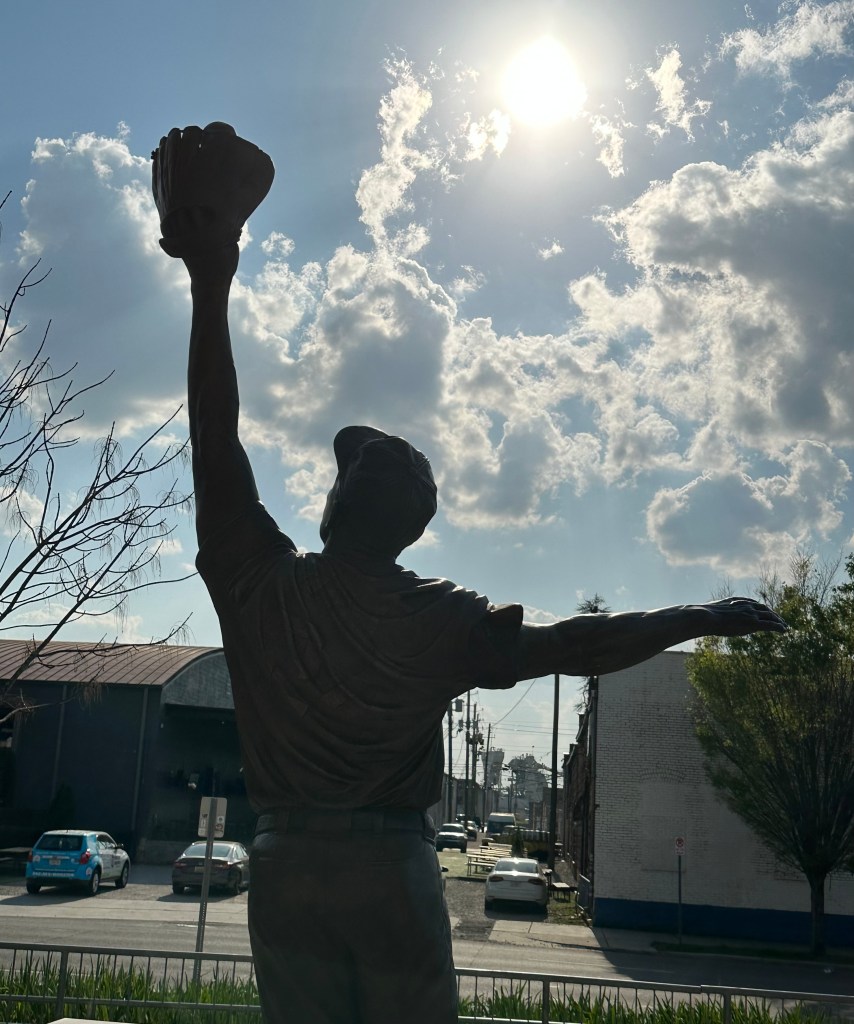
Checking the baseball map, I also found I had time for a brief stop at the Willie Mays statue outside nearby Regions Field.
And with that, it was time to hit the road. It was a dumb mistake to fly into the wrong city, but it was a smart one too. Plus, it could have been worse. Far worse.
Business brought me to Fort Worth this past week, though a tight schedule prevented me from planning any baseball detours as part of the trip. Too bad since I’m currently working on the SABR Games story that took place in Fort Worth in 1952 and would have benefited greatly from even a few extra hours in town. But then I looked at the map. 🤔
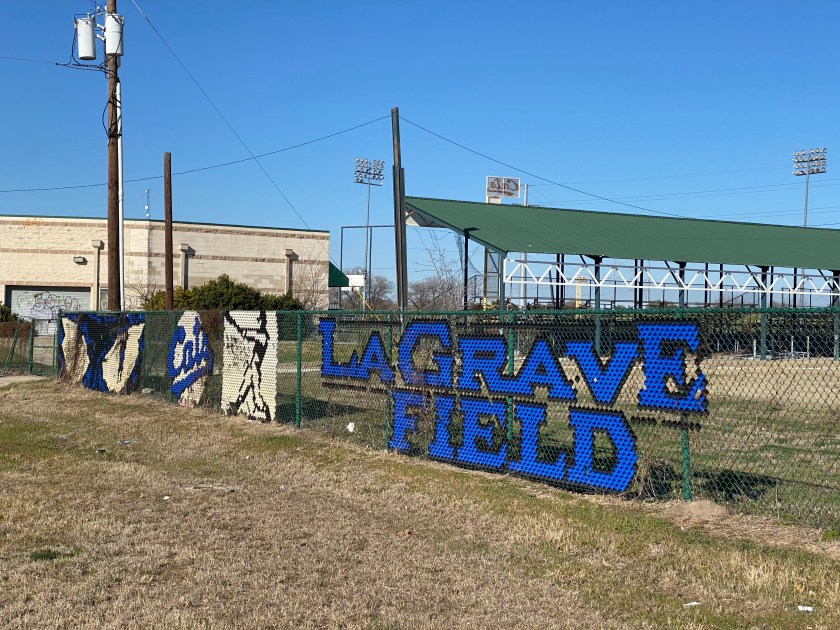
Wait a minute! My meeting (at Tarrant County College) is only a mile from LaGrave Field?! Maybe, just maybe, I can pull this off.
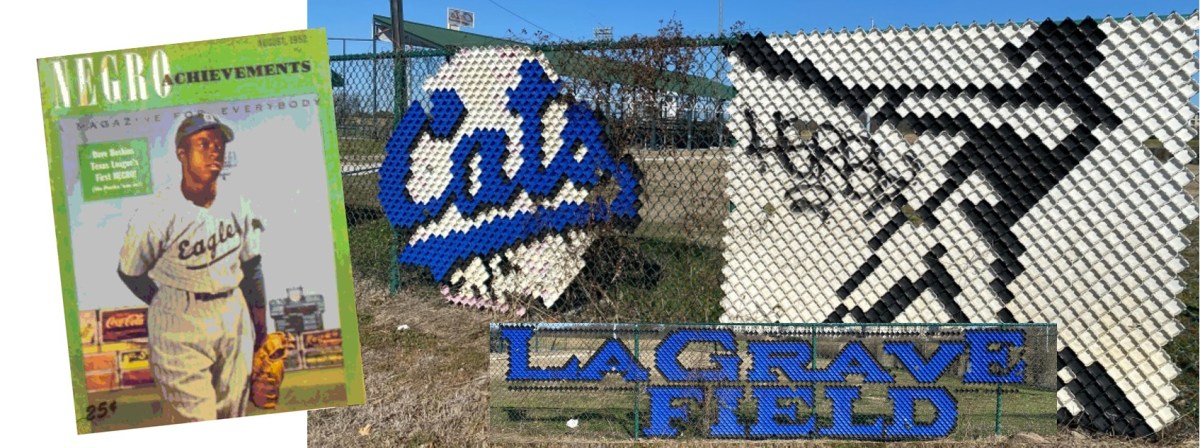
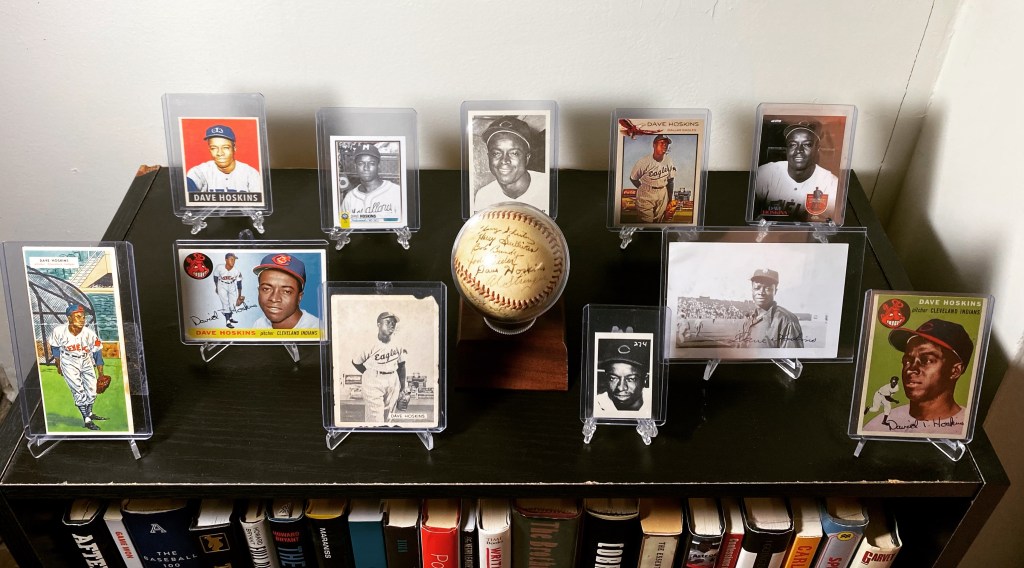
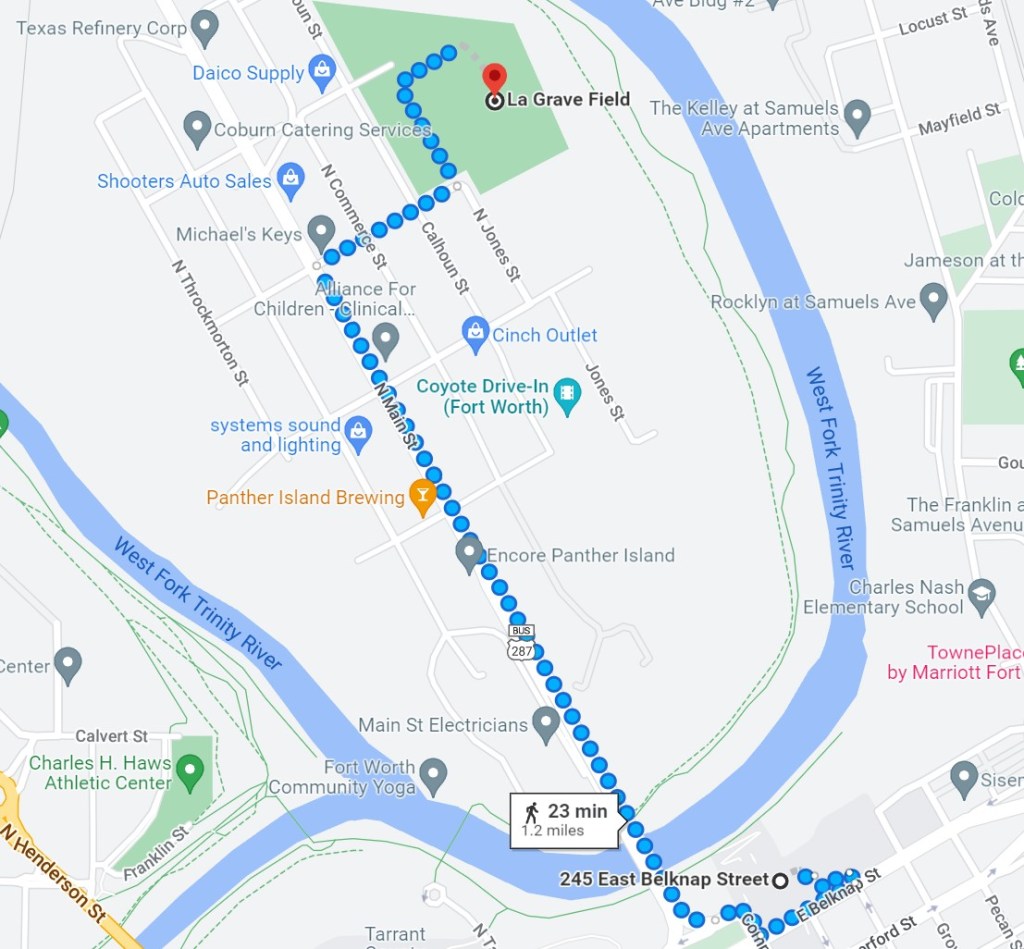
Luck was with me as my event ended almost an hour early, so after saying my goodbyes and packing up my gear I set off on my mile-plus walk to the site of the Texas League’s first of two Dave Hoskins Nights. (If the name is unfamiliar, Hoskins was the two-way sensation who not only broke the Texas League’s Color Barrier in 1952 but was also the circuit’s top draw, top pitcher, and third best hitter. Previously he had starred in the Negro Leagues as part of the Homestead Grays Murderers Row!)
1952 Globe Printing baseball card
While the second Dave Hoskins Night was hosted by the ace’s home fans in Dallas, this first tribute, on August 28, came from the fans of his team’s crosstown rival, the Fort Worth Cats. Hoskins for his part pitched well enough to reward celebrants with a shutout and his 20th victory of the season. He even banged out two hits for good measure.
So this Dave Hoskins history was what was on my mind as I began the short walk to the ballpark, though Hoskins was hardly the most renowned player to take the field at LaGrave. Two of my favorite Dodgers, for example, were Fort Worth Cats en route to the big leagues: Duke Snider and Maury Wills, the latter breaking the team’s Color Barrier three years after Hoskins integrated the league.
The walk itself started out simple enough but got a bit dicey halfway through. Google’s walking directions had me take Main Street, which for several blocks became more highway than street. That there was no sidewalk over this stretch added adventure if not danger to this part of the journey. To boot, wearing a suit and carrying two travel bags wasn’t exactly optimal for dodging traffic, so I was fortunate that there weren’t many cars at this time of day. I was definitely happy to reach the stretch where the sidewalk resumed.
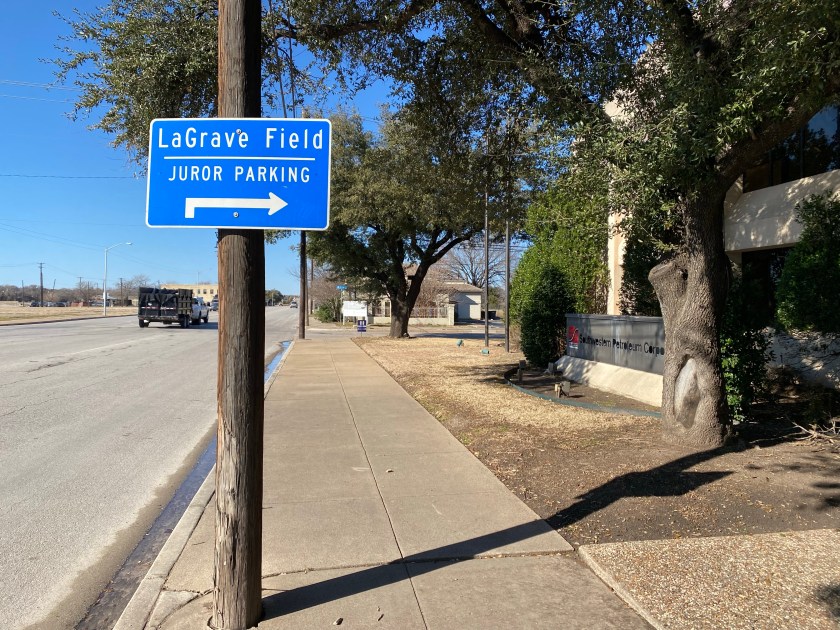
Abandoning the Google directions, I followed this street sign and turned off Main St. early to take a shortcut through a parking lot. I was quickly rewarded by a view of the ballpark. While taking my first photo, a car pulled up to me and asked if I was trying to get onto the field. Before I could respond fully, the driver warned me that the field was patrolled by a security guard whose car I could now see.
Just seeing the old shuttered ballpark, from any angle, made the walk worthwhile, but I had a second goal. To qualify for SABR Landmark status, abandoned ballparks, no matter how historic, need markers. Would my walk around the perimeter lead me to one?
Bingo!
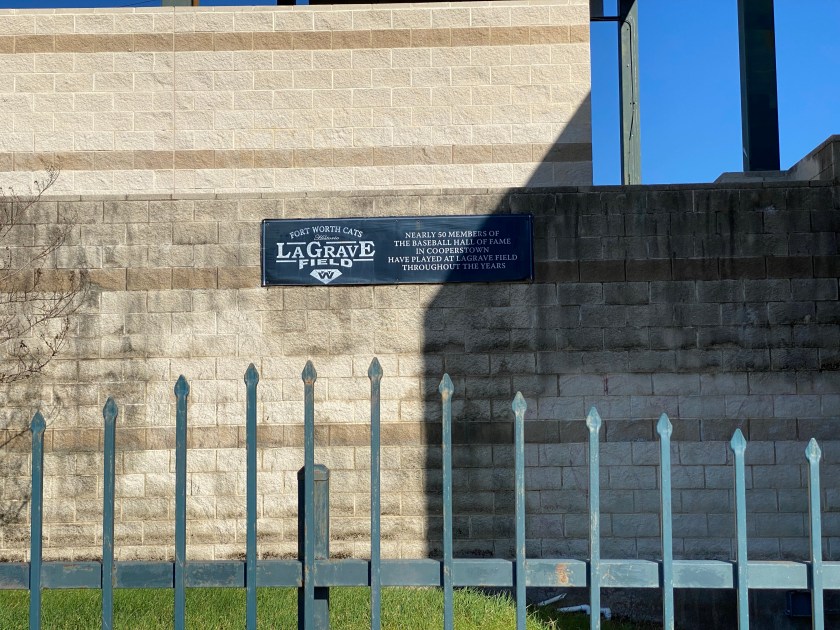
Shadows didn’t permit a clean shot of the marker, but I could still make out the words.
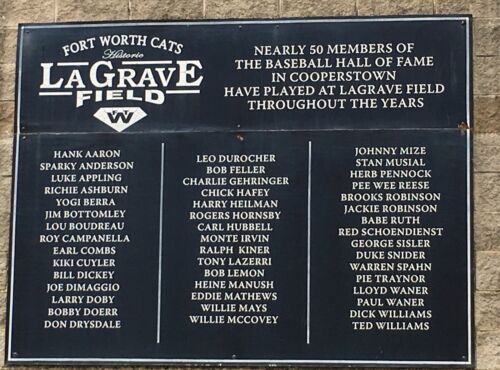
FORT WORTH CATS HISTORIC LAGRAVE FIELD – Nearly 50 members of the Baseball Hall of Fame in Cooperstown have played at LaGrave Field over the years.
In better days there was actually a bottom half to the sign, which named the Hall of Famers. In fact, the sign sells the old ballpark short as Satchel Paige and many other Negro League greats played here as well.
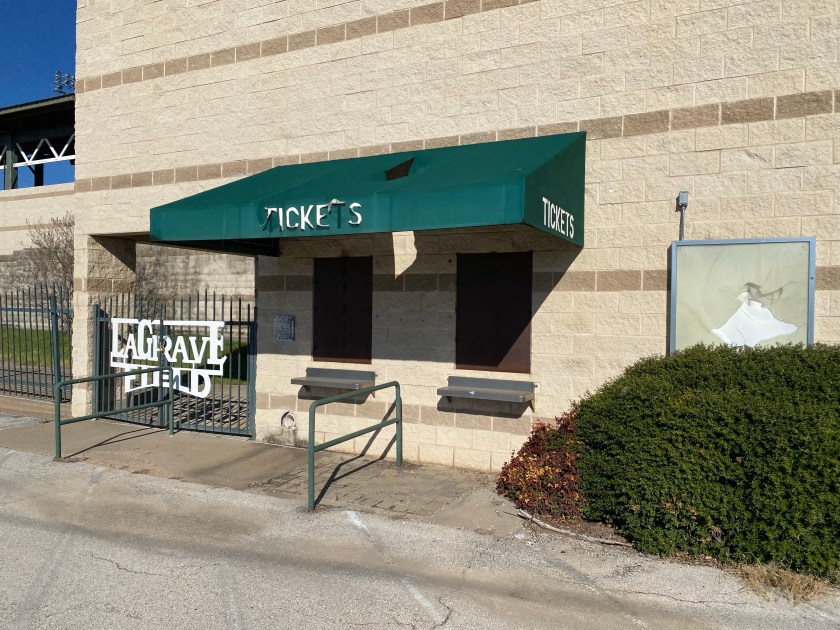
Having nabbed a picture of the marker, I also managed a picture of the old ticket office just before the aforementioned security guard interrupted my hardball voyaging.
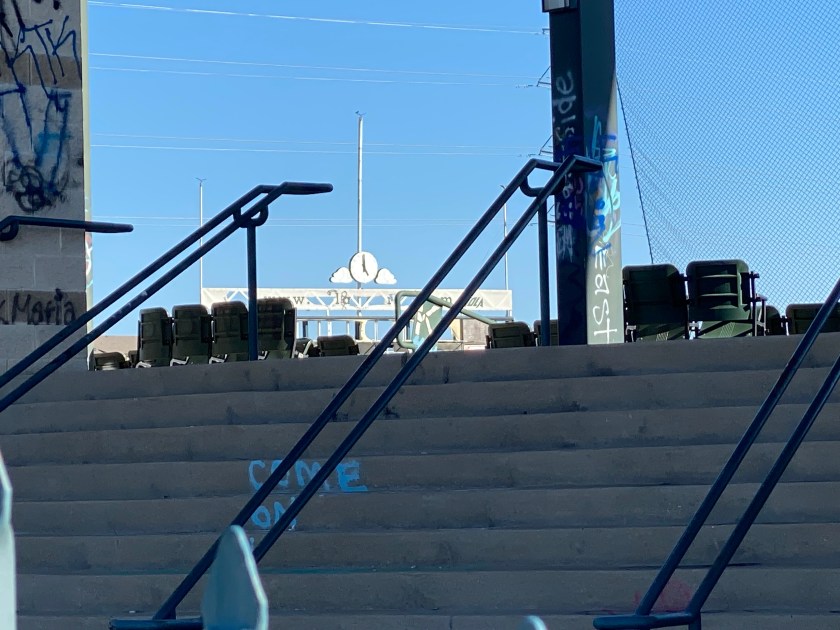
The concerned watchman let me know they really didn’t like people walking around the ballpark, but he softened his stance somewhat when I told him I was from the Society for American Baseball Research. He asked how much longer I needed to be there and I told him I maybe needed just one more picture from a different spot. Reluctantly, he assented, and thanks to his largesse you are now looking at a shot of the centerfield scoreboard, complete with clock.
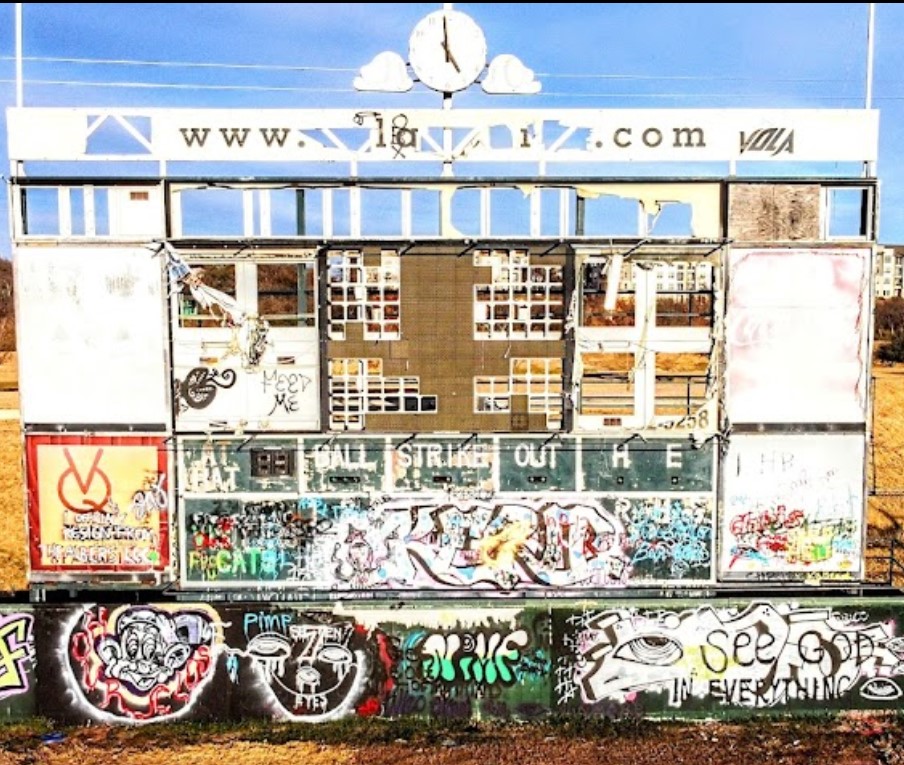
Here is an image from Google Maps that shows a much better view while testifying to the overall state of neglect and disrepair to which the ballpark has fallen victim. Graffiti runs the gamut from “Pimp” to “See God in everything.” (Click here for a photo not nearly as depressing.)
Between the watchful eyes of security and a plane to catch, my visit to LaGrave came to a quick end, though not without some humor. Having taken the most direct path to a spot I thought Uber could retrieve me, I sent my driver a helpful note.
“It’s Jason. I’m on Main and 7th, right across the street from…wait, what?!”
I enjoyed my short trek to LaGrave but also left saddened at the current state of the ballpark and its even more uncertain future. It’s easy to picture that even a year down the road, the history I was able to visit will be gone entirely, and with it, I believe, no small part of the cultural wealth and heritage of Fort Worth itself.
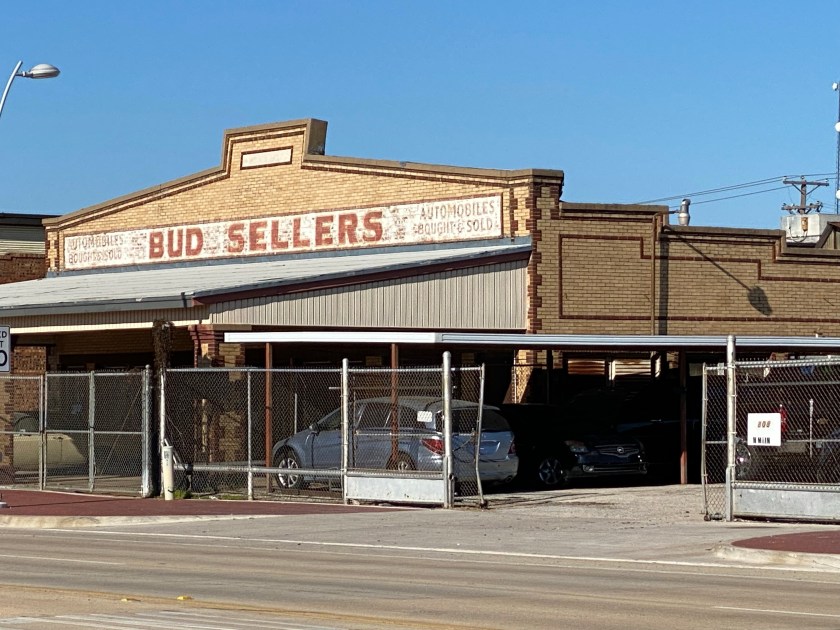
Baseball can be played in many places, but that isn’t to say they’re interchangeable. Some places are sacred, and I believe this is one of them. Walt Whitman sung of grass as “the beautiful uncut hair of graves.” Taking some liberty with his verse, here’s hoping the uncut hair of LaGrave might once again provide fans and yawpers alike with “the thrill of the grass.” Until then, if you’ll pardon the “potty” humor, I guess there’s always Bud Sellers. 🤣
Amid the noise of bouncing basketballs and splashing in the new pool at the Athletic Recreation Center, there exists a baseball diamond whose provenance is embedded in baseball’s past. Just outside the fence along the third baseline stands a Pennsylvania historical marker that details that background. Primarily funded by the generous donations of SABR members and dedicated in September 2017, the marker explains that the property played host to the first National League game, was the site of the first interracial baseball game and was home of the American Association’s Philadelphia Athletics.
Harry Stovey leads off second base at Athletic Park in 2017
In 2015 I went down a rabbit hole and discovered Jerry Casway’s biography of the Jefferson Street Ballparks. I was new to SABR and just developing my passion for 19th century baseball history. After learning about the extraordinary history that took place there, I decided to hop in my car and make the half hour trek to the Athletic Recreation Center and view the site with my own eyes. When I arrived, I walked onto the field where I was mentally transported back in time. I tried to imagine the sights, sounds and smells that would have been familiar to those who visited the ballparks during the 19th century. I’d like to take you on that journey.
The Jefferson Street ballparks were situated in a Philadelphia neighborhood called Brewerytown. Its proximity near the Schuylkill River, outlying farms, and lack of development attracted brewers and beer related industries to the area in the 1860s. The Philadelphia Evening Bulletin recalled the Brewerytown of the late 19th century with fondness. “…the air was as nourishing as vaporized bread…It was a place for family bakeries and rich delicatessens, a neighborhood scrubbed to within an inch of its life and resounding to the guttural language of Goethe and Schiller…” Railroad lines serviced the industry along the river while streetcar lines acted as the neighborhood’s public transit option, bringing fans to and from the ball grounds. The noises and smells of a developing Brewerytown enveloped this epicenter of Philadelphia baseball for nearly three decades.
Olympic Ball Club clubhouse along Master Street. 1860s
The property was used regularly for baseball beginning in 1864 when the Olympic Ball Club leased the grounds. On September 3, 1869, the first interracial baseball match between nationally prominent clubs was played at the Jefferson Street Grounds. The Olympic Ball Club, an all-white team, and Philadelphia Pythians, an all-black team, squared off in a match that was reported on as far away as Utah.
The Athletics called Jefferson Street home during their championship season of 1871, the first professional baseball league championship season in history. On April 22, 1876, all the inaugural National League games were rained out except the game in Philadelphia where Boston defeated the Athletics in the first National League game in history. But the Athletics were expelled from the League at the end of the season, ending Philadelphia’s affair with top-flight baseball. It would be six years before Major League Baseball returned to the Quaker City and Jefferson Street.
Frank Leslie’s Illustrated Newspaper. 10/6/1883
The Jefferson Street Grounds experienced change in the absence of top-flight baseball between 1877-1881. A school was constructed on the original field, while 26th street was cut through the middle of the lot. But in 1883, baseball returned to Jefferson Street when the American Association’s Philadelphia Athletics constructed Athletic Park at 27th and Jefferson streets. The first city championship game in years was played on April 14 between the Athletics and Al Reach’s Philadelphia Phillies. The account published in the Times noted that “the audience gave audible criticisms on the merits of both nines” when the squads were warming up on the field. Evidently, Philadelphia fans haven’t changed in 139 years. Toledo visited Athletic Park on May 26, 1884, and when Moses Fleetwood Walker, MLB’s first African American player, stepped to the plate for the first time, the Philadelphia fans rose to their feet and applauded him. Jackie Robinson received a different reception 63 years later.
I thought about these things as I stood in the baseball diamond at the Athletic Recreation Center. I could almost smell the beer, hear the fans yelling themselves hoarse, and see Moses Fleetwood Walker step into the batter’s box as the American flag lazily waved in deep center field. History buries its treasure deep.
In the case of the smells, sounds, and sights from within the Jefferson Street ballparks our imagination is almost all we have that will allow us to visit this space as it once was. Newspaper accounts the only vestiges of their existence. But they are lacking the context that I often enjoy, the fan experience. I left the Athletic Recreation Center convinced that I needed to do something to memorialize the place and the people who made it important.
Athletic Park as printed in the 1886 G.W. Bromley Atlas of Philadelphia
Finding what made the Jefferson Street ballparks special and worthy of a Pennsylvania State Historical Marker wasn’t difficult. Period newspaper accounts and images combined with secondary source work made this nomination a home run. I was confident the oversight committee would approve the marker. My concern was funding the marker.
The cost for the historical marker in 2017 was approximately $2,000. I had created a GoFundMe in late 2016 to fundraise and by late March, had raised approximately $500 of the $2,000. On March 27, 2017 I announced that the Pennsylvania State Historical and Museum Commission (PSHMC) approved my nomination. Once this announcement was made, full funding was achieved within a week!
The next challenge was finalizing the wording with the PSHMC. Ultimately everything I wrote made it onto the sign with one alteration: I stated that the April 22, 1876, game between Boston and the Athletics was the first Major League Baseball game in history. Despite explaining that MLB has held that stance since 1969, the PSHMC required the wording to be changed to “first National League game.”
Jefferson Street Ballparks historical marker
The Jefferson Street Ballparks historical marker was officially dedicated on September 30, 2017. Speeches were given by Dick Rosen, then Co-Chair of the Connie Mack SABR chapter, Rob Holiday, Director of Amateur Scouting Admin of the Phillies, a member of the Athletic Base Ball Club of Philadelphia (vintage baseball), and me. After the speeches and the unveiling, the Athletic Base Ball Club played a game of Philadelphia Town Ball and invited attendees and those in the community to join in the action. The Athletic club’s uniforms are almost exact replicas of the Athletics’ 1866 uniforms. It was surreal seeing those uniforms back on such a historic field. My favorite part was the young kids engaging in a 19th century game on a field where so much history had taken place, and their naivete to it all. The Philadelphia Inquirer covered the event and published a story in their October 1, 2017, issue
Philadelphia Town Ball played on the grounds of Athletic Park
Just days ago, the Philadelphia faithful packed Citizens Bank Park three straight nights as the Phillies hosted the Houston Astros in the 2022 World Series. It has been an exhilarating month for Philadelphia baseball fans, who have once again become a topic in the grand postseason narrative. I had the privilege to attend two postseason games, both Phillies victories, and they were both the loudest baseball experiences I’ve ever had. The crowd was authentic, bombastic and boorish. As we cheered our Phillies and jeered the opposition, the wind rustled leaves on an old crusty baseball diamond in Brewerytown, some five miles away from Philadelphia’s current baseball epicenter. Did our voices travel those five miles to Jefferson Street and transform into distant echoes of what once was a hotbed of baseball activity? Maybe that’s too mystical for the real world, but I’ll choose to believe it.