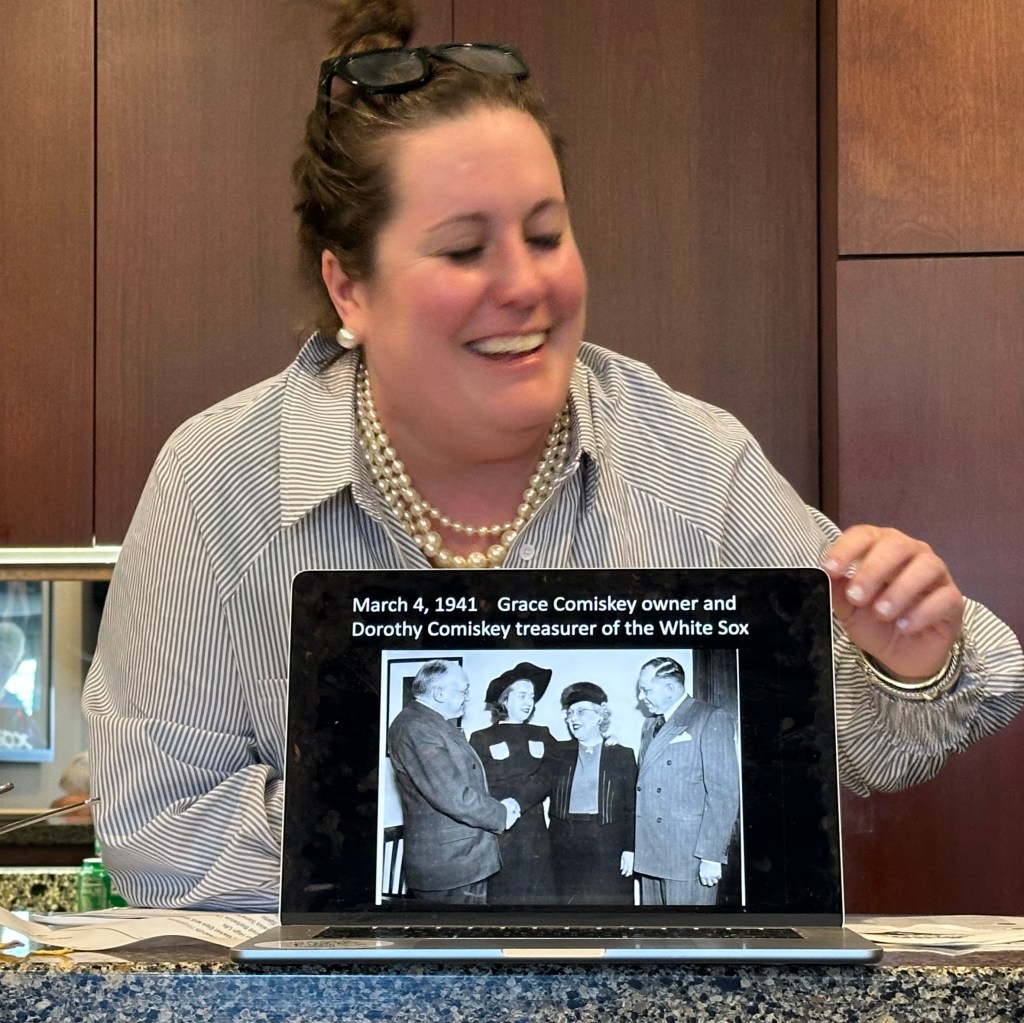
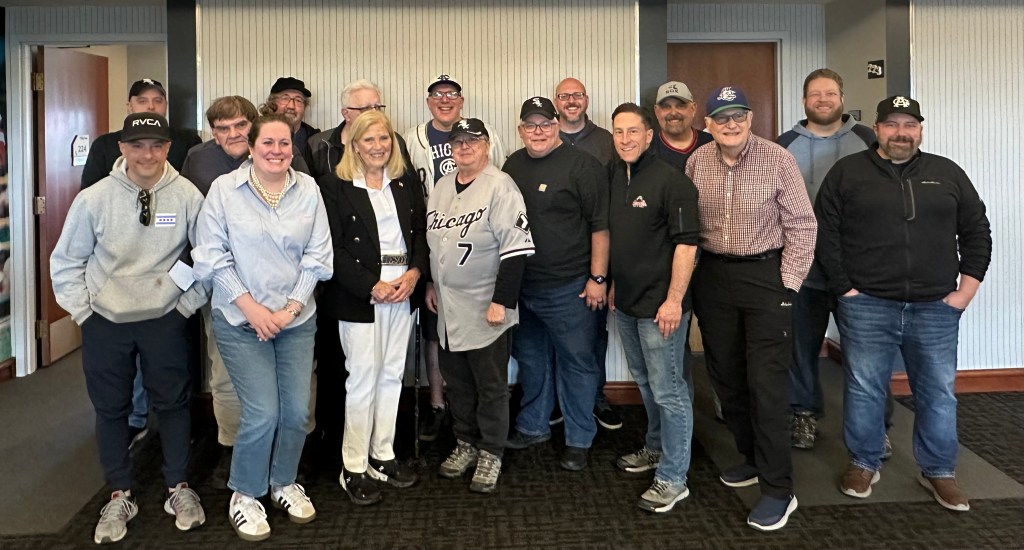
A tremendous SABR Chicago event starring Charles Comiskey researcher Mary O’Malley brought me to Rate Field, formerly known as Guaranteed Rate Field, formerly known as U.S. Cellular Field, formerly known as Comiskey Park (but not THE Comiskey Park), for my second White Sox game of the year.
Mary O’Malley regales Suite 224 with an outstanding presentation on the Comiskey family
Though the Sox blew a 9th inning lead and 9th inning comeback, it was hard to remember a better day at the ballpark. Apart from the game action, which was as dramatic as it was inevitable, the “bonus content” was almost too much to fathom. For one thing, our suite enjoyed a visit from Charles Comiskey’s great-granddaughter Patti Bellock, who couldn’t have been a warmer guest or better storyteller.
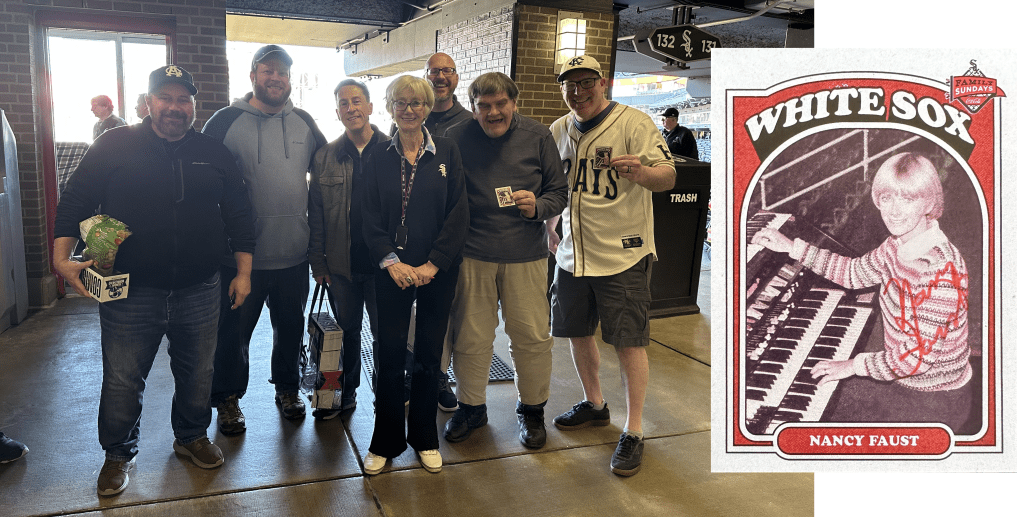
There was also a meet-and-greet with legendary organist Nancy Faust after the game, complete with signed trading cards!
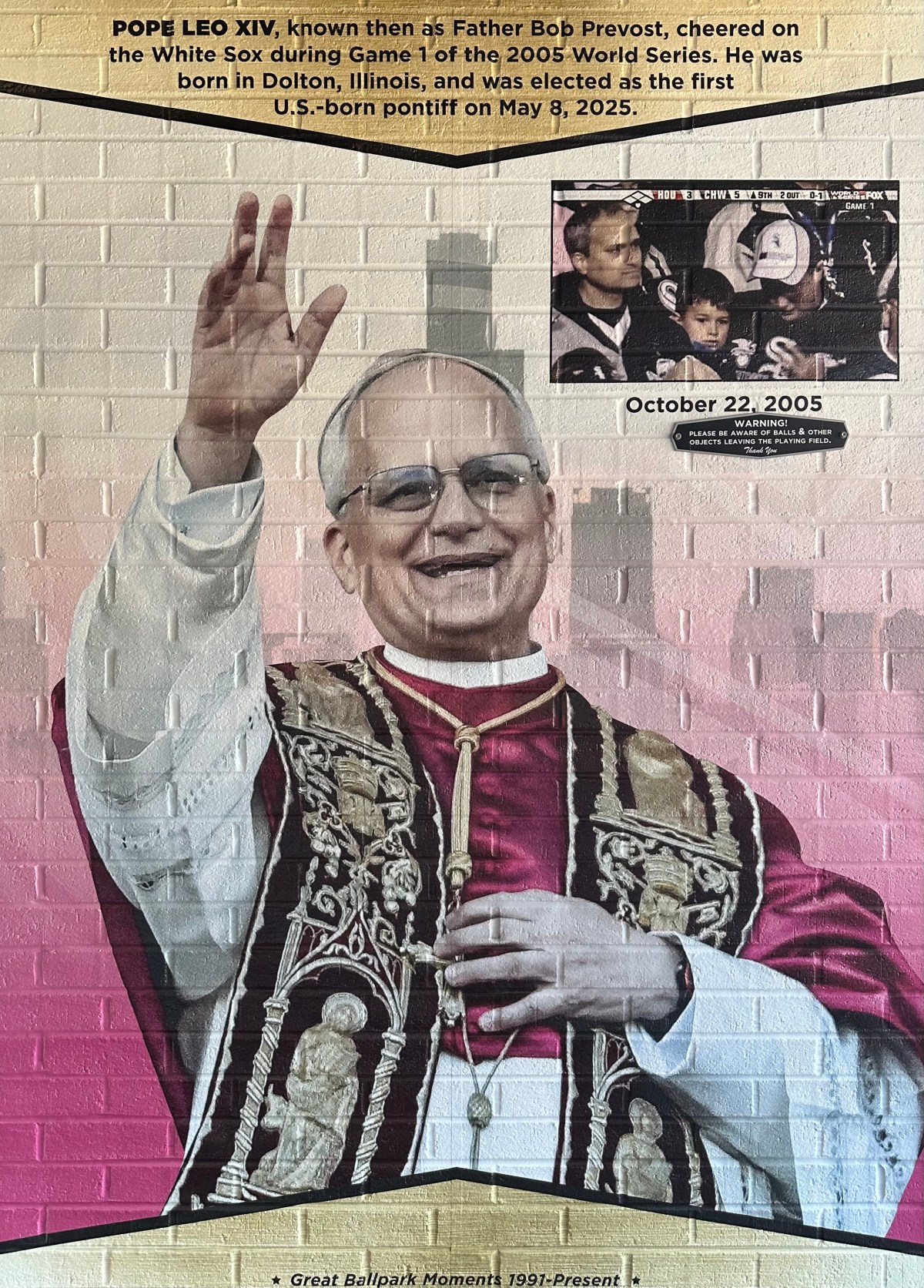
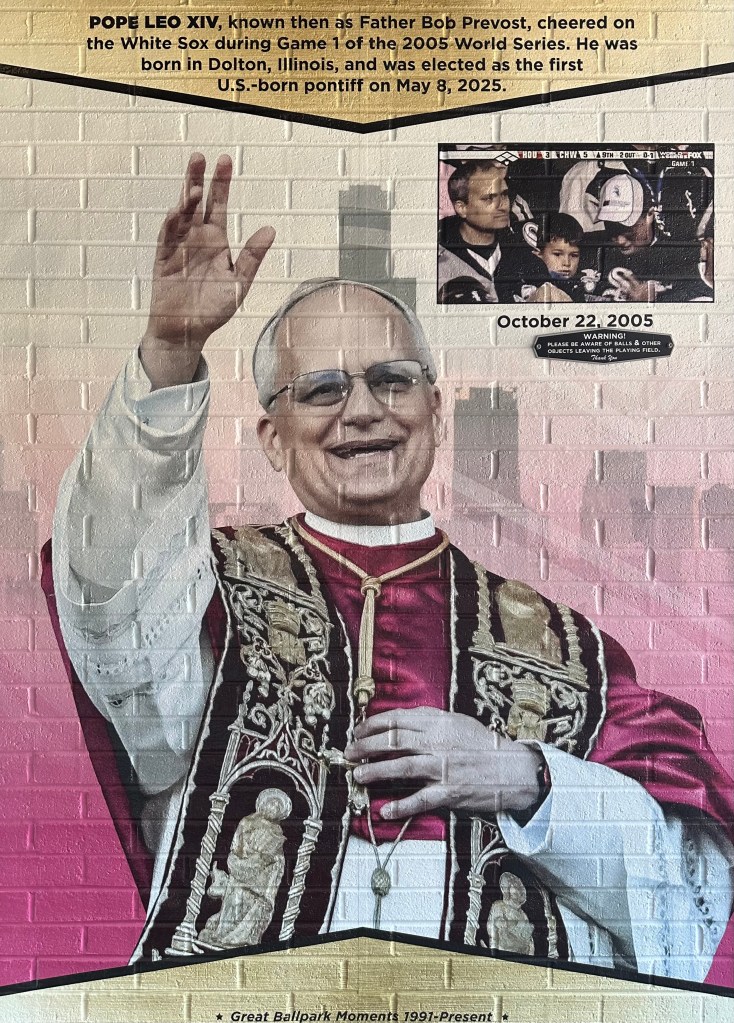
Finally, the game afforded a chance to visit the ballpark’s most newest, albeit unofficial, SABR Landmark, a mini-mural of the world’s most famous White Sox fan, Pope Leo XIV.
The installation is the latest in the Rate’s “Great Ballpark Moments, 1991-Present” series, somehow not yet rebranded as “First Rate Moments” to go with the stadium’s new name. As a testament to the new Pope’s popularity, a pre-game photo-op in front of Leo might have been the longest line of the day.
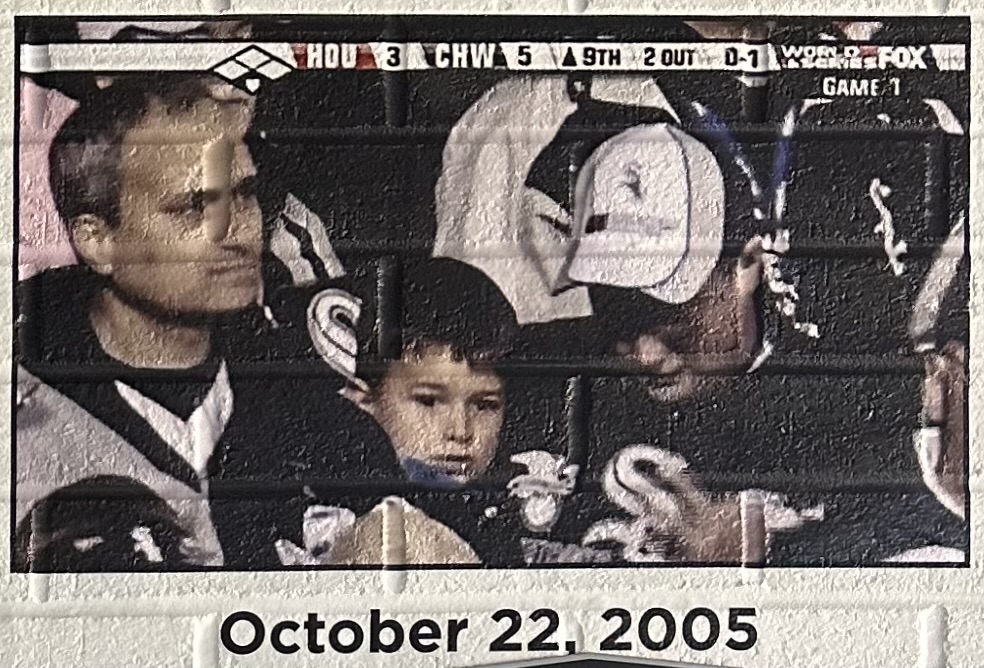
The mural’s placement, at the entrance to section 140, was selected to mark the former Father Bob’s seats at the 2005 World Series. A small inset graphic on the mural captures a moment from the first game of the series when Prevost was somewhat miraculously captured on camera.
Following an interview with the new Pope’s brother and the unearthing of this Fall Classic footage, there was no lingering mystery as to whether Leo was a Cubs fan or a Sox fan. However, that’s not to say the World Series image is wholly (or is that Holy?) without mystery. Beneath Pope Leo’s jacket, he appears to be wearing a jersey, but here’s the question: Which one?
Though today Leo may issue any number of Papal Bulls, a Greg Luzinski jersey is out of the question given that the four-time All-Star retired several years before the Sox donned the black pinstripes. Besides, if the Pope was looking to go throwback, would he not choose Don Pall? Similarly, Frank Thomas seems unlikely. After all, how could one reconcile the Pontiff’s pleas for peace and compassion with a hero known as the “Big Hurt?”
Given that Leo is not just Leo but Leo the Fourteenth it would be fitting indeed if he was rocking a Paul Konerko #14 jersey. Of course, how could Leo have known back then that he would someday be Pope? Lacking such prophecy, perhaps his fondness for the Apostle’s Creed might would instead have led him to a number 24 jersey.
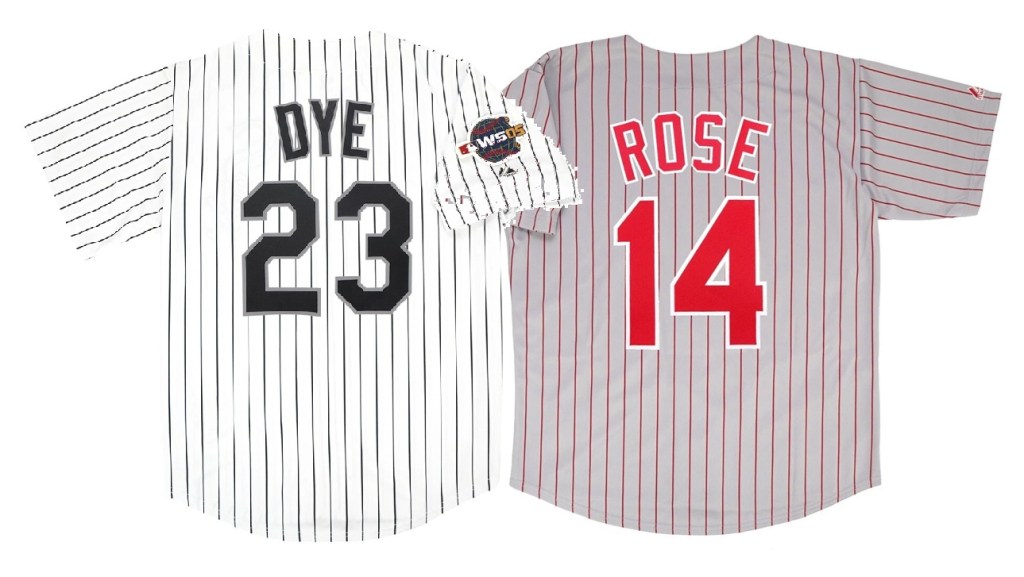
Potentially, Prevost might have gone double duty with a 23 jersey, paying homage not only to Michael Jordan but to key Sox pickup Jermaine Dye. Provided he could forgive Baseball’s greatest sin, could the clergyman rep Easter weekend any better than Dye on Friday, Rose on Sunday?
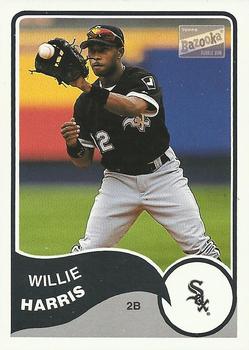
As with much in this world, we may never know the answer. About all we can do is petition the Lord in prayer. “Willie Harris?” you might ask, but you tell me: Is the Pope Catholic?!
I am really excited to share the story of my day trip on January 3, 2025 to visit Gil Hodges’ hometown of Petersburg, Indiana.
Let me first explain for those that might not know. Gil Hodges was born in Princeton, Indiana but Petersburg was his hometown.
Petersburg is in southwest Indiana, about a 30-minute drive east of U.S. 41, in Pike County. I live in Terre Haute. Terre Haute is north of Petersburg on the central west edge of Indiana (at the intersection of U.S. 41 and Interstate 70). Princeton is about thirty minutes southwest of Peterson (at the intersection of U.S. 41 and S.R. 64).
I visited Petersburg and Princeton on this trip. It took me only about an hour and thirty minutes to drive from Terre Haute to Petersburg; a very easy drive, mostly on good state roads and national highways.
I visited sites in Petersburg and was fortunate to spend a little time with a man who knew Gil and the Hodges family. I’ll tell you more about that man later. While in Petersburg, I visited:
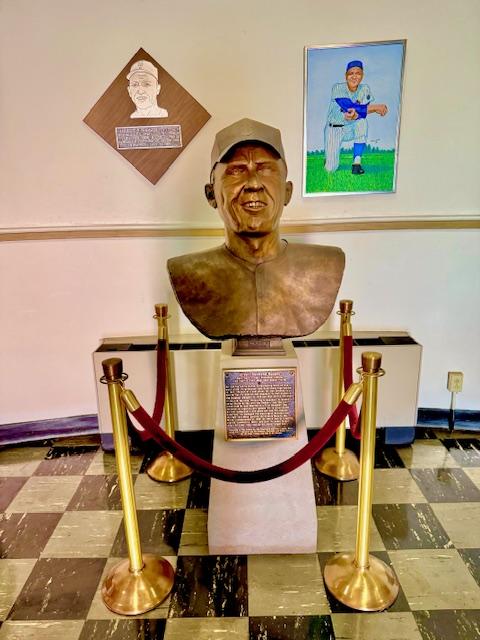
Pike County Courthouse to see the bronze bust of Gil Hodges in the rotunda,
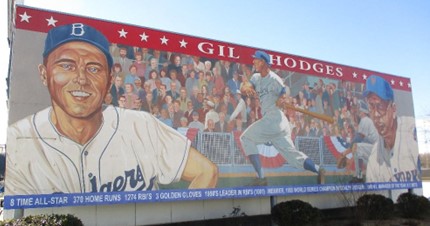
Mural of Gil Hodges that is across the street from the Courthouse,
Bridge that is named for Gil Hodges, and
Boyhood home of Gil Hodges.
I’ll tell you a little bit about each and share pictures and videos that I took that day.
In Princeton, I visited the ballpark that is named for Gil Hodges. I’ll show you pictures and a video that I took there, too.
Gil Hodges Bronze Bust in the Pike County Courthouse
The bust is on the main level of the courthouse. It was created by sculptor Don Ingle and dedicated on June 14, 1997. Randy Harris, Mayor of Petersburg at the time, led a two-year fundraising project and was instrumental in getting the bust made and placed at the courthouse.
One thing to remember if you visit, be sure to go when the courthouse is open (weekdays) if you want to be able to get inside to see the bust!
Gil Hodges Mural
The Gil Hodges mural is across the street from the courthouse. You can’t miss it! It’s fantastic to see and very well done. The 52’ X 16’ mural was first completed and dedicated in 2009. Again, then-Mayor Randy Harris had a hand in this project. In 2022, following Gil’s induction into the National Baseball Hall of Fame, the mural was updated to include the HOF logo and a plaque commemorating Gil’s enshrinement. For some reason, these features were missing on the day that I visited. The mural was created by artist and Petersburg High School graduate Randall Heddon. Heddon also created the picture of Gil in his Mets uniform that hangs on the wall next to the bronze bust in the courthouse.
Gil Hodges Bridge
The Gil Hodges Bridge is on State Road 57 as it crosses the East Fork of the White River, on the north edge of Pike County. The bridge is only about a 10-minute drive from downtown Petersburg. This picture below provides a view of the sign on the south side of the bridge (looking in a northerly direction).
Gil Hodges Boyhood Home
I learned from visiting with people in Petersburg that the boyhood home of Gil Hodges is located at 1401 E. Main Street. The home is only a few blocks east of the courthouse (at the SE corner of Main and 14th Streets). I learned that when Gil’s mother passed away, the house was sold. The same family that purchased the house from the Hodges family seemingly still owns the property.
Gil Hodges Ball Park (Princeton, Indiana)
Gil Hodges Ball Park is centrally located in Princeton adjacent to Lafayette Park. The street address is 700 N. Lafayette Park Drive. The ball park looks to be in awesome condition.
If you’re looking for a place to eat or get a milkshake, I highly recommend Dick Clark’s Family Restaurant at 702 N. Prince Street in Princeton.
Wrap Up
Gil Hodges was born on April 4, 1924. As of the day of my trip, he would have been 100 years old. I am a really big fan of the New York baseball teams and players from the era in which Gil Hodges played. I love reading and learning about the Boys of Summer, Willie Mays and the New York Giants, and of course Mickey Mantle, Whitey Ford and some of those Yankees teams. What a great era for baseball. While I didn’t get to see these players and teams in person, I have been fortunate to make friends with people who did.
I’ve learned so much from being part of the New York Giants Preservation Society. I encourage you to check them out if you don’t already follow them. One more thing about the Brooklyn Dodgers…..I was lucky to shake Carl Erskine’s hand on an airplane once. He boarded a flight in Denver (to Indianapolis) after I had already taken my seat. As he passed by my seat, He could tell by the expression on my face that I recognized him. He reached out, smiled, and shook my hand. Neither of us said anything, but we both knew. What a thrill for me. Erskine…. another baseball hero of mine from Indiana. Anderson, Indiana (hometown of Carl Erskine) is likely the next place I’m heading for a day trip!
I almost forgot to tell you about the man I met from Petersburg. His name is Randy Harris. Randy is a former Mayor of Petersburg. He currently sells real estate and has an office on Main Street (just a couple blocks west of the courthouse). For a time, Randy owned and operated a restaurant called Randy’s Americana Café. I called and introduced myself to Randy. Not knowing about his personal connections to Gil and the Hodges family, I called and told him I was coming to town to visit sites and wanted to make sure this café was going to be open. Mr. Haris explained that he had sold the restaurant but told me I was welcome to stop by his real estate office when I was in town. I could not have imagined getting so lucky. Randy told me stories about growing up in Evansville and Petersburg, and about Gil and his family. Randy knows all about the bust and mural. I encourage any of you that visit Petersburg to see Gil Hodges sites to call Randy Harris. He’s a great guy with great stories.
It is very nice to see that Gil’s legacy is celebrated in Petersburg and Princeton. Gil passed away at 47 years-old from a heart attack. During his very short life, he seemingly had a significant impact on the people he knew.
Clem Labine is quoted as saying “Not getting booed at Ebbets Field was an amazing thing. Those fans knew their baseball, and Gil was the only player I can remember whom the fans never, I mean never, booed.”
Pee Wee Reese is quoted as saying “If you had a son, it would be a great thing to have him grow up to be like Gil Hodges.”
Arthur Dailey of the New York Times is quoted as saying “He (Hodges) was such a noble character in so many respects that I believe Gil to have been one of the finest men I met in sports or out of it.”
Gil’s plaque at the courthouse concludes “Gil was a man of integrity, dignity, community, family and God. He never forgot where he came from, and we will never forget him.”
Thanks Gil for being a great ballplayer. Thanks for giving us great baseball memories and for being such a good teammate and person.
This is my first blog. Thanks for reading.
So happy I made this trip!
Greg Phegley
Links to the videos I made during my trip are below.
I was fortunate enough to spend the start of July in one of the world’s great cities, Montreal, home to the Expos from 1969 to 2004. Of course the baseball history (and baseball card history!) of Montreal stretches back much further than that.
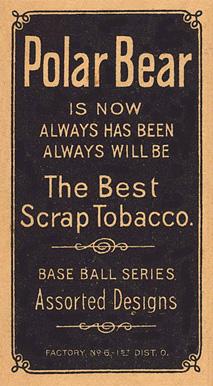
The Montreal Royals joined the International League in 1897 and went on to win seven league titles, all between 1941 and 1958. A Montreal Royal, James “Doc” Casey, is even represented in the 1909-11 American Tobacco Company “White Borders” (T206) set affectionately dubbed “The Monster.”
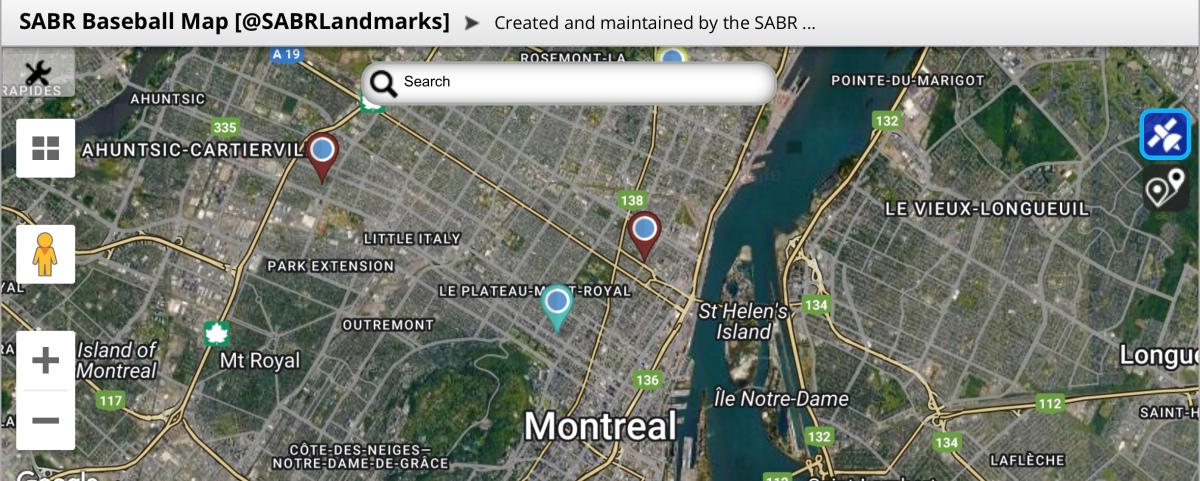
Of course, the most famous Royal of them all played for the 1946 Montreal squad, recognized as one of the top 100 minor league teams of all-time. A pleasant half hour walk through some fun and artsy neighborhoods brought me to his colorful mural at 3907 St. Laurent Blvd.
From there, I had two choices. Walk back to my hotel or walk another 30-40 minutes to hit another Jackie Robinson landmark. I chose the latter.
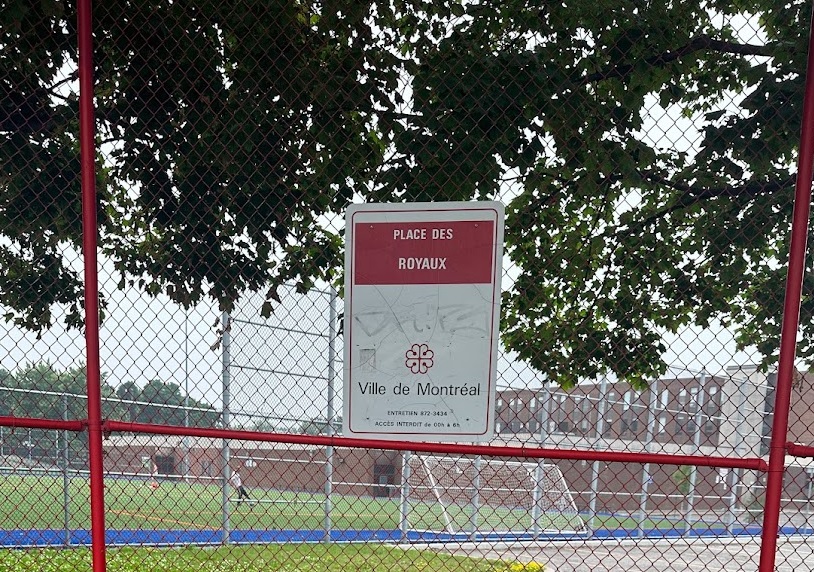
The Montreal Royals of Jackie’s time played their games at Stade De Lorimier (pronounced duh-lor-eem-yay). The ballpark is long gone, but the city has commemorated the “place of the Royals” with a…dingy metal sign?!
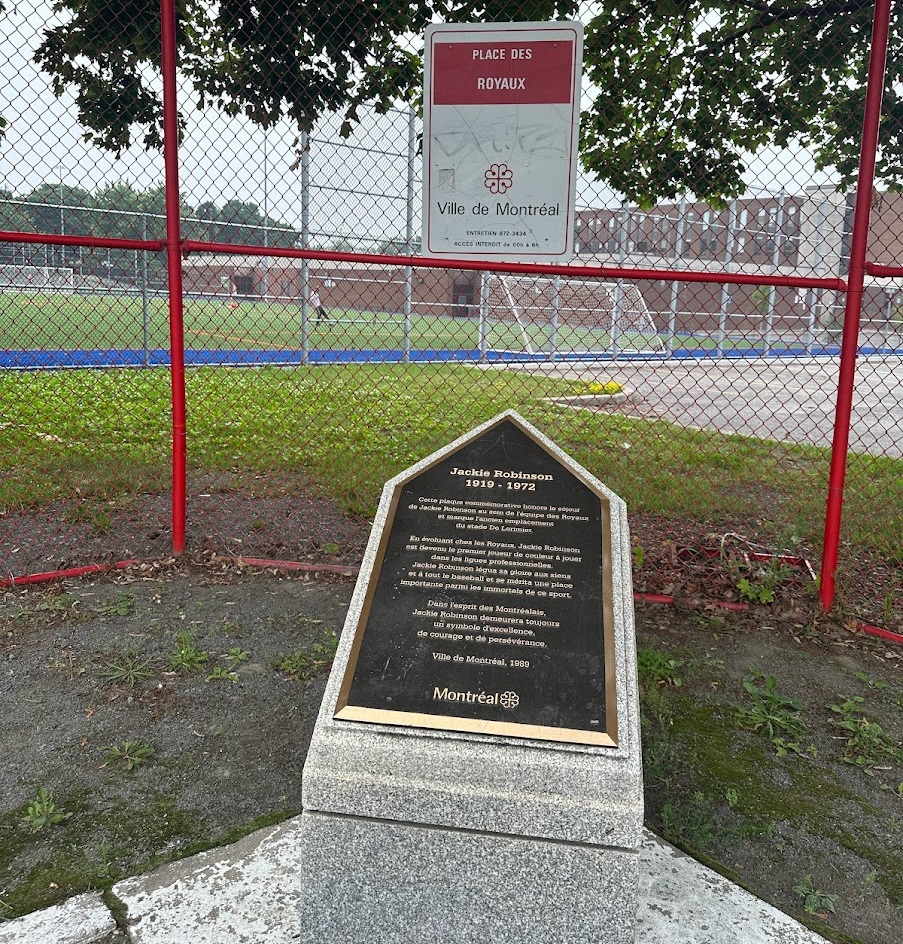
Okay, so that’s only half true. Yes, the marker could use an upgrade, but there is also an excellent tribute to Jackie Robinson just below it.
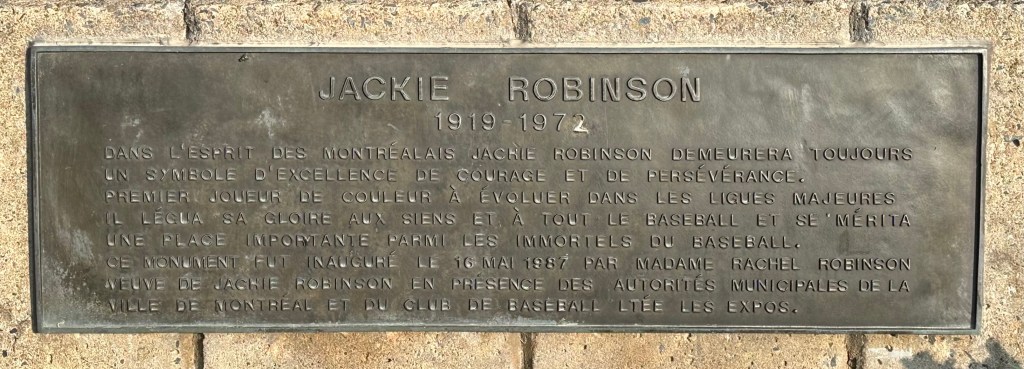
Loosely translated to English, the words on the sign read—
This commemorative plaque honors Jackie Robinson’s stay with the Royal team and marks the former location of De Lorimier Stadium.
By playing with the Royals, Jackie Robinson became the first player of color to play in professional leagues.
Jackie Robinson bequeathed his glory to his family and all baseball and earned an important place among the immortals of this sport.
In the minds of Montrealers, Jackie Robinson will always remain a symbol of excellence, courage and perseverance
City of Montreal, 1989
You may have noticed the plaque takes the form of home plate, and this is no coincidence. In fact, it is part of a larger mini-ballpark, complete with outfield grass and bleachers.
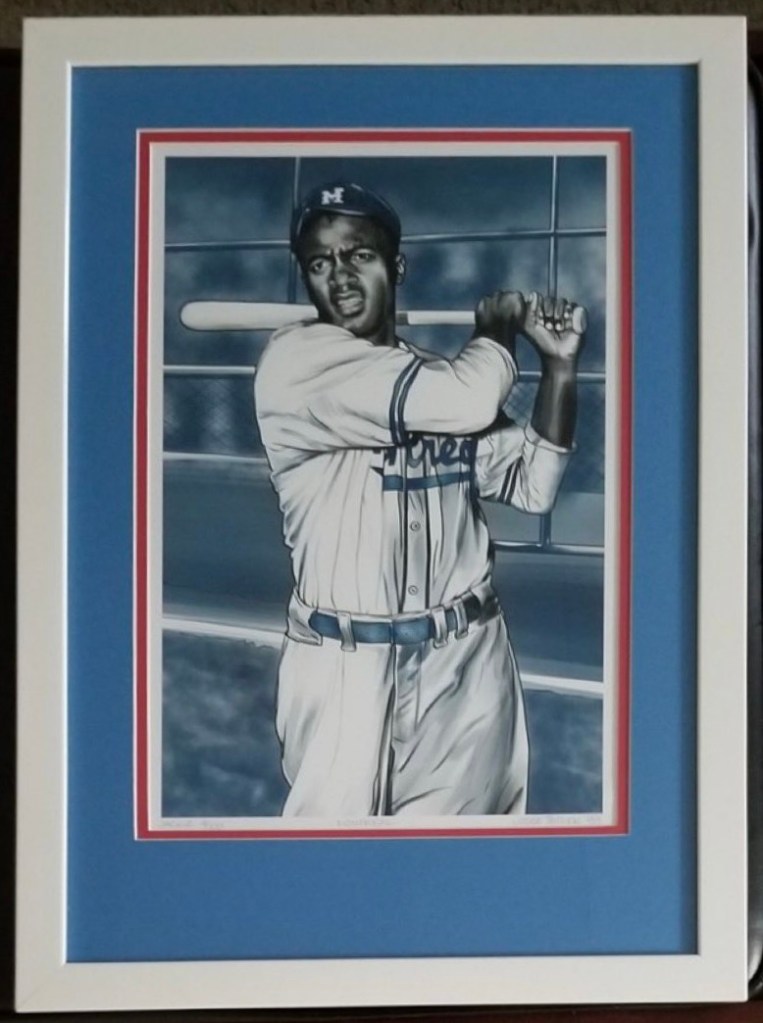
Though there were other landmarks I might have made by foot, I already had plans to tour them the next day with Montreal baseball artist Josée Tellier, whose wonderful Jackie Robinson artwork adorns the entrance to our guest room.
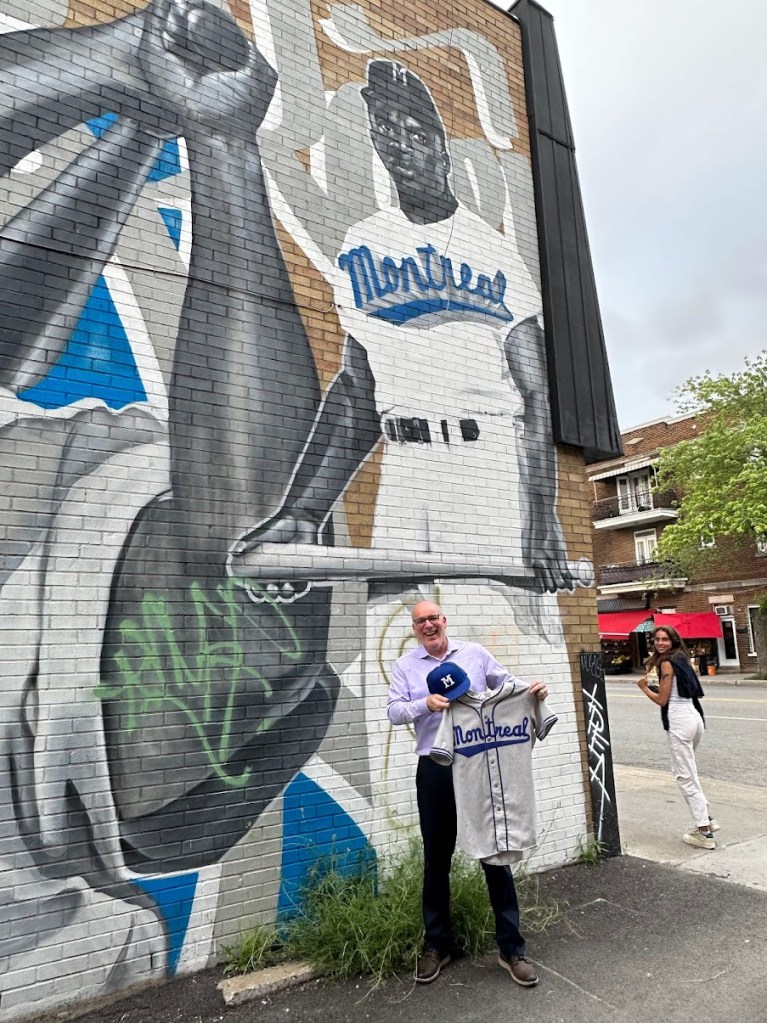
As this second day of landmarks was more distant from my hotel, we caught a cab to their general vicinity before setting out on foot. Our first stop was Jackie’s second mural in Montreal. If you look closely you’ll notice one of the locals totally not thinking what I’m doing is super dorky.
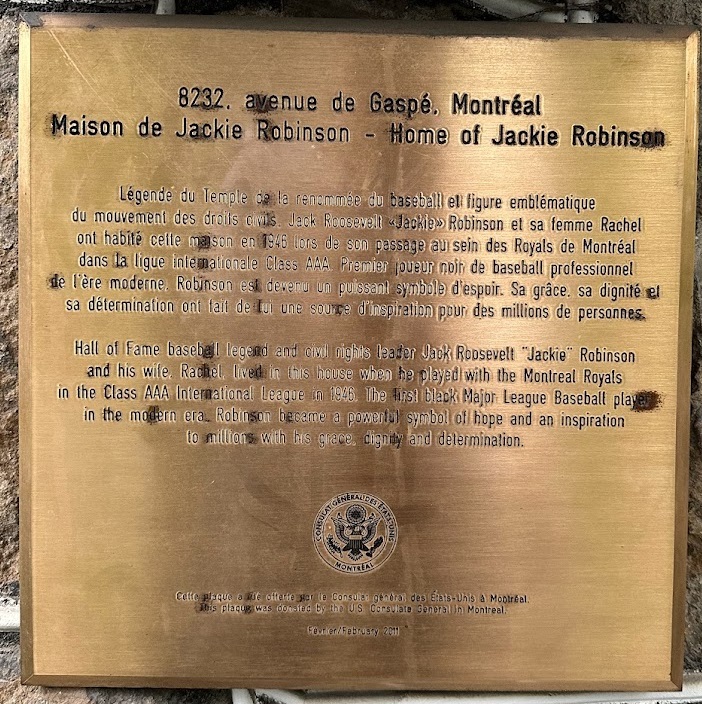
We were definitely in Mr. Robinson’s neighborhood now, or more correctly Mr. and Mrs. Robinson’s neighborhood. As proof, here is the house just a few blocks away that Jackie and Rachel called home in 1946.
Here is a closer look at the plaque by the door. (Note the bottom half presents the English translation.)
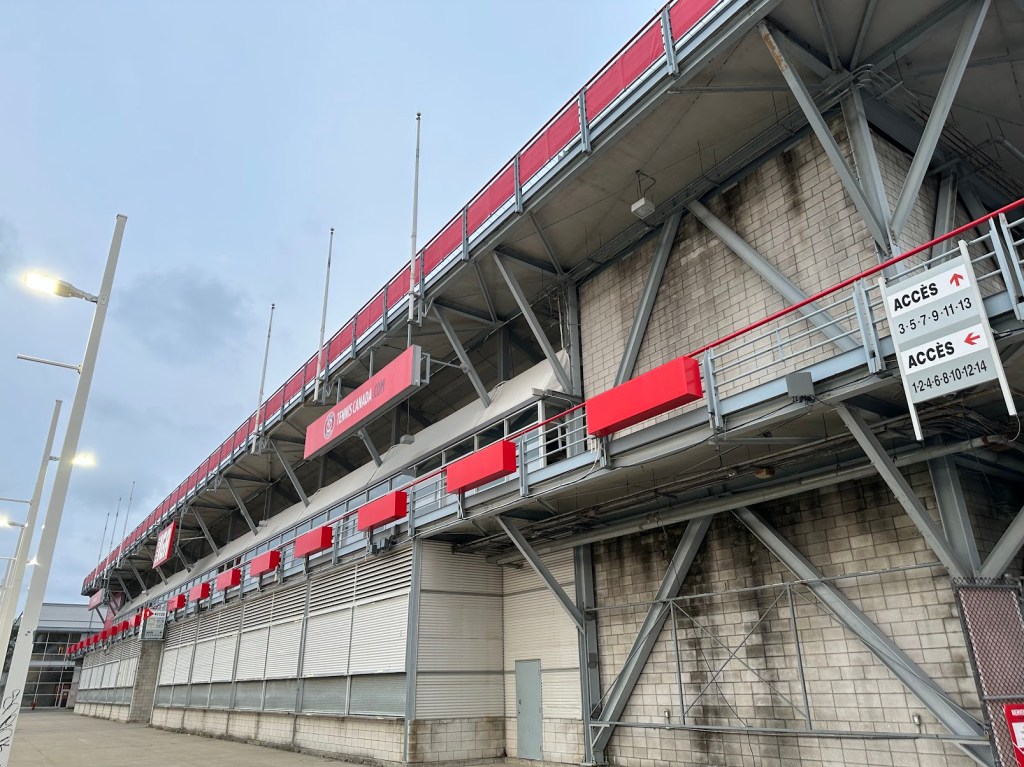
Our final landmark for the evening was nearby Jarry Park, home of the Montreal Expos from 1969-76. A small portion of the original stadium structure still remains as part of a newer tennis facility.
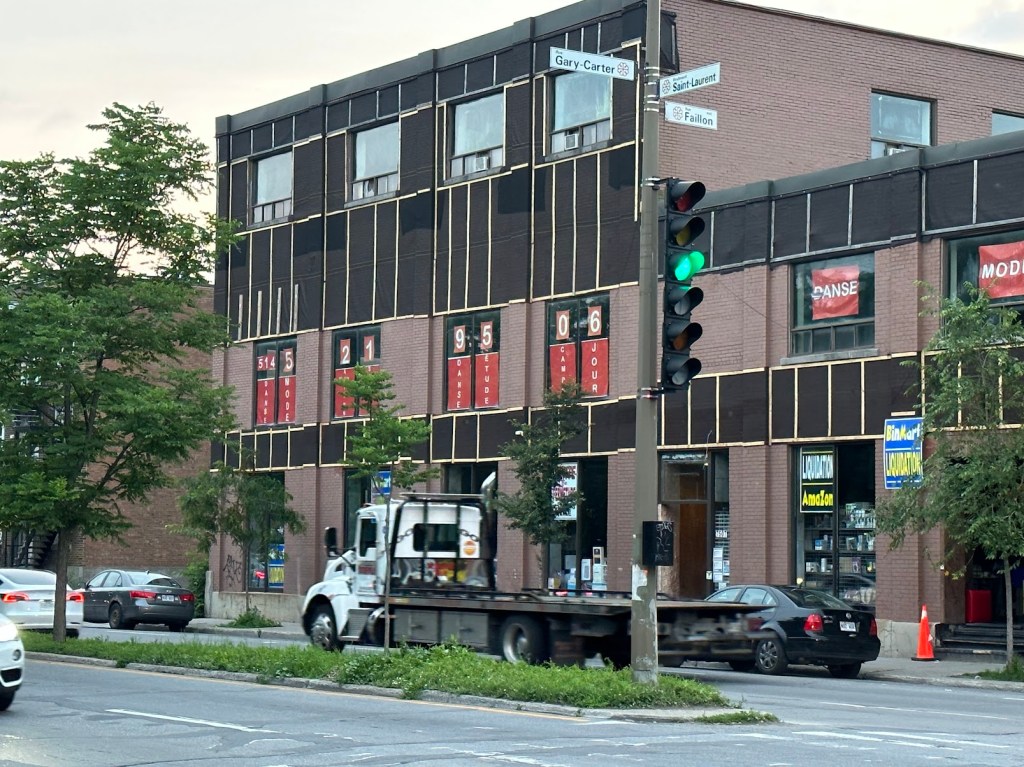
The street name equally serves to remind visitors that a beloved major league team once played here.
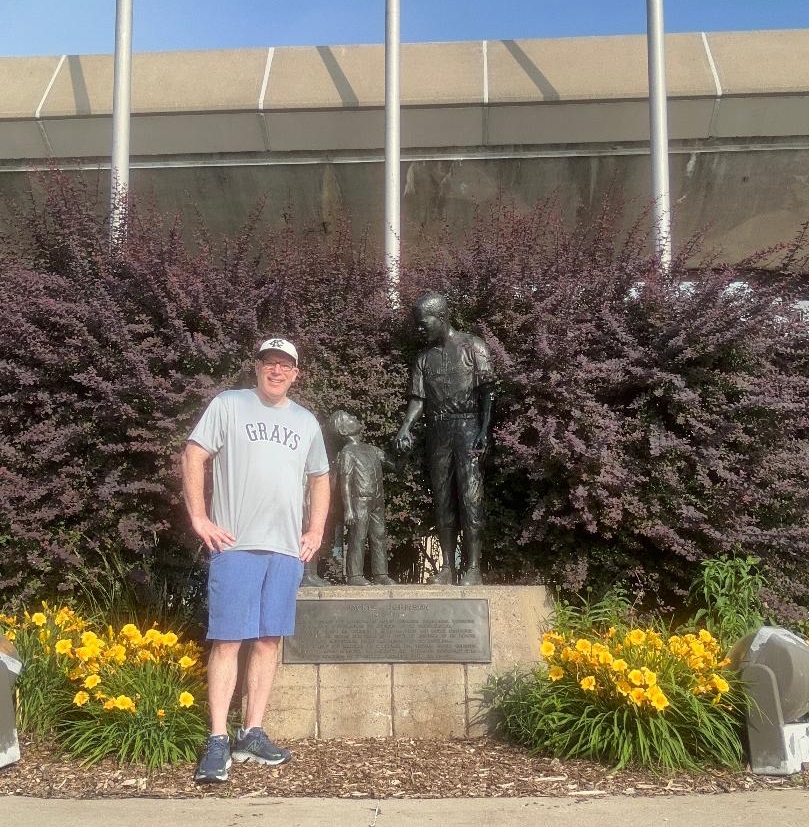
As we wrapped up this round of landmarks, Josée made sure I knew there was one more Jackie Robinson landmark we didn’t cover because it was too far away: the Jackie statue at Olympic Stadium. Lucky for readers of the Hardball Voyager, I got up the next day at 5 AM and decided a 7-mile walk wouldn’t be completely insane.
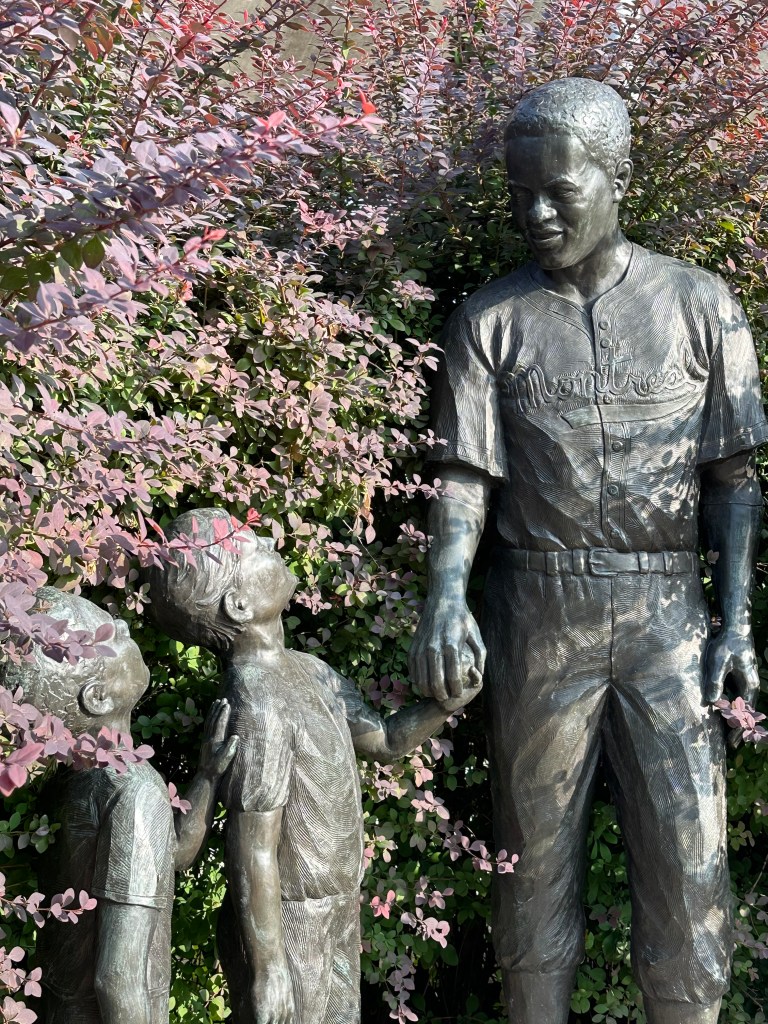
Here is a view of the statue without some guy blocking it.
And here is a close-up of the plaque.
Finally, here is the statue from further away. Olympic Stadium is the giant flying saucer-looking thing behind it.
Olympic Stadium was of course home to the Expos from 1977 until 2004, after which MLB relocated the team to Washington, DC. (Boo! Bud stole the Expos!) Amid all today’s talk of expansion and relocation, there are high hopes in Las Vegas, Nashville, Salt Lake City, and Portland but only the dimmest of forecasts for a return to Montreal.
Still, right in front of this stadium without a team stands Jackie—in what now may be recast as an act of defiance—handing the ball to the next generation, refusing to let the game die. I guess time will tell, at least here in Montreal.










 The Hardball Voyager