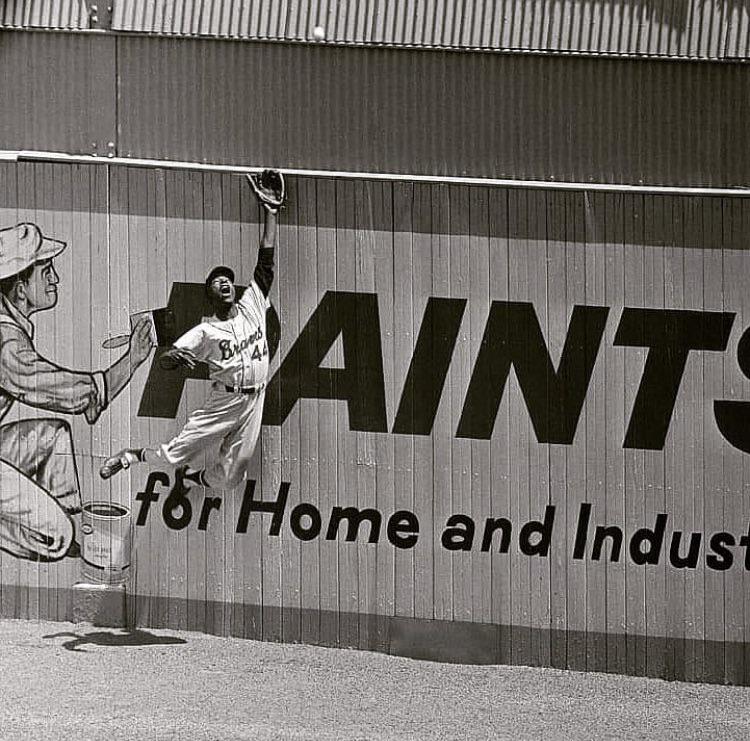
Hank Aaron Project

Since late August I have been on a quest to log every pitching appearance in the extraordinary life and baseball career of Hank Aaron. Now before anyone loses their cool here, I’m well aware that Aaron played the outfield, winning three Gold Gloves to boot, but I’m also aware of something else: Aaron made more money in his career as a pitcher than in the outfield.

Confused? Then perhaps it’s time to clarify. Aaron wasn’t pitching baseballs. He was pitching television sets, specifically Magnavox television sets, a side hustle for which he was paid a cool million dollars over five years.

“I’m Hank Aaron and I want you to meet the winning team from Magnavox.”

Naturally a project of this magnitude requires that work be done in phases. At the moment, I am only releasing Aaron’s work as a Magnavox pitchman in the immediate aftermath of the 1974 baseball season.

With hopes that my friends at the SABR Baseball Map will eventually make this interactive, here is an early what is likely the most ambitious undertaking to date to map the Hammer’s work as an appliance salesman in October 1974.

In all, the Great Hank Aaron Magnavox Tour of 1974 had five phases, each represented by a cluster of location markers on the map.

  • October 8-10, 1974 – “Spring Training” at Magnavox plants in Tennessee and North Carolina
  • October 15-16, 1974 – Appearances at four Bay Area Magnavox dealers (Daly City, San Francisco, Concord, Oakland). Also attended Game 5 of the 1974 World Series while in Oakland.
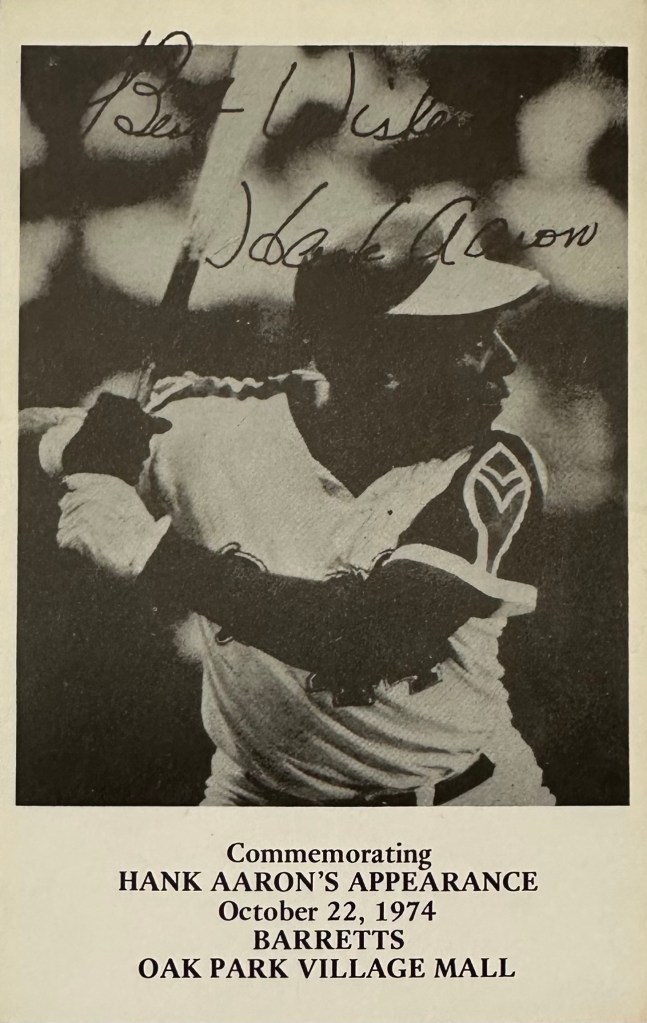
  • October 22, 1974 – Appearance at Magnavox dealer in Oak Park, IL
  • October 26-28, 1974 – Sponsored appearances at Magic Mountain theme park in Valencia, CA
  • October 30, 1974 – Appearances at four NY/NJ area Magnavox dealers (Staten Island, NY; Roxbury, NJ; Wayne, NJ; Paramus, NJ)
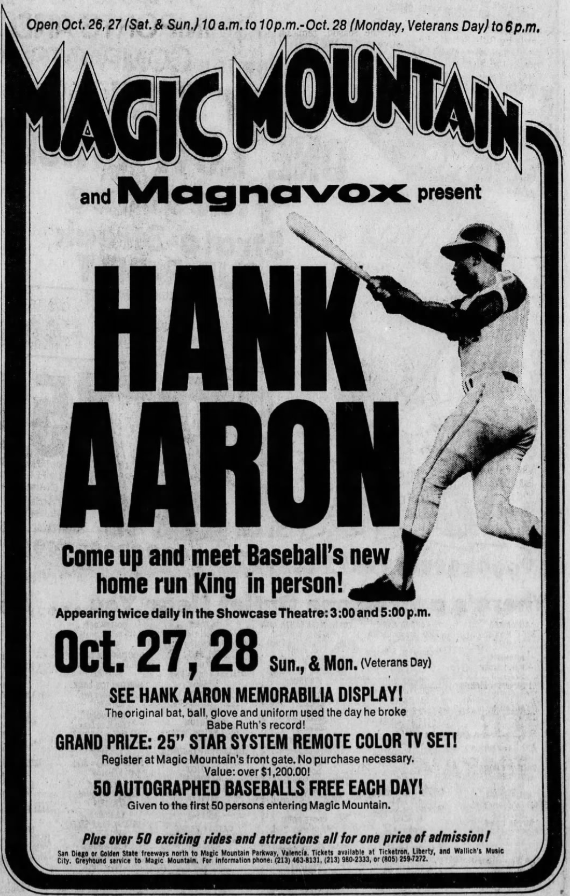
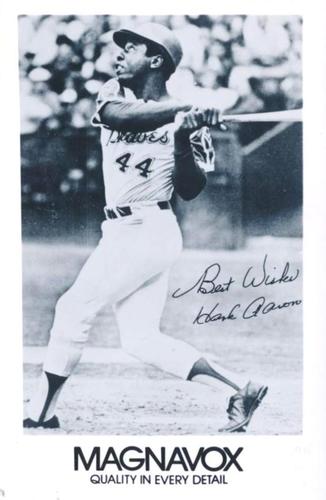
To the chagrin of the Hammer’s biggest fans, the dealership appearances were too frenzied and brief to support autograph requests. Some even bordered on violent. However, many attendees went home with specially produced baseball cards that included Aaron’s facsimile signature, and some even took home bigger prizes.
In the case of Aaron’s lone Midwest appearance, the card giveaway even identified the date and venue, though Hardball Voyagers hoping to visit the historic locale today will be sorely disappointed.
Having crisscrossed the country several times over as part of his tour, which began only days after hitting home run 733 in Atlanta’s season finale against the Reds, it would be natural to imagine the game’s newly crowned Home Run King would be ready for a break. Instead, however, the 40-year-old Aaron hopped a plane to Tokyo the very next day and on November 2 defeated Japanese slugger Sadaharu Oh in a home run hitting competition.

* * * * *

Author’s Note: Feel free to use the map and source data however you wish. But the Project is still very much a work in progress so your input would be appreciated. Specifically, if you come across any tour stop that is not here please let me know (jason DOT 1969 AT yahoo DOT com). If there are errors in any of the Magnavox locations, or if there are any errors in the appearance dates, please pass those on as well.
Grave Hunting Adventure in Oregon (with an Unexpected Surprise)

By: Adam J. Ulrey

Looking for Baseball Graves and there was a surprise I wasn’t expecting…

It was a beautiful 75 degree day in Oregon and a perfect day to go grave hunting. I set out in the morning from Creswell, Oregon to hit four graves starting in Independence and then moving onto the final three that were all in Salem, Oregon.

It was a beautiful drive up to outside the little town of Independence, Oregon looking for the grave of Ed Mensor. The Buena Vista Cemetery was up on a hill overlooking the valley below. Driving up the one-lane gravel road, I knew there would be no map or for that matter a number to call. So it would be looking at every grave until I found Mr. Mensor.

The surprise I found was as I was looking. I completely forgot that my cousin was buried here as I ran across his stone. He was only 36 and died after a battle with cancer. He was a wonderful person and I still miss him.

So I walked from the top to the bottom of the cemetery. There were about 200 plots and of course I found him after walking almost all of the cemetery. Ed Mensor played for the Pittsburgh Pirates from 1912-1914 as an outfielder. He batted .221 with one home run and eight RBIs for his brief career. He would play until he was 35 years old mostly in the minor leagues with seven other teams. Read a bit more about him here https://www.baseball-reference.com/bullpen/Ed_Mensor.

It was onto Restlawn Memorial Gardens in Salem about 22 miles away. So when I arrived, what a stark difference – I just came from a little cemetery on top of a hill to a place that had thousands of graves over a huge 10-acre parcel of land.

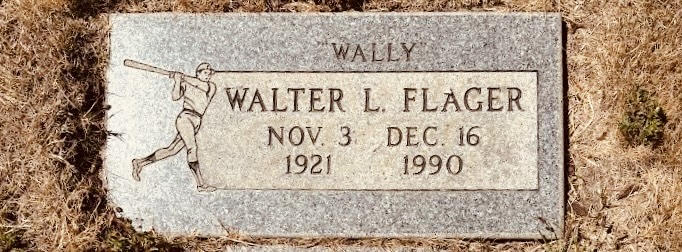
So I went in to the office and got a map and directions to the grave of Wally Flager. He played in the majors for one year but ended up playing for two different teams starting out with Cincinnati for 21 games and then onto the Pittsburgh Pirates for 49 games. He would hit a respectable .241 with two homers and 21 RBIs. He would play just two more seasons in the minors before leaving the game at 26 years old. He was buried on the front row of the section named Prayer. He served in World War II. You can read a bit more on him here https://www.baseball-reference.com/bullpen/Wally_Flager.

Onto my last stop which is where the final two players I set out to view would be. At Belcrest Memorial Park in Salem I found an even bigger place with thousands upon thousands of stones and burial sites. Thank God again for the office and the wonderful person who could show me on the map right where to go. I found Howard Maple, who played at Oregon State University before he would move onto the pros. He played only one year for the Washington Senators in 1932 getting into 44 games. He only had 41 at bats with 10 hits and seven RBIs. You can read about him at his BR-Bullpen site https://www.baseball-reference.com/bullpen/Howard_Maple.

After finding Howard Maple it was onto Max Marshall. He is interred in a space inside the funeral home with his wife. I found him after searching because the number and place they gave me was wrong – he was on the opposite side of where they told me. So even if they give you the coordinates, if you don’t find them search yourself as they are probably there. I imagine when you have thousands of people buried and entered it could be easy to write down the wrong number where someone is.

Max played for Wake Forest before moving onto the pros and playing for the Cincinnati Reds from 1942-44. He played mostly right field but ended up playing all three outfield positions. He started for the reds in both 1942 and 1943. He had 311 hits for his career with a .245 batting average. He hit 15 homers for his career. He played 12 years total and after playing his last game for Tulsa at the age 33 he would come back and play for Salem at 39 years old in the Western International League. Here’s a little bit of info on Max from the BR-Bullpen page https://www.baseball-reference.com/bullpen/Max_Marshall.

After nearly three hours listening to an old baseball game and driving over 100 miles I found all four, took the pictures, and marked the coordinates for all to find.

What a great fun day as I love to drive, and to help with the Landmarks Committee Project is icing on the cake. 

Second home

However much baseball has changed in my lifetime one aspect that has always stayed the same is the notion of a home team and an away team. This is true even when the two squads share the same ballpark (e.g., Dodgers/White Sox Spring Training) or play at a neutral site such as Mexico City or the Field of Dreams. After all, someone has to bat first.

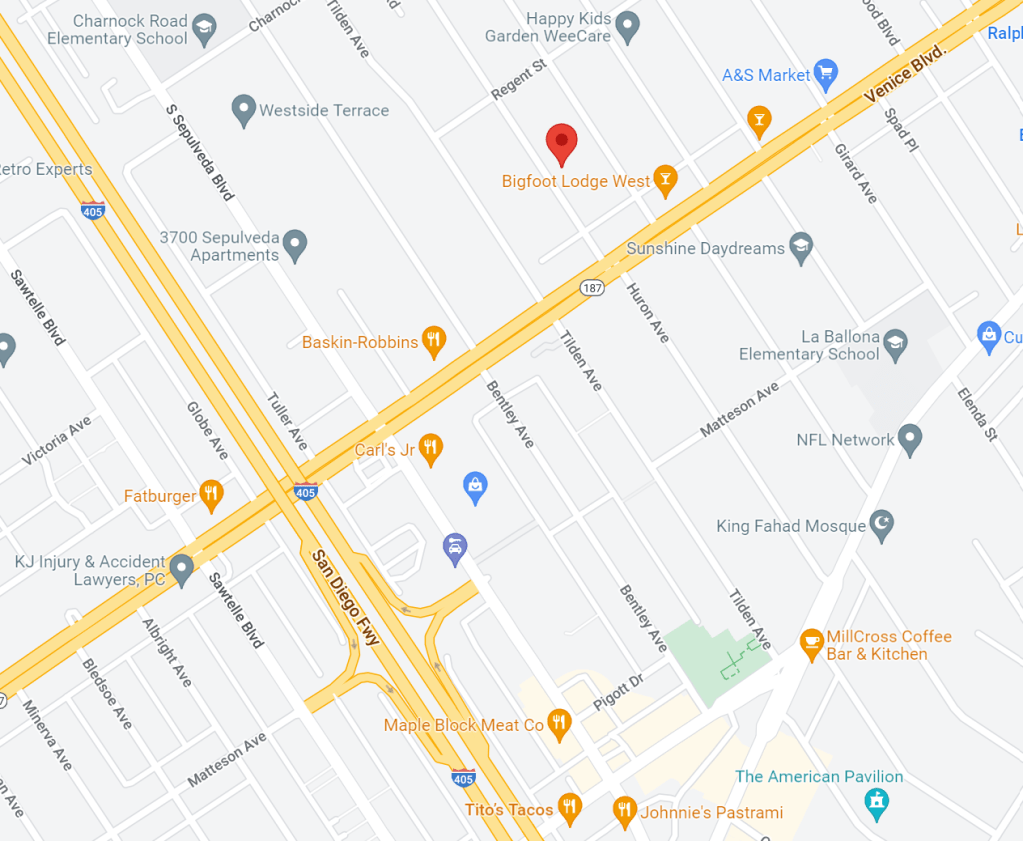
The same is true with people and places. As we find ourselves in different spots over the course of our lives, we are sometimes at home and other times visitors. As a kid, I knew one home and that was the Palms/Mar Vista area of Los Angeles. Until halfway through the eighth grade, I’d spent my entire life in the same house on the same street in the same neighborhood. (Why this house has since been re-branded “Bigfoot Lodge West” is beyond the scope of this article.)

The red pin on the map was our house and center of my universe. That school in the upper left corner, Charnock Road Elementary, was where I walked for first and second grade. Tito’s Tacos, at the bottom of the map, was where we’d go out to eat. The Baskin-Robbins in the middle is where we’d go for ice cream when guests were in town. And most importantly, in the same strip mall as Baskin-Robbins was the liquor store where I traded what I could skim from my mom’s parking meter change for pack after pack of baseball cards.

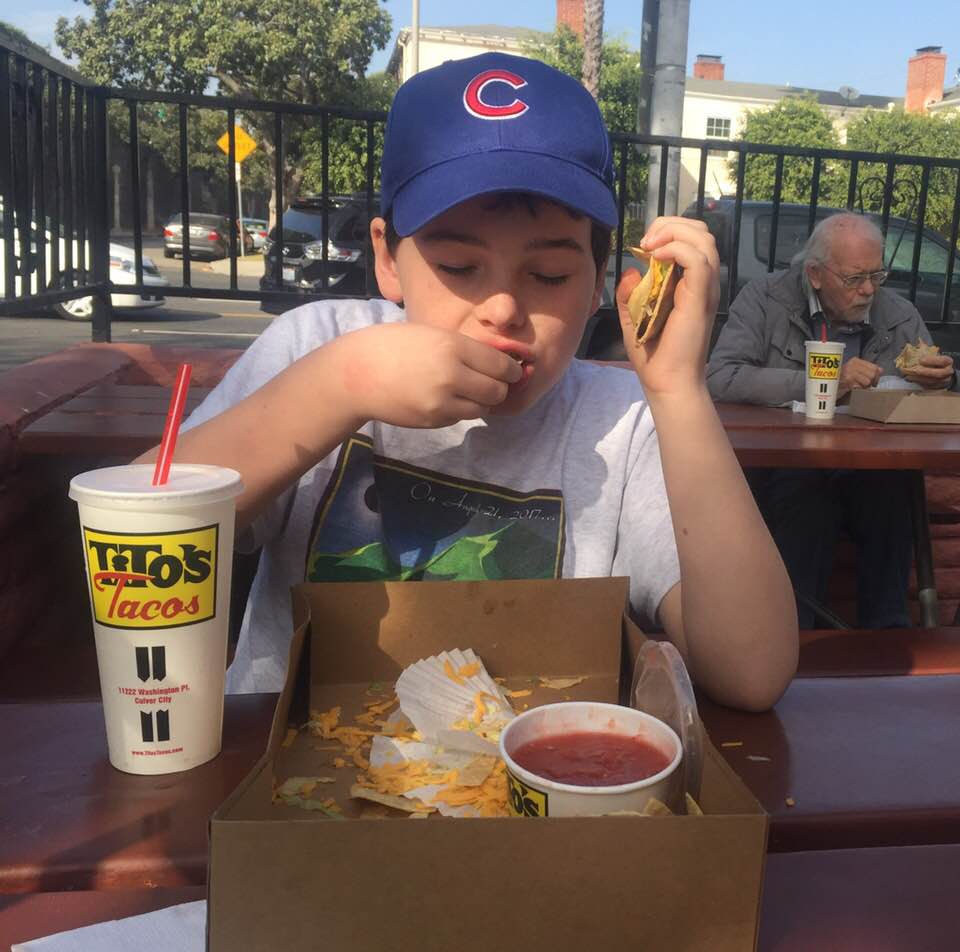
Every now and then I make the trip back to Los Angeles to see old friends and take in a Dodger game. Forty years later, the old neighborhood is part familiar, part unrecognizable. Make the mandatory trip to Tito’s and place the same order I’ve always placed (tacos with cheese), head down Venice Boulevard to Baskin-Robbins, and this is home. Pass just about anything else, even the house I grew up in, and I’m the visitor, connected to nothing I see.

My son keeping tradition alive, 2017

Los Angeles will always be home to me, but my connections have dwindled to a just four: high school buds, tacos, the Dodgers, and nostalgia. Not a bad four to keep, I suppose, but sure a lot less than in the old days. That’s what the decades do to a place. Things happen. Things change. The blessing, of course, is that my remaining touchpoints, while few, have all gotten better with age.

* * *

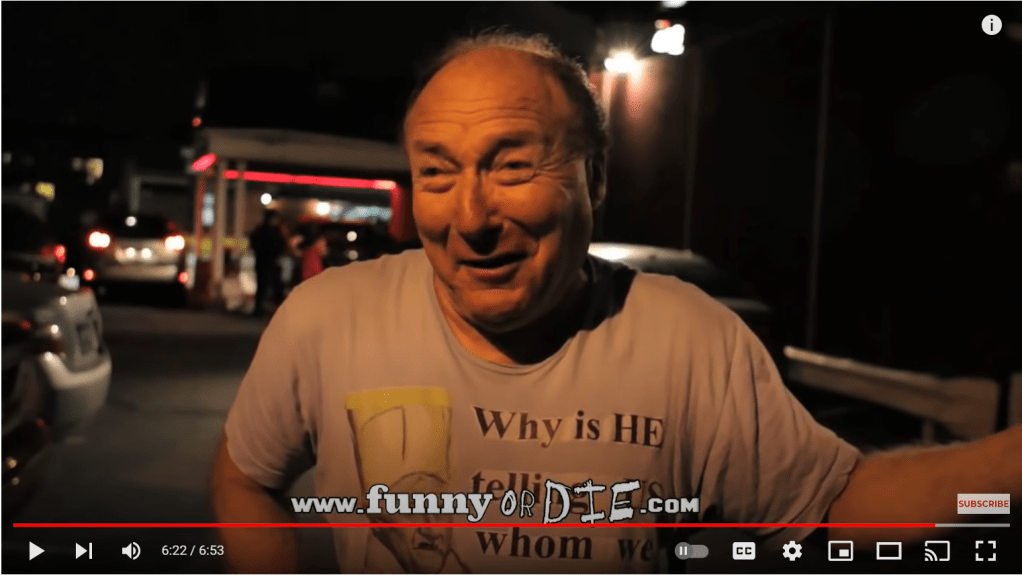
Only a few years ago there was a fifth connection to the city: family. My dad passed in October 2020, an indirect COVID casualty, but before that had spent a good 70 years of his life in L.A. That said, his true spiritual home was Venice, especially Venice Beach.

Locals, depending how far back they go, will remember him as the “cardboard sign man” of the 1980s and 90s, or–this century–as the “tee shirt guy.” In a town that prides itself on its freaks and crazies, my dad managed to lap the field, rendering the pretenders of this new urban Bohemia downright normal by comparison.

Accidental Jewel co-star Nelson Schwartz

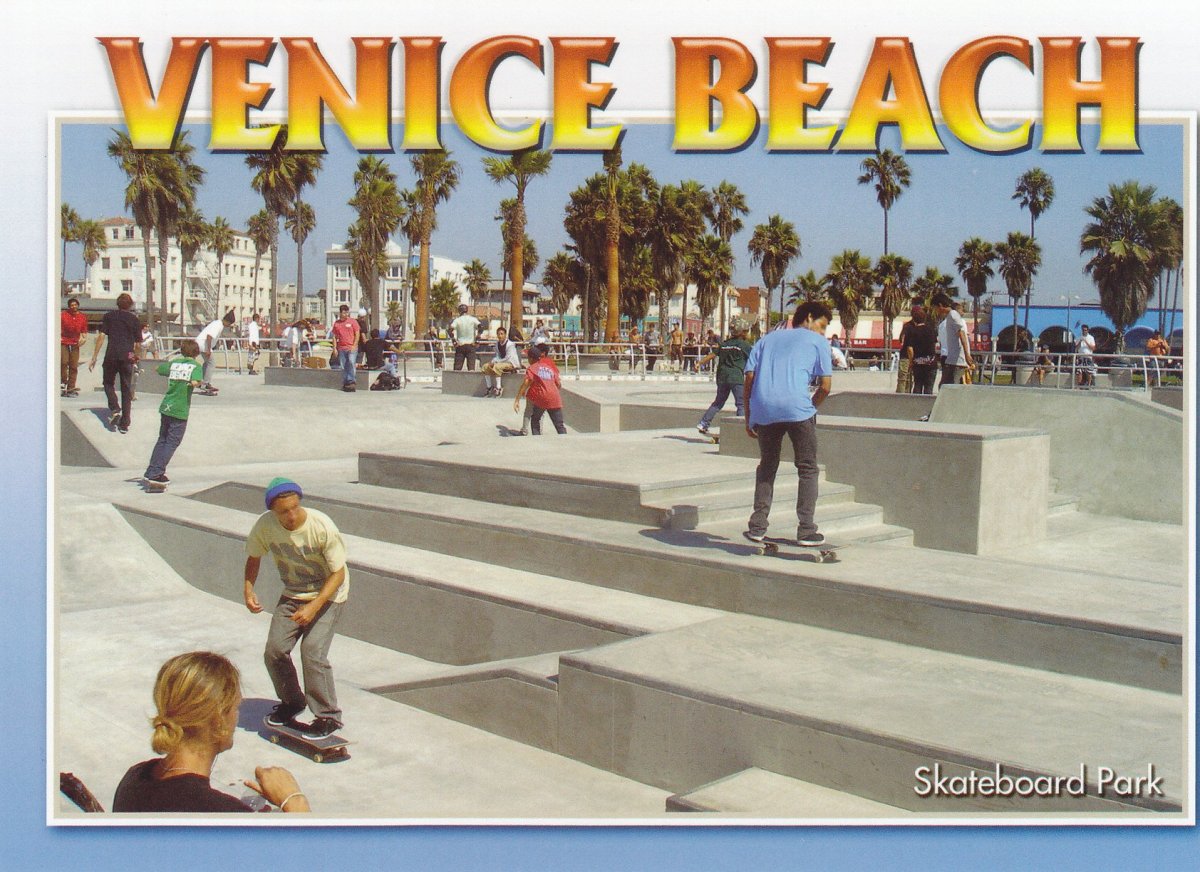
Still, despite my dad’s near celebrity status (if not because of it) I hated Venice as a kid. Too dirty. Too weird. And, when my dad was there (i.e., all the time!) too embarrassing! I was definitely the away team here, a reluctant (though frequent) visitor at best. I hadn’t yet learned to appreciate the ways Venice was my dad’s lifeblood, nor was I aware of its baseball history. And, for damn sure, I had no idea there were baseball cards!

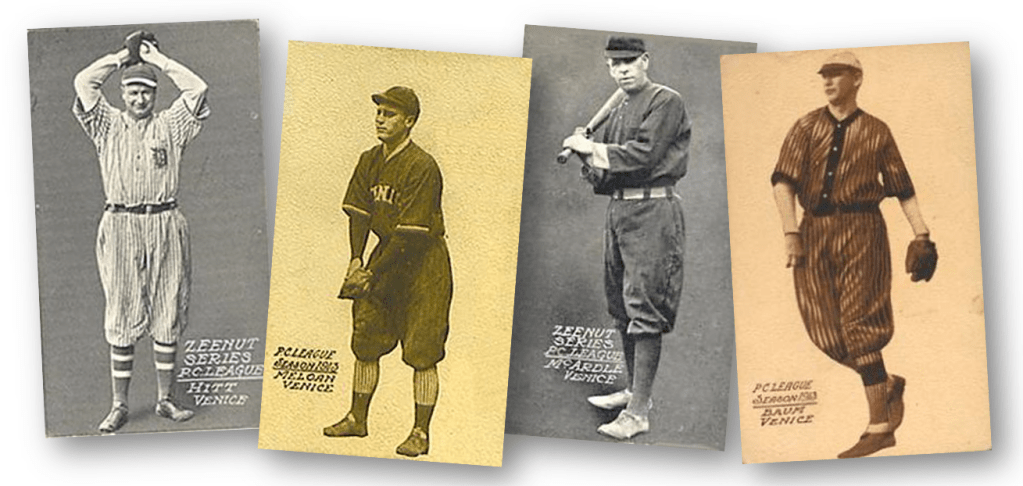
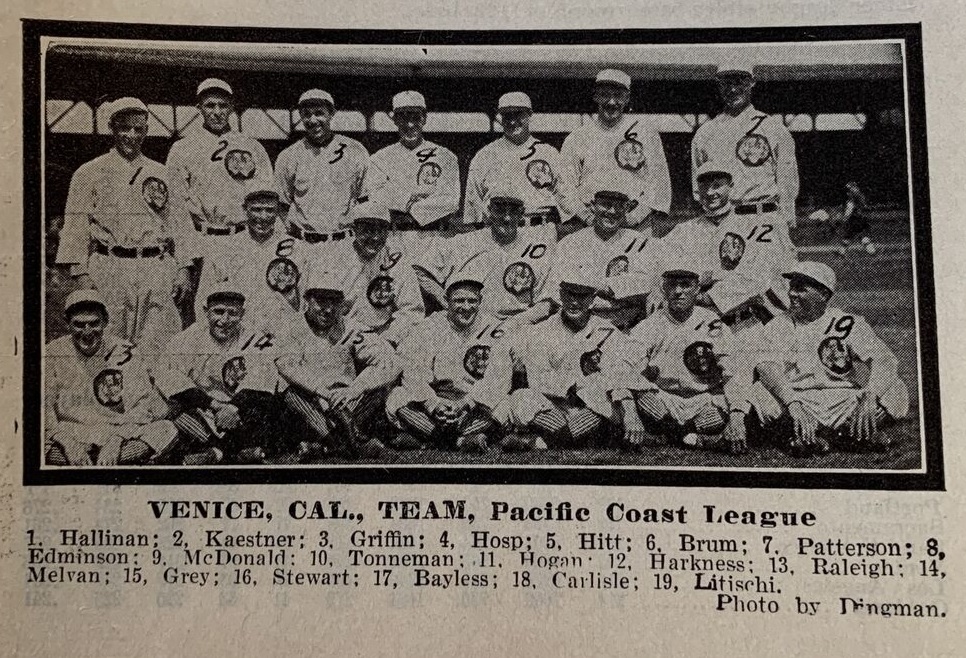
Venice Tigers baseball cards, 1913-14

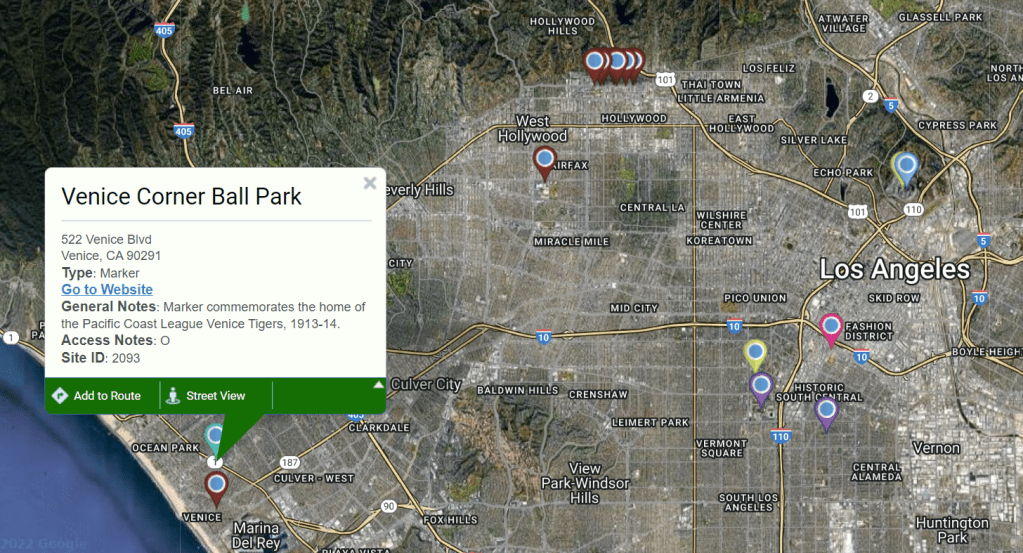
Yes, Venice was briefly home to the Venice Tigers of the Pacific Coast League. The team that had called Vernon home from 1909-1912 (and would return to the industrial enclave south of Los Angeles in 1915) spent the 1913 and 1914 seasons just a few blocks from the Pacific Ocean. (You can see the approximate location of the Venice ballpark on the SABR Baseball Map. You can also spot Vernon in the map’s lower right-hand corner.)

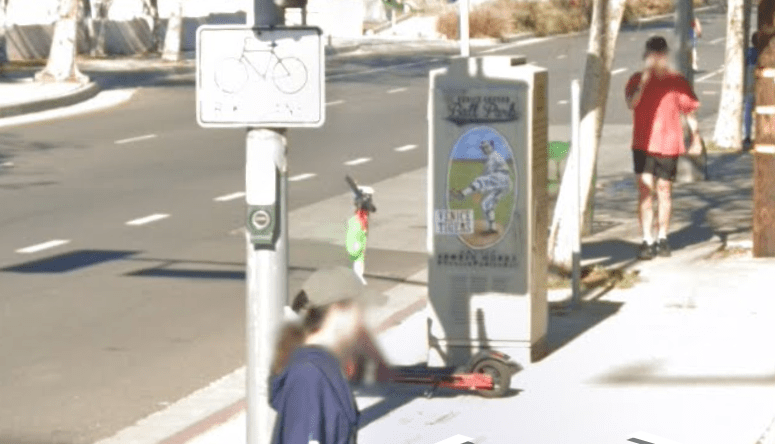
Moving from the map to real life, the marker is not so easy to locate. Having wandered the neighborhood a fair amount, nary noticing a thing baseball related is proof of this. However, some nice online photos are available though the Historical Marker Database. Google Street View also affords this image, though my understanding is that it’s frequently defaced by graffiti.

The presence of the Tigers in Venice (and even Vernon) pre-dates my dad by quite a bit, and it would be a stretch to even call my dad a baseball fan beyond his love of Fernando Valenzuela. Still, I feel drawn to this Pacific Coast League squad of no-names simply because these Tigers, like my dad, called Venice their home, even if both parties left too soon.

I have a Venice trip in my future, one that I’ve already put off too many times. A friend has been holding my dad’s ashes for me far longer then etiquette should allow, and the plan has always been to spread them at Venice Beach. There are a lot of reasons why I’ve waited this long, but I feel like the ghost of an old ballpark, whether as bonus or distraction, may be just what I need to get moving.

* * *

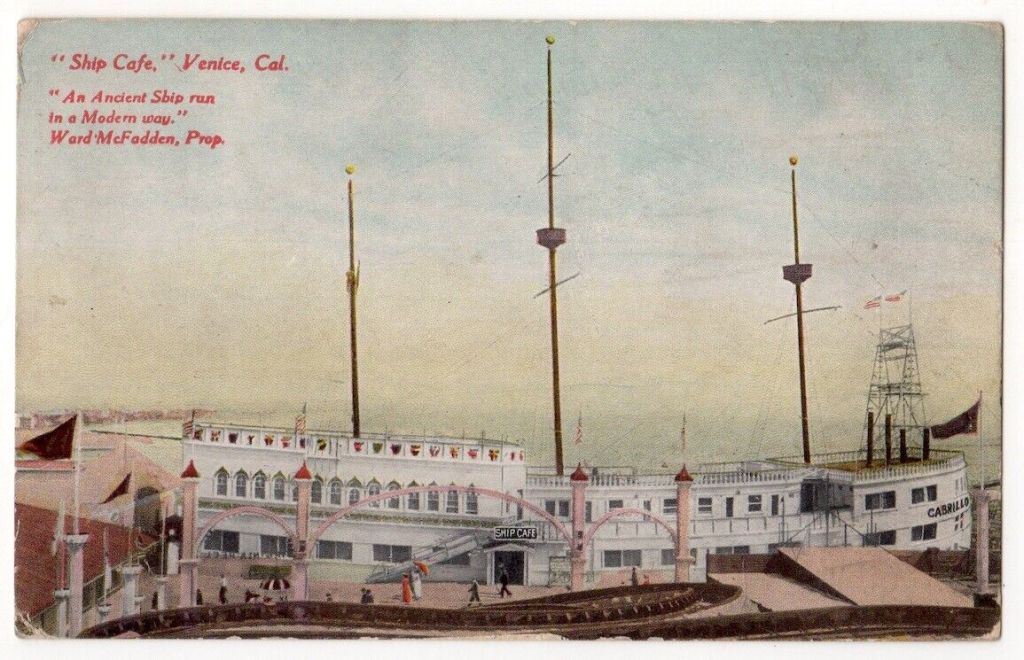
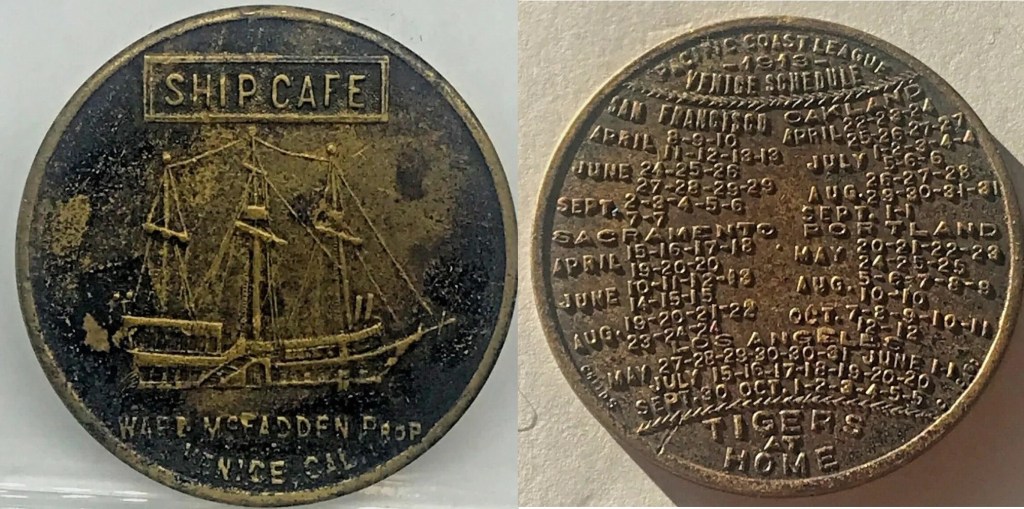
While I’m in the neighborhood I can also check out a couple other Venice Tigers-themed sites. About 0.4 miles from the Corner Ballpark marker, there is the precise location (southwest corner of South Venice and Abbott Kinney) where the ballpark (built in only five weeks!) stood . Though not an official SABR Landmark, why not take a look! And finally, if I’m dropping ashes off the Venice Pier, I may as well stroll past the old parking spot of Ward McFadden’s Ship Café.

What does the Ship Café have to do with baseball?! How else did fans get ahold of their 1913 Venice Tigers schedule doubloons!

There will be a weirdness to the trip, as is tautologically true of all things Venice, but the weirdness will not emanate from the sights, the sounds, or even the smells. Now the weirdness will be my dad joining me, unmistakably, at every step. It will be his weirdness, once off-putting but now sufficiently missed as to turn the unwanted to welcome and the foreign to familiar. Steeped in his memory, this New Venice will offer me what it offered the Tigers, neither errand nor detour but—for however long it lasts—Home.

Author’s Note: This article is dedicated to my father, Nelson Schwartz (1947-2020) and his special love of all things Venice.