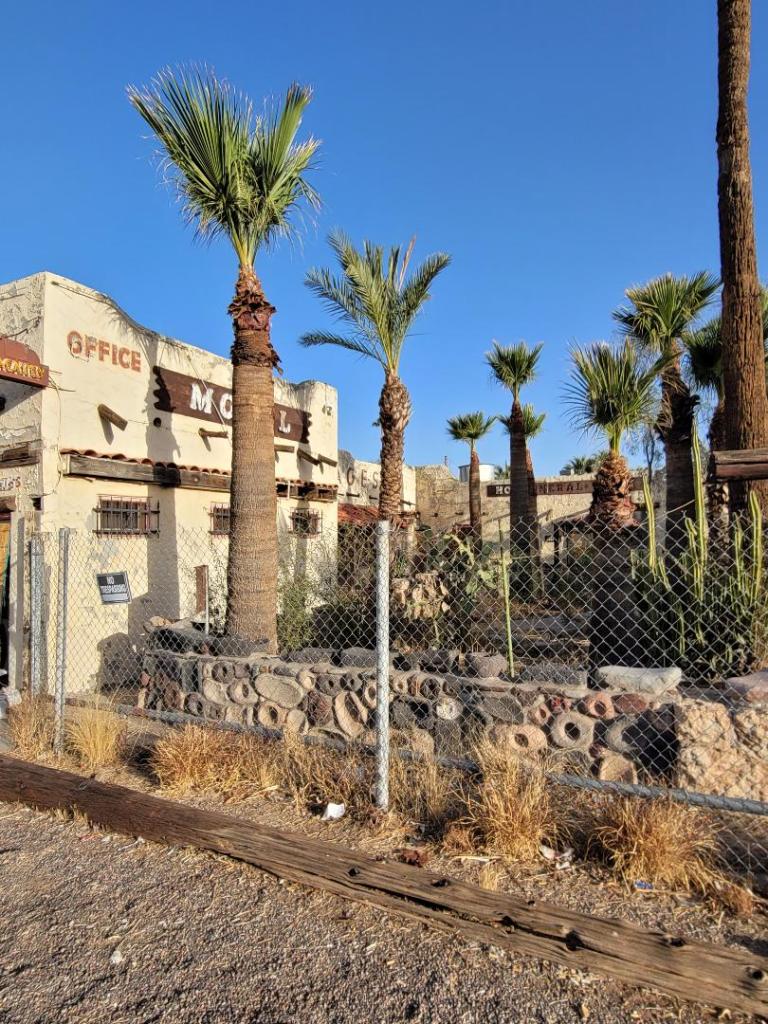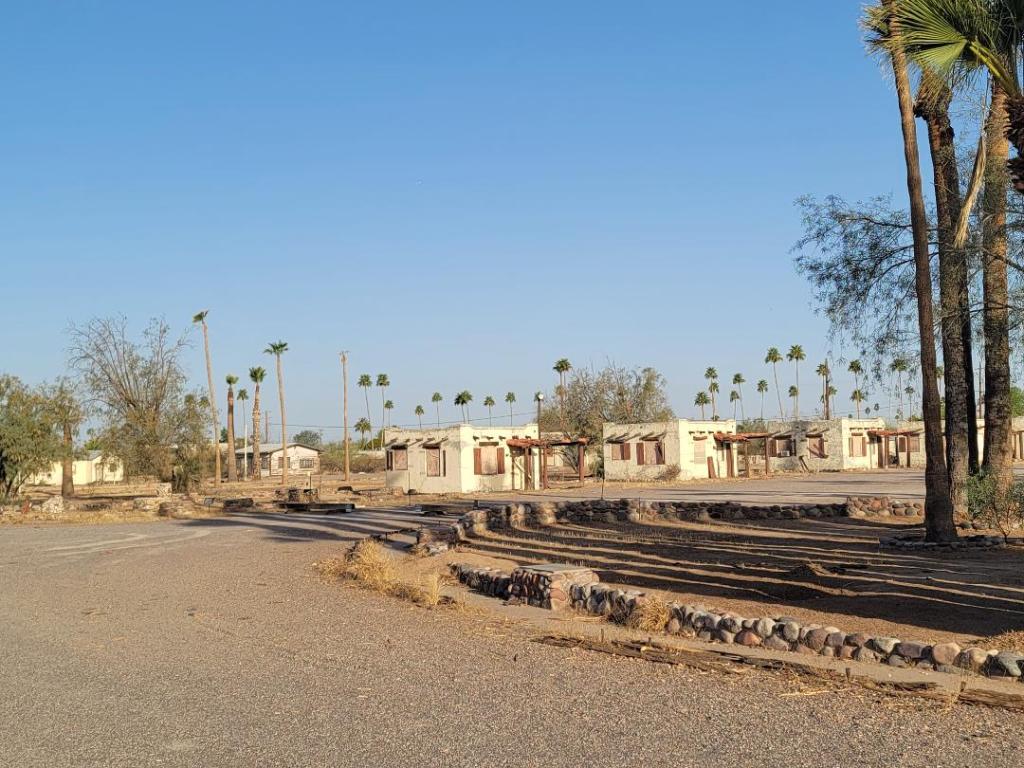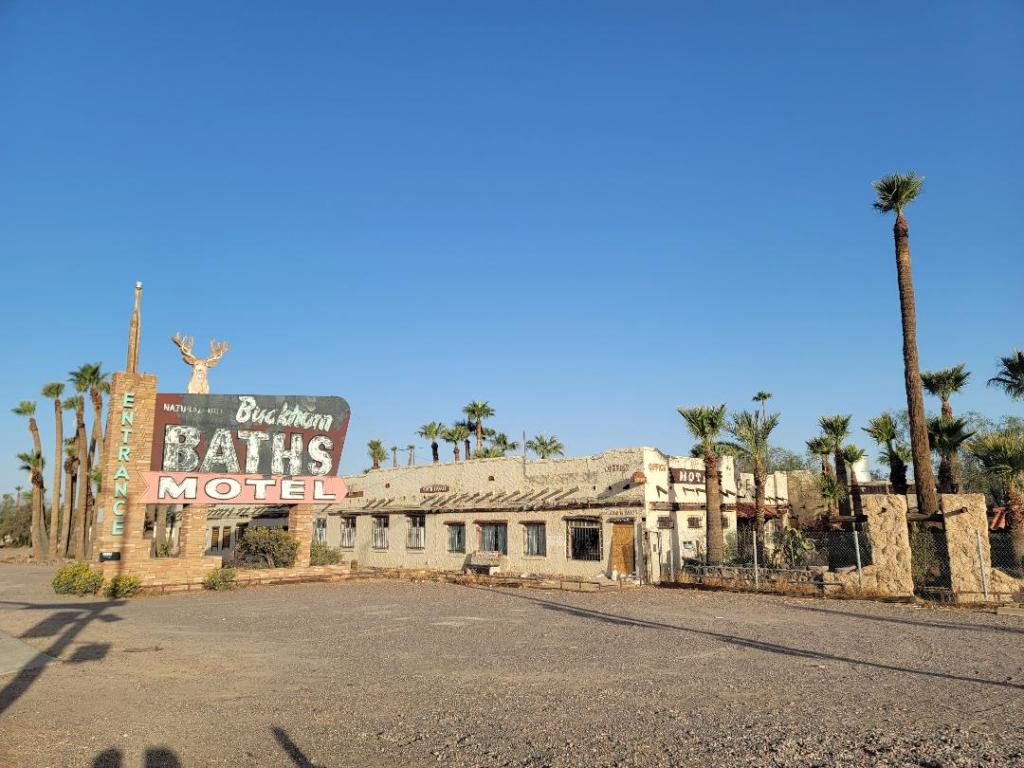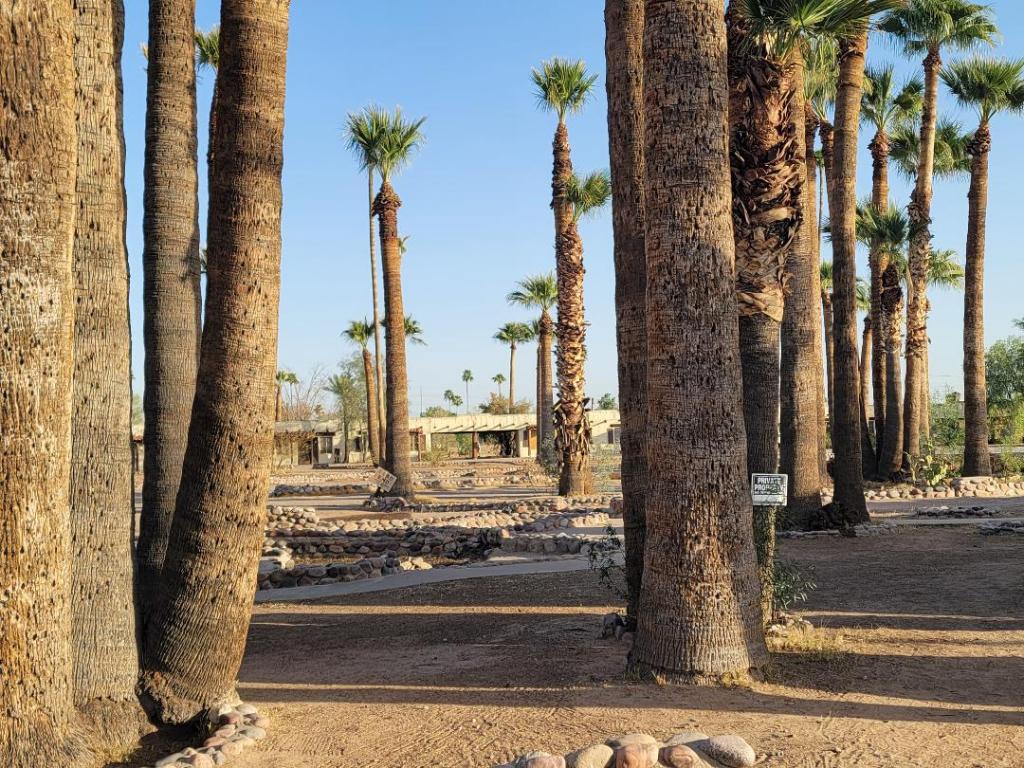
I had taken a five-day getaway to Arizona for spring training; the Cactus League in late February-early March is one of my favorite things in the world. On my fourth night in, I sat in my hotel room flipping through a book on the Cactus League, and I came across a chapter devoted to a place I had never been.
And that’s how I ended up entering the name of an abandoned mineral bath resort in Mesa into my GPS on a Friday morning.
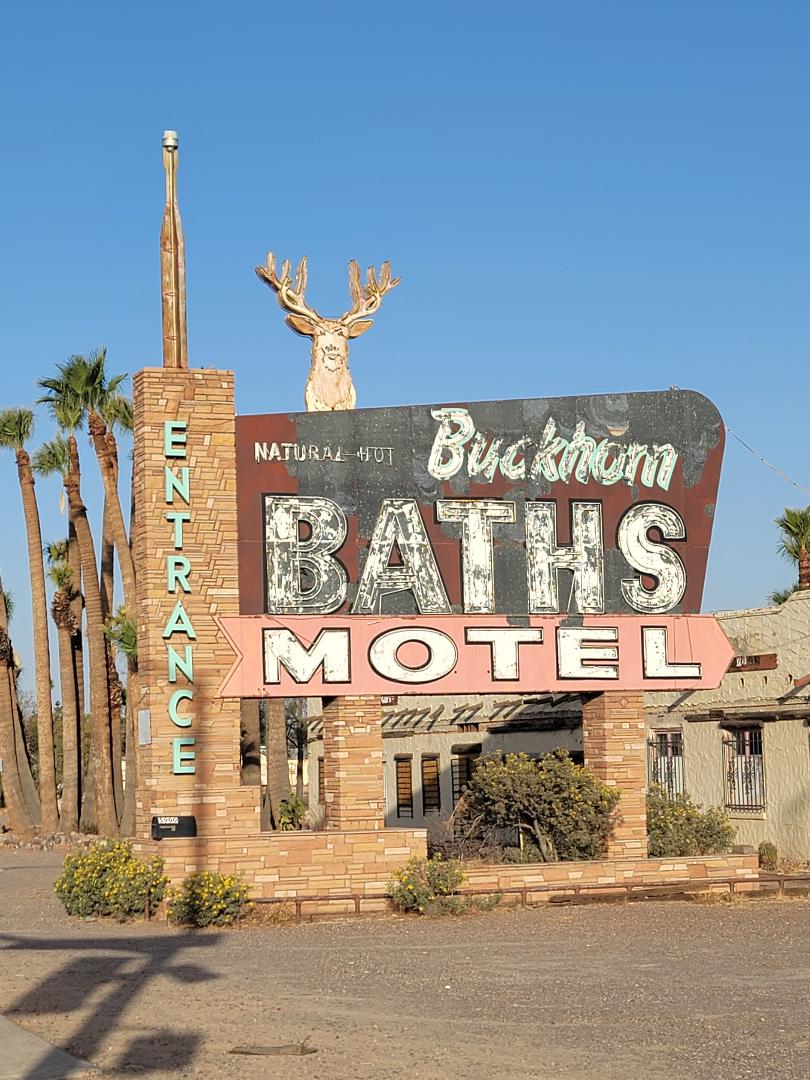
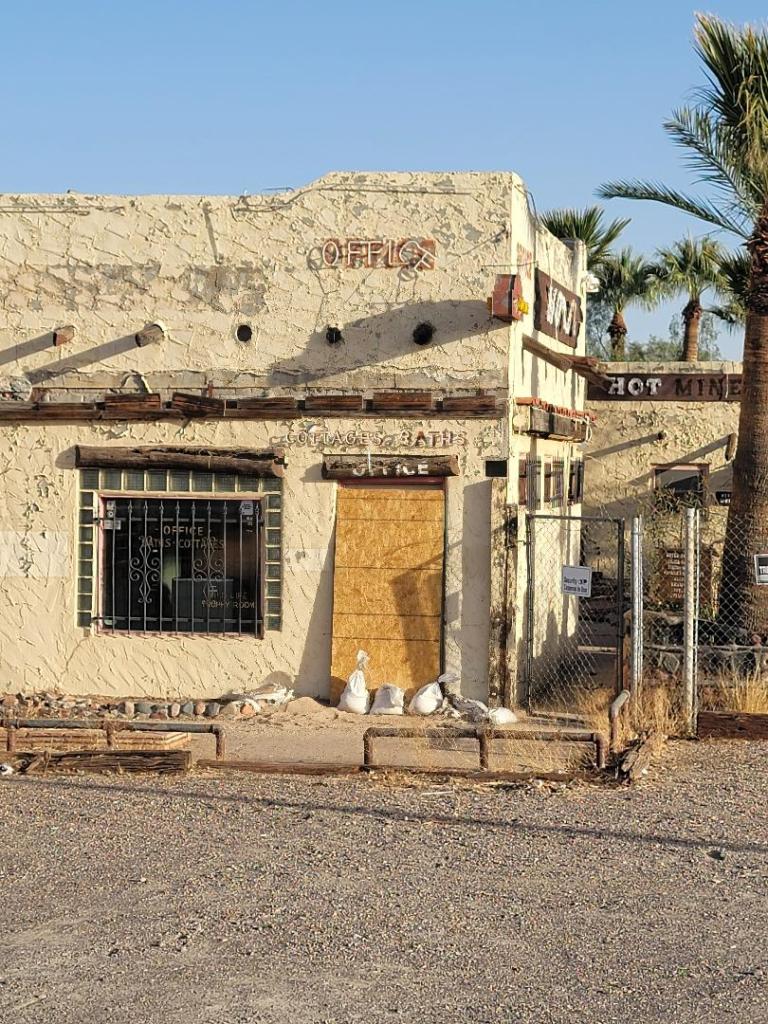
The Buckhorn Baths were a spring institution for ballplayers and celebrities located on what is now the corner of E. Main St. and Recker Road in Mesa.
Established by Ted and Alice Sliger in 1939, the Buckhorn Baths hosted numerous teams as they prepared for the season. The New York Giants, their most frequent visitors started the trend in 1947.
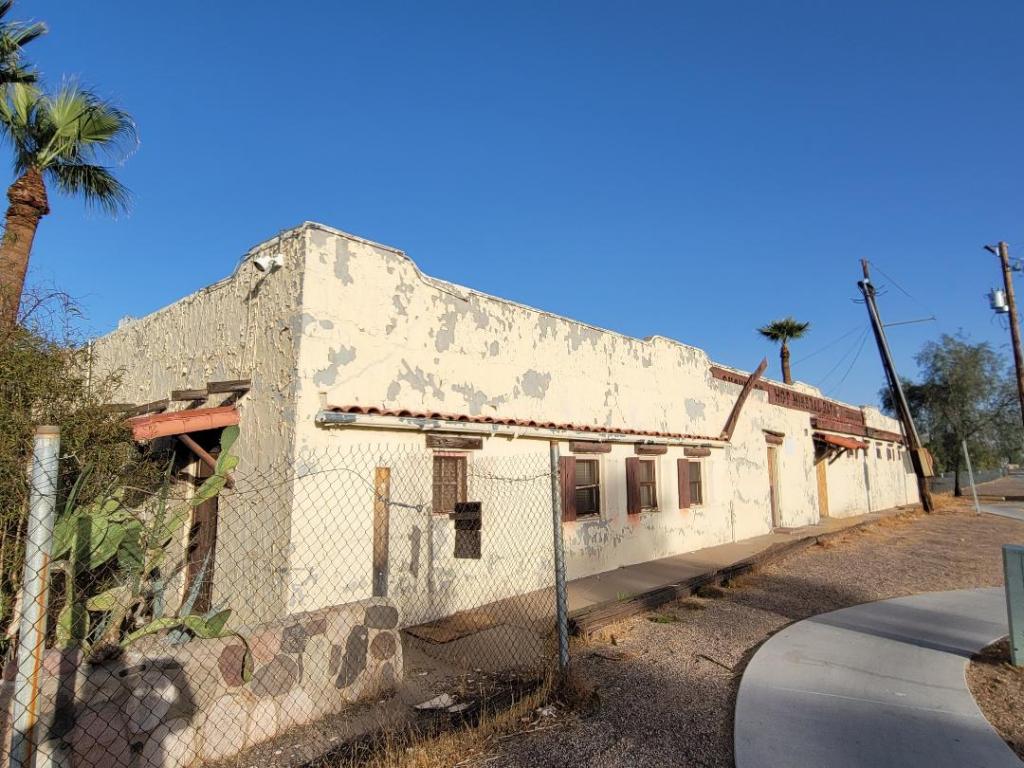
In 1999, the Buckhorn Baths closed for good, and have been sitting abandoned ever since.
I can’t believe it took me as long as it did to make it here. I’m fascinated with historic abandoned places, and I love baseball. It’s a perfect combination.
Wouldn’t it be great if the people in Mesa were able to transform this into a Cactus League Museum? It would probably never happen. But at the very least, I really hope they can avoid tearing this all down. You can imagine how wonderful this place was in its heyday just by looking at it.
For a good history of this place, I recommend checking out Cactus League Spring Training by Susie Steckner and the Mesa Historical Museum (Arcadia, 2012). There are some wonderful pictures in there.
I am really excited to share the story of my day trip on January 3, 2025 to visit Gil Hodges’ hometown of Petersburg, Indiana.
Let me first explain for those that might not know. Gil Hodges was born in Princeton, Indiana but Petersburg was his hometown.
Petersburg is in southwest Indiana, about a 30-minute drive east of U.S. 41, in Pike County. I live in Terre Haute. Terre Haute is north of Petersburg on the central west edge of Indiana (at the intersection of U.S. 41 and Interstate 70). Princeton is about thirty minutes southwest of Peterson (at the intersection of U.S. 41 and S.R. 64).
I visited Petersburg and Princeton on this trip. It took me only about an hour and thirty minutes to drive from Terre Haute to Petersburg; a very easy drive, mostly on good state roads and national highways.
I visited sites in Petersburg and was fortunate to spend a little time with a man who knew Gil and the Hodges family. I’ll tell you more about that man later. While in Petersburg, I visited:
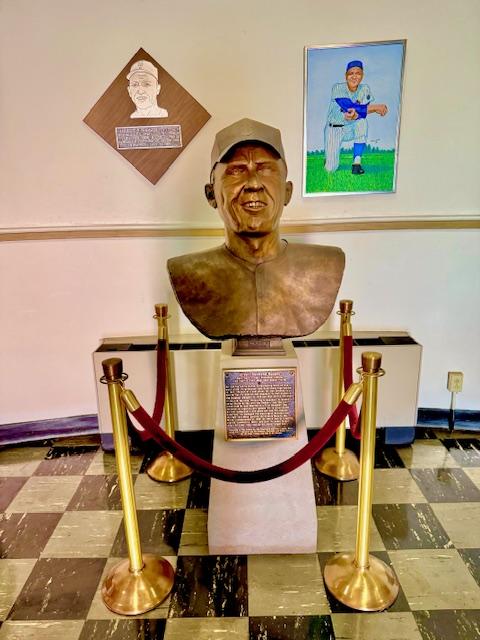
Pike County Courthouse to see the bronze bust of Gil Hodges in the rotunda,
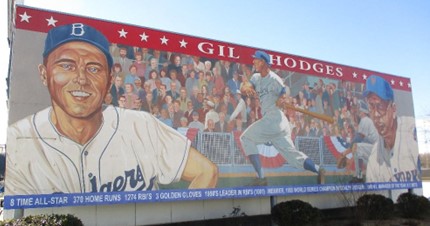
Mural of Gil Hodges that is across the street from the Courthouse,
Bridge that is named for Gil Hodges, and
Boyhood home of Gil Hodges.
I’ll tell you a little bit about each and share pictures and videos that I took that day.
In Princeton, I visited the ballpark that is named for Gil Hodges. I’ll show you pictures and a video that I took there, too.
Gil Hodges Bronze Bust in the Pike County Courthouse
The bust is on the main level of the courthouse. It was created by sculptor Don Ingle and dedicated on June 14, 1997. Randy Harris, Mayor of Petersburg at the time, led a two-year fundraising project and was instrumental in getting the bust made and placed at the courthouse.
One thing to remember if you visit, be sure to go when the courthouse is open (weekdays) if you want to be able to get inside to see the bust!
Gil Hodges Mural
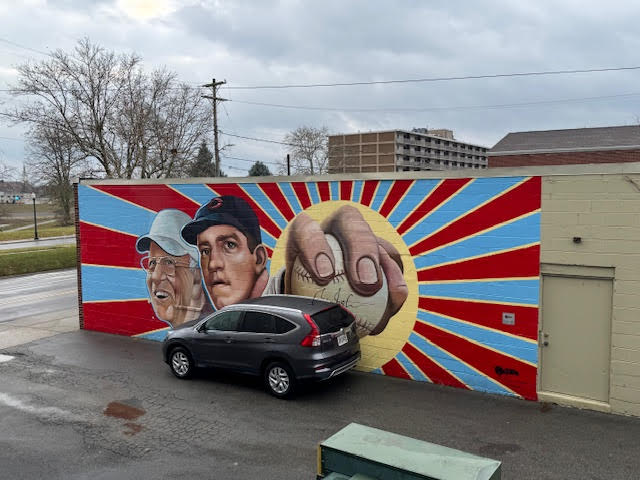
The Gil Hodges mural is across the street from the courthouse. You can’t miss it! It’s fantastic to see and very well done. The 52’ X 16’ mural was first completed and dedicated in 2009. Again, then-Mayor Randy Harris had a hand in this project. In 2022, following Gil’s induction into the National Baseball Hall of Fame, the mural was updated to include the HOF logo and a plaque commemorating Gil’s enshrinement. For some reason, these features were missing on the day that I visited. The mural was created by artist and Petersburg High School graduate Randall Heddon. Heddon also created the picture of Gil in his Mets uniform that hangs on the wall next to the bronze bust in the courthouse.
Gil Hodges Bridge
The Gil Hodges Bridge is on State Road 57 as it crosses the East Fork of the White River, on the north edge of Pike County. The bridge is only about a 10-minute drive from downtown Petersburg. This picture below provides a view of the sign on the south side of the bridge (looking in a northerly direction).
Gil Hodges Boyhood Home
I learned from visiting with people in Petersburg that the boyhood home of Gil Hodges is located at 1401 E. Main Street. The home is only a few blocks east of the courthouse (at the SE corner of Main and 14th Streets). I learned that when Gil’s mother passed away, the house was sold. The same family that purchased the house from the Hodges family seemingly still owns the property.
Gil Hodges Ball Park (Princeton, Indiana)
Gil Hodges Ball Park is centrally located in Princeton adjacent to Lafayette Park. The street address is 700 N. Lafayette Park Drive. The ball park looks to be in awesome condition.
If you’re looking for a place to eat or get a milkshake, I highly recommend Dick Clark’s Family Restaurant at 702 N. Prince Street in Princeton.
Wrap Up
Gil Hodges was born on April 4, 1924. As of the day of my trip, he would have been 100 years old. I am a really big fan of the New York baseball teams and players from the era in which Gil Hodges played. I love reading and learning about the Boys of Summer, Willie Mays and the New York Giants, and of course Mickey Mantle, Whitey Ford and some of those Yankees teams. What a great era for baseball. While I didn’t get to see these players and teams in person, I have been fortunate to make friends with people who did.
I’ve learned so much from being part of the New York Giants Preservation Society. I encourage you to check them out if you don’t already follow them. One more thing about the Brooklyn Dodgers…..I was lucky to shake Carl Erskine’s hand on an airplane once. He boarded a flight in Denver (to Indianapolis) after I had already taken my seat. As he passed by my seat, He could tell by the expression on my face that I recognized him. He reached out, smiled, and shook my hand. Neither of us said anything, but we both knew. What a thrill for me. Erskine…. another baseball hero of mine from Indiana. Anderson, Indiana (hometown of Carl Erskine) is likely the next place I’m heading for a day trip!
I almost forgot to tell you about the man I met from Petersburg. His name is Randy Harris. Randy is a former Mayor of Petersburg. He currently sells real estate and has an office on Main Street (just a couple blocks west of the courthouse). For a time, Randy owned and operated a restaurant called Randy’s Americana Café. I called and introduced myself to Randy. Not knowing about his personal connections to Gil and the Hodges family, I called and told him I was coming to town to visit sites and wanted to make sure this café was going to be open. Mr. Haris explained that he had sold the restaurant but told me I was welcome to stop by his real estate office when I was in town. I could not have imagined getting so lucky. Randy told me stories about growing up in Evansville and Petersburg, and about Gil and his family. Randy knows all about the bust and mural. I encourage any of you that visit Petersburg to see Gil Hodges sites to call Randy Harris. He’s a great guy with great stories.
It is very nice to see that Gil’s legacy is celebrated in Petersburg and Princeton. Gil passed away at 47 years-old from a heart attack. During his very short life, he seemingly had a significant impact on the people he knew.
Clem Labine is quoted as saying “Not getting booed at Ebbets Field was an amazing thing. Those fans knew their baseball, and Gil was the only player I can remember whom the fans never, I mean never, booed.”
Pee Wee Reese is quoted as saying “If you had a son, it would be a great thing to have him grow up to be like Gil Hodges.”
Arthur Dailey of the New York Times is quoted as saying “He (Hodges) was such a noble character in so many respects that I believe Gil to have been one of the finest men I met in sports or out of it.”
Gil’s plaque at the courthouse concludes “Gil was a man of integrity, dignity, community, family and God. He never forgot where he came from, and we will never forget him.”
Thanks Gil for being a great ballplayer. Thanks for giving us great baseball memories and for being such a good teammate and person.
This is my first blog. Thanks for reading.
So happy I made this trip!
Greg Phegley
Links to the videos I made during my trip are below.
Looking for Baseball Graves and there was a surprise I wasn’t expecting…
It was a beautiful 75 degree day in Oregon and a perfect day to go grave hunting. I set out in the morning from Creswell, Oregon to hit four graves starting in Independence and then moving onto the final three that were all in Salem, Oregon.
It was a beautiful drive up to outside the little town of Independence, Oregon looking for the grave of Ed Mensor. The Buena Vista Cemetery was up on a hill overlooking the valley below. Driving up the one-lane gravel road, I knew there would be no map or for that matter a number to call. So it would be looking at every grave until I found Mr. Mensor.
The surprise I found was as I was looking. I completely forgot that my cousin was buried here as I ran across his stone. He was only 36 and died after a battle with cancer. He was a wonderful person and I still miss him.
So I walked from the top to the bottom of the cemetery. There were about 200 plots and of course I found him after walking almost all of the cemetery. Ed Mensor played for the Pittsburgh Pirates from 1912-1914 as an outfielder. He batted .221 with one home run and eight RBIs for his brief career. He would play until he was 35 years old mostly in the minor leagues with seven other teams. Read a bit more about him here https://www.baseball-reference.com/bullpen/Ed_Mensor.
It was onto Restlawn Memorial Gardens in Salem about 22 miles away. So when I arrived, what a stark difference – I just came from a little cemetery on top of a hill to a place that had thousands of graves over a huge 10-acre parcel of land.
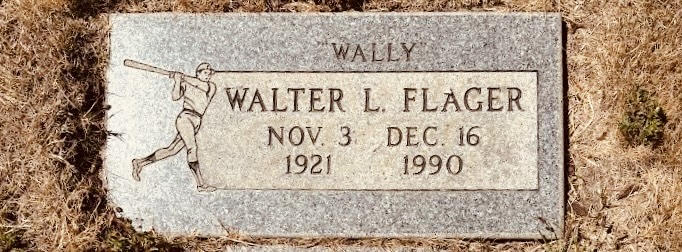
So I went in to the office and got a map and directions to the grave of Wally Flager. He played in the majors for one year but ended up playing for two different teams starting out with Cincinnati for 21 games and then onto the Pittsburgh Pirates for 49 games. He would hit a respectable .241 with two homers and 21 RBIs. He would play just two more seasons in the minors before leaving the game at 26 years old. He was buried on the front row of the section named Prayer. He served in World War II. You can read a bit more on him here https://www.baseball-reference.com/bullpen/Wally_Flager.
Onto my last stop which is where the final two players I set out to view would be. At Belcrest Memorial Park in Salem I found an even bigger place with thousands upon thousands of stones and burial sites. Thank God again for the office and the wonderful person who could show me on the map right where to go. I found Howard Maple, who played at Oregon State University before he would move onto the pros. He played only one year for the Washington Senators in 1932 getting into 44 games. He only had 41 at bats with 10 hits and seven RBIs. You can read about him at his BR-Bullpen site https://www.baseball-reference.com/bullpen/Howard_Maple.
After finding Howard Maple it was onto Max Marshall. He is interred in a space inside the funeral home with his wife. I found him after searching because the number and place they gave me was wrong – he was on the opposite side of where they told me. So even if they give you the coordinates, if you don’t find them search yourself as they are probably there. I imagine when you have thousands of people buried and entered it could be easy to write down the wrong number where someone is.
Max played for Wake Forest before moving onto the pros and playing for the Cincinnati Reds from 1942-44. He played mostly right field but ended up playing all three outfield positions. He started for the reds in both 1942 and 1943. He had 311 hits for his career with a .245 batting average. He hit 15 homers for his career. He played 12 years total and after playing his last game for Tulsa at the age 33 he would come back and play for Salem at 39 years old in the Western International League. Here’s a little bit of info on Max from the BR-Bullpen page https://www.baseball-reference.com/bullpen/Max_Marshall.
After nearly three hours listening to an old baseball game and driving over 100 miles I found all four, took the pictures, and marked the coordinates for all to find.
What a great fun day as I love to drive, and to help with the Landmarks Committee Project is icing on the cake.
2022 year marked the 30th anniversary of the highest grossing baseball film of all time, A League of Their Own. Countless screenings were held and other events were scheduled to celebrate this landmark film in the weeks before the release of the new Amazon television series of the same name. For me, a trip to Indiana that summer was both a figurative and literal homecoming to embrace the movie that has had a significant impact on my life for the past three decades.
I have been to Evansville’s Bosse Field and Huntingburg’s League Stadium many times. Both are about a 40-minute drive in different directions from my hometown in western Kentucky. I was 12 years old when filming began in the summer of 1991 and could still recognize what a big deal it was to have a Hollywood production come to southern Indiana. My brother and dad actually drove over to be extras late in the filming schedule for what would end up being the World Series scenes. The end result had a huge impact on me. Already fascinated (and still am) with World War II, I started reading anything I could find on baseball during the war, the home front, and this All-American Girls Professional Baseball League that I had never heard of (before seeing the movie five times in the theater). Decades later, I’m working with the International Women’s Baseball Center, creating Women in Baseball Week, and presenting at conferences on my research into women in the game. It’s safe to say I’m hooked, so imagine my excitement when heading home for a family visit, I saw both stadiums had games scheduled for the week I would be in town. What better way to relive all that film has given me than to pay them back-to-back visits?
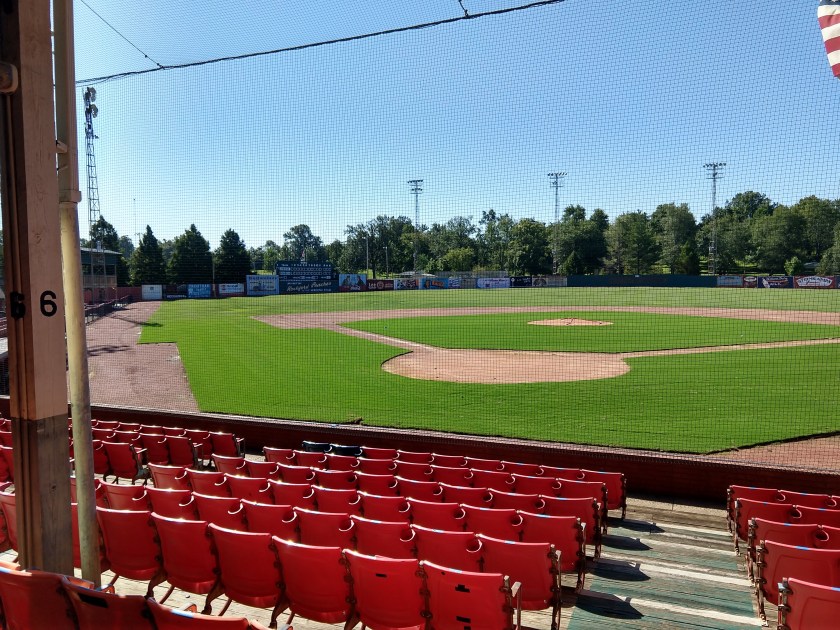
Leading off was a trip to Bosse Field in Evansville. Located at 23 Don Mattingly Way, Bosse Field (pronounced “bossy” for those who might not know) opened in 1915 and is believed to be the third oldest professional ballpark still in use behind only Fenway Park and Wrigley Field. Though situated on the edge of Garvin Park, the stadium is nestled in a neighborhood of homes, factories, and warehouses, many dating back to the World War II era when Evansville was a leading armaments manufacturer for the war effort.
Location scouts for the film would have been hard pressed to find a more suitable ballpark for the production’s needs. The stadium is encompassed by a red brick wall, presenting a classic look, with lighting situated inside this outer wall but beyond the outfield fence and on top of the grandstand roof. Approaching the stadium, visitors are met by an impressive three-story tall main gate of brick, stone, and windows. For movie fans, this is where Jimmy meets Dottie’s husband post-World Series and they all exchange pleasantries before boarding the bus back to the hotel.
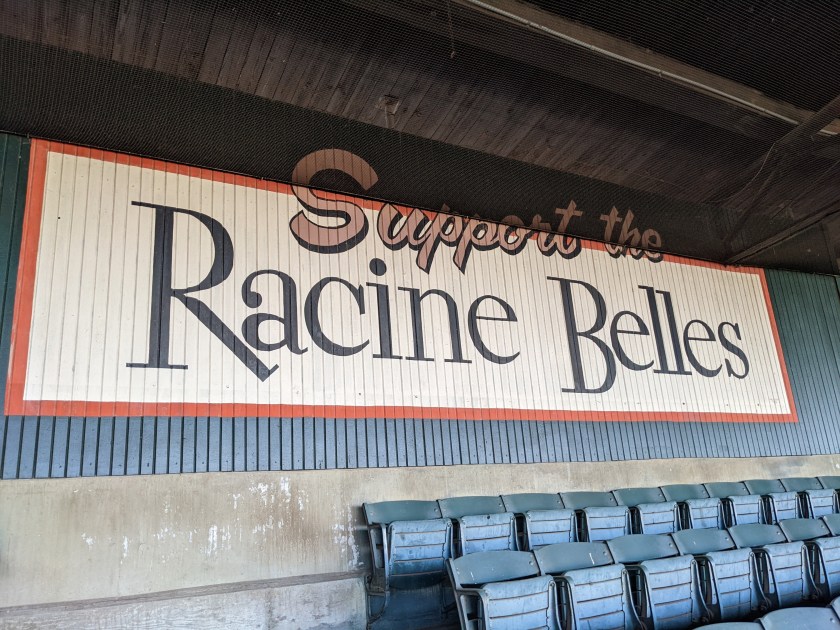
The area wrapping around the outside of the stadium in either direction of the main gate constitutes the concourse where most concessions and merchandise are sold. At both ends are additional entrances to the stadium and stepping through these North and South Gates, visitors will find more fun holdovers from the film. Just above these gates are old fashioned advertising for shoes and coffee used in filming and further up from each gate toward the back of the grandstand are two large, identical signs reading Support the Racine Belles. They look great and I am glad to see the stadium still embraces their role in its history 30 years later. The stadium seats just over 5,100 in green metal and wooden chair backs, situated in a smooth half circle and mostly under roof coverage. As always, I find myself moving to a new location every inning just to get a different look at the field.
Bosse Field has been home to the Frontier League Evansville Otters since 1995 and I’m lucky to still have trading cards, programs, and ticket stubs from that first season. On my visit, however, the Otters were on the road and the Women’s Professional Fastpitch tour was in town. A couple thousand people turned out to watch the USSSA Pride take on the Smash It Sports Vipers and the atmosphere was absolutely electric. Having been a softball fan for the past 30 years as well, I was experiencing a most unique opportunity to watch Shelby Pendley play live (for me, the first time in six years) and see Olympic gold medalist Kelly Krestchman coaching. Reigning NCAA home run queen Jocelyn Alo, on the heels of graduating from another national championship season at the University of Oklahoma, went yard on the first pitch of her first at bat. The crowd went wild and so did I.
On top of A League of Their Own filming, I know the AAGPBL played an exhibition game or two here in the late 1940s. How cool to see women pro ball players in Bosse where all of that had happened before. A small gift shop caught my eye on the way out where I bought a large book on the history of Bosse Field. Seemingly half the photos were contributed by Justin Sheller, who played Stilwell Angel in the film, which is fine by me.
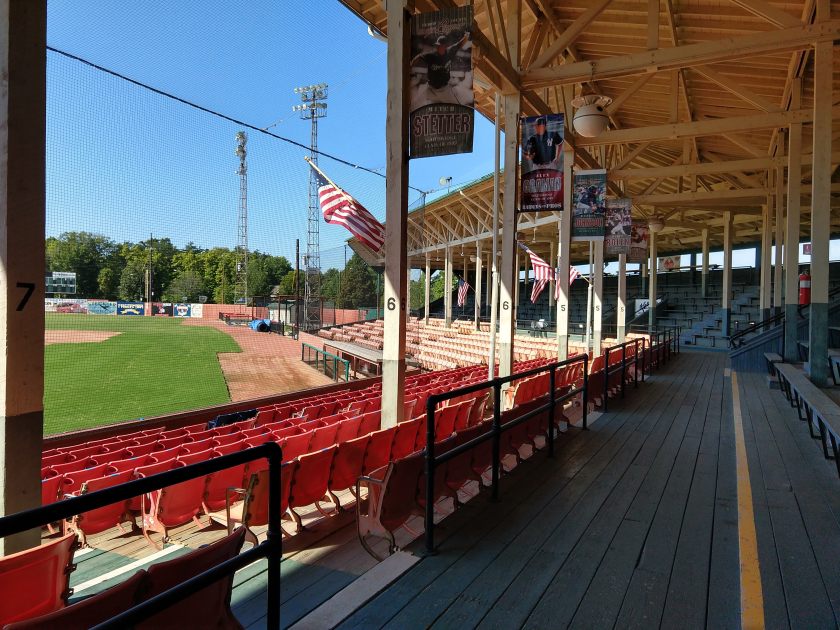
The following day’s plans were extra special in that I brought my mom along to League Stadium for that evening’s game and my brother and niece would be driving down from Indianapolis to join us. My first trip to League Stadium would have been 1993 when, also with my mom, we stopped to see where the movie was filmed on our way to Bloomington, Indiana. We had a brief tour with a local volunteer, took a lot of pictures, and even bought a folding chair used in the film, which still sits in my office. New chair backs were obtained from the old Atlanta-Fulton County Stadium and installed in the late 1990s in time for the Dubois County Dragons of the Frontier League to take up residence. On this night, we would be watching the current tenants, the Dubois County Bombers of the summer collegiate Ohio Valley League play my hometown Owensboro RiverDawgs.
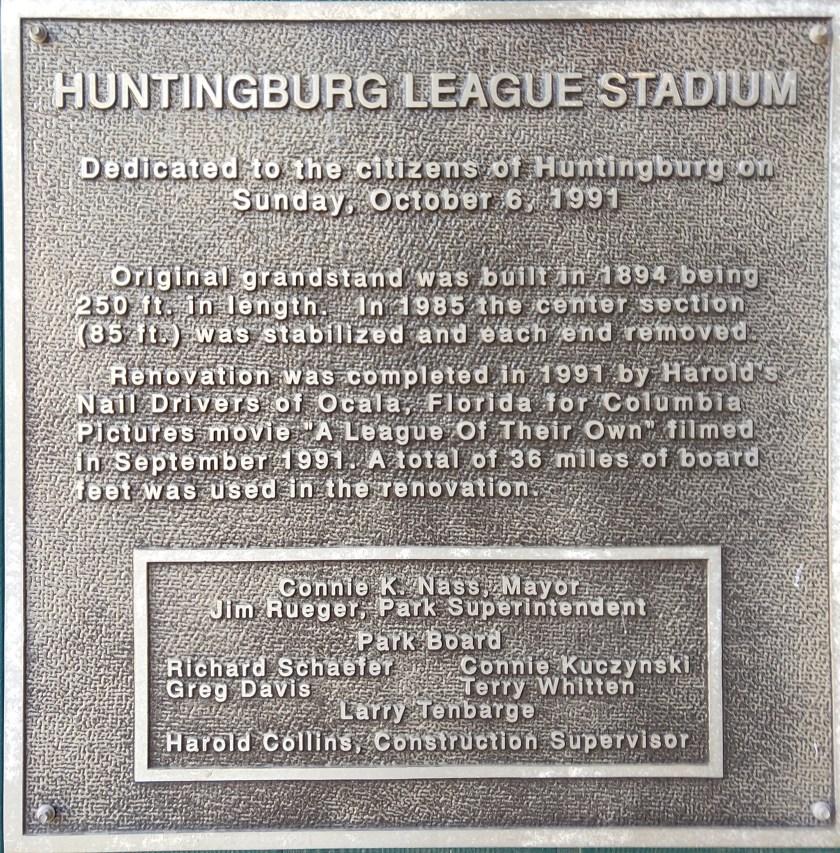
Similar to Bosse Field, League Stadium is situated in a city park, but surrounded by tennis and basketball courts, a playground, pool, and youth baseball and softball fields. A replica Rockford Peaches bus greets visitors at the park’s entrance. The ballpark does not have quite as grandiose of a main gate as Bosse, although this is understandable. The original rectangular grandstand dates back to the 1890s and it wasn’t until the location was chosen in 1991 for A League of Their Own that it was renovated to its current, more traditional ballpark shape. Movie fans will note that no scenes in the film feature the outside of this park.
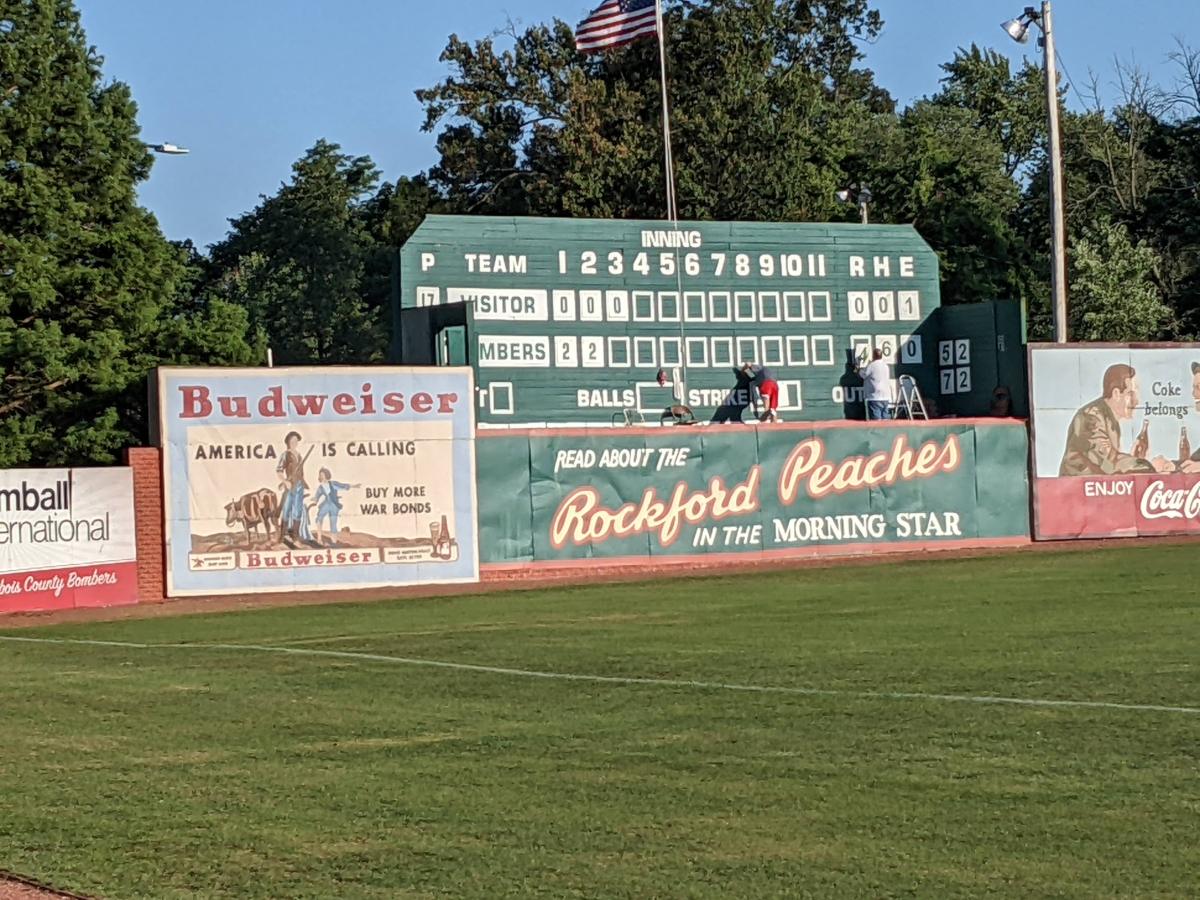
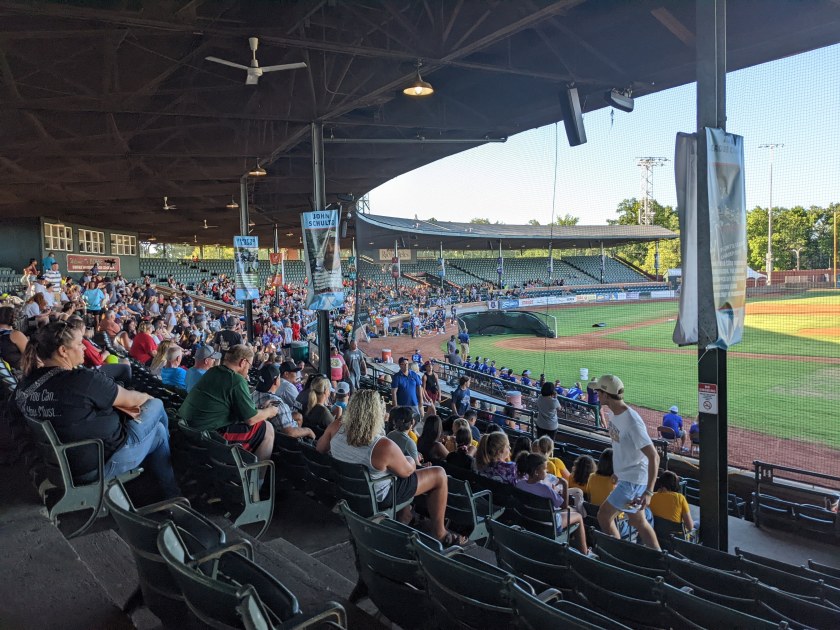
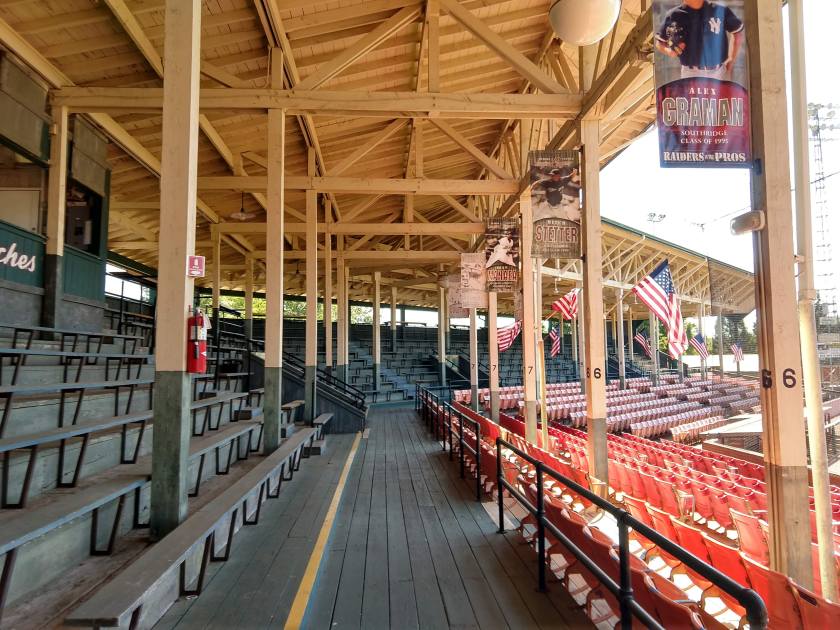
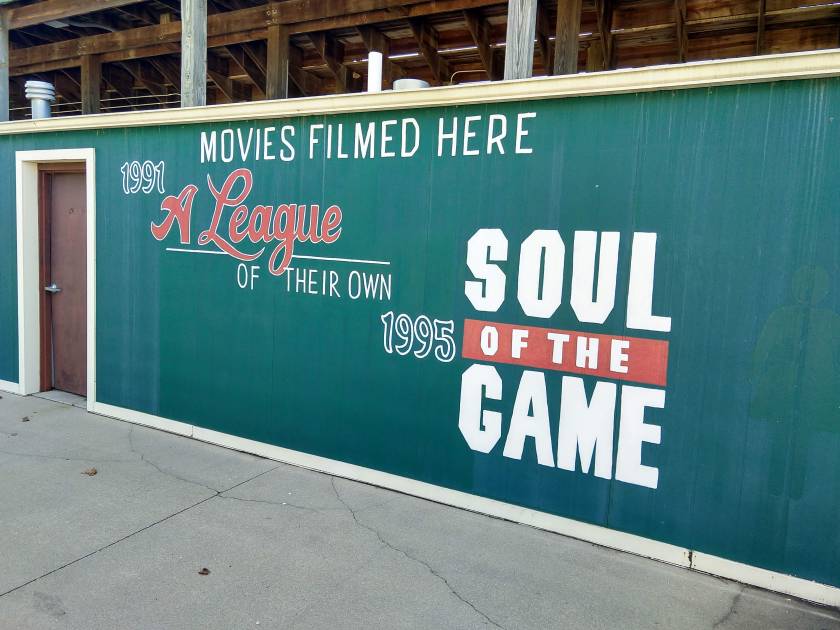
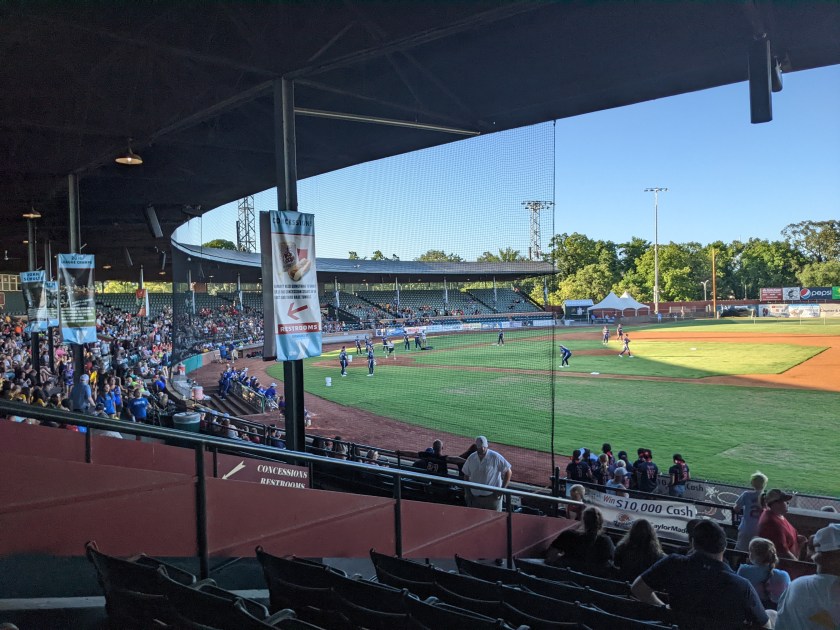
The inside, however, is a nostalgic marvel. The aforementioned seats from Atlanta fill the lower area at field level, but the upper level near the press box remains the same bench seating from the film. At nearly 2,800 seats, League Stadium’s capacity is just over half that of Bosse Field. There is still a sign for Harvey Bars on the outfield fence and both the press box and left field scoreboard feature the same “Rockford Peaches” in script. A newer electronic scoreboard used for games sits just behind the right field fence. Like Bosse, food and merchandise are located outside of the stands. There is a small exhibit area with plaques, props and costumes from A League of Their Own and HBO’s Soul of the Game, also partially filmed here and released in 1996. Our tickets for the game had us about eight rows behind home plate, but from the looks of the stadium, there is not a bad seat in the house.
Many of the “amenities” found in current minor league stadiums are absent at both Bosse Field and League Stadium. You won’t find chain restaurant outlets, bar seating along the outfield wall, or a splash park for the kids. What League Stadium expertly delivers is a trip back through time, which I am sure appeals to a lot of us. The team’s nickname is derived from a World War II bomber and the players wear 1940s style uniforms. Female staff follow suit in replica Peaches uniforms and hand write seat assignments on ticket stubs. Flags and banners hang from the columns supporting the roof and most of the music played between innings is either Big Band or from the A League of Their Own soundtrack. Fans of both baseball and the film almost need multiple visits to take it all in and fully appreciate the total experience curated by both stadiums. First, there’s exploring the history and architecture of the spaces and witnessing the game in such a classic environment.
Next, you have the games themselves. Evenly matched summer collegiate baseball or professional softball will do it for me every time. Finally, there’s the movie aspect. Literally everywhere you look can be a reference to a favorite part of the film whether it’s the final collision at home in the World Series, Stilwell Angel getting nailed in the face with a glove, or the legendary “There’s no crying in baseball” scene.
My family’s visit to League Stadium was fun, although a bit sad. My dad passed away in October of 2019, leaving this mini-family reunion feeling incomplete. On the way home, I realized something that now has cemented A League of Their Own as a film, baseball or otherwise, that will always hit close to home. My absolute favorite shot of the entire film is during Kit’s at bat in the World Series. After driving a high one into right field, we see her rounding first heading straight toward the camera for a turn at second. Her skirt is flying, her cleats are kicking up dirt in the base path, and there is a wall of excited people in the stands behind her, punctuated by the giant Support the Racine Belles sign. It is a beautiful, classic shot. And then I made a new connection – my dad is there. Maybe not exactly in the shot as it’s difficult to pick out anyone specifically and I only know he was in the back of the first base / right field end of the stands. He had watched the whole scene being filmed and was a part of it, and now he’s forever a part of my favorite shot in a favorite movie about a sport and history that I love. It’s a bittersweet, but welcomed feeling every time I have watched the movie since.
A few months ago, I had the unique opportunity to watch the USA Baseball Women’s National Team play back-to-back games at former AAGPBL ballparks in Rockford and Kenosha, both of which are also on the SABR Landmarks Baseball Map. Watching these games, alongside AAGPBL players no less, was a unique experience that I never anticipated. I never thought I would write blogs for SABR or have dinner with actors, writers, and directors connected to A League of Their Own, both the film and the series. There is a beauty to never having specific expectations toward an interest or hobby and just letting it flow. I never anticipated A League of Their Own affecting me so profoundly, but thanks a visit home in 2022, I realize I’ve been living my best baseball life for 30 years.